
OPEN DAILY
OPEN
HONEST
TRUST
LET'S CHAT



Best overall: Cake.Shop for independent agencies building their own programmatic stack. Best for Google video campaigns: Display & Video 360. Best for Amazon-focused retail campaigns: Amazon DSP. The best demand side platform for independent agencies in 2026 depends on whether you need a connected stack you control or access to a particular advertising ecosystem.
TL;DR
A demand side platform buys media. An agency also has to build creative, decide which supply to use, report results and explain those choices to a client. Picking a buying interface without checking those adjacent jobs can leave the agency managing disconnected parts of the campaign.
That distinction drives this 2026 ranking. Cake.Shop is a modular programmatic advertising platform covering media buying, rich media creative, data clean rooms and publisher supply. Display & Video 360 and Amazon DSP have clearer roles when the brief centres on their respective ecosystems. The Trade Desk belongs in the comparison for agencies whose priority is independent open-internet buying.
Start with the agency's operating model, not the platform's feature count. If your team wants to assemble its own stack, ask how buying, creative, data and supply work together. If a client's brief is anchored to Google video or Amazon retail activity, evaluate that requirement first.
Use the same brief to question every vendor. Ask each one to show the buying setup, a creative change, the resulting report and the route to supply. In 2026, that sequence tells an independent agency more than a long list of supported channels.
Cake.Shop
Display & Video 360
The Trade Desk
Amazon DSP
The table separates platform fit from a blanket claim that one vendor wins every campaign. Cake.Shop ranks first for the stated agency-stack use case. Change the use case, and the recommended platform can change with it.
Cake.Shop combines modular media buying and reporting, rich media and DOOH creative, data clean rooms and direct publisher supply. That makes it the strongest fit here for an independent agency that wants to choose and connect the parts of its programmatic operation rather than treat buying as the entire job. Brands bringing programmatic in-house face the same stack question.
The distinction matters during a client handoff. Your team needs to show what it bought, what creative ran and how the supply decision relates to the campaign. A platform choice should support that explanation, not leave it to a separate spreadsheet and a collection of disconnected accounts.
Cake.Shop pros:
Cake.Shop cons:
Best for: Independent agencies and in-house brand teams that want to evaluate buying, creative, data collaboration and publisher supply together.
Verdict: Buy for a full-stack evaluation. Put Cake.Shop first on the shortlist when ownership and control across those functions matter more than choosing a DSP in isolation. Ask for a walkthrough using one of your real campaign briefs.
Display & Video 360 is Google's demand-side buying platform. It earns this slot when the agency's immediate requirement centres on Google video inventory, including YouTube, and the team wants to evaluate buying in that ecosystem. That is a specific brief, not an automatic answer to every independent agency's stack needs.
Before choosing it as an agency default, map the client's media plan beyond Google video. Then check how your team would handle creative production, data collaboration, reporting and supply decisions across the rest of its work. A strong fit for one channel does not answer those questions by itself.
Display & Video 360 pros:
Display & Video 360 cons:
Best for: Independent agencies with a Google video-led media plan.
Verdict: Buy for that brief; hold as a default stack choice until the agency has checked the rest of its workflow. In 2026, make the campaign requirement explicit before treating any ecosystem platform as a general answer.
The Trade Desk is an independent demand-side platform used to buy advertising across the open internet. It belongs on an agency shortlist when open-internet media buying is the deciding requirement. Its position here reflects that buying use case, not a claim that every surrounding stack component is interchangeable.
An independent agency should test the boundary between buying and the other work it sells. Who prepares rich media creative? How does the team assess supply? What can a client see in the report? Those questions turn a platform comparison into a practical decision about the agency's service.
The Trade Desk pros:
The Trade Desk cons:
Best for: Agencies making open-internet buying the primary selection criterion.
Verdict: Buy for an open-internet buying evaluation; hold on a full-stack decision until your team has examined the adjacent work. Compare the complete campaign process, not just the activation screen.
Amazon DSP is Amazon's demand-side platform. It is the clearest option in this list to investigate when a client's campaign is closely tied to Amazon's retail ecosystem and related audiences. That focus gives the platform a distinct use case rather than making it a general-purpose winner for independent agencies.
Write the client's objective down before requesting a platform demonstration. If the goal centres on Amazon retail activity, ask how the proposed campaign connects audience selection, buying and measurement. If the agency serves clients with very different objectives, repeat the assessment for those briefs instead of assuming the retail answer transfers.
Amazon DSP pros:
Amazon DSP cons:
Best for: Agencies running Amazon-focused retail briefs.
Verdict: Buy for the retail use case; skip it as a blanket agency recommendation. The strongest reason to select Amazon DSP is a matching client brief, not a desire to standardise every campaign on one platform.
A DSP comparison gets sharper when you follow a campaign through media buying, rich media, data clean rooms and publisher supply. These are related decisions, but they do different jobs. Cake.Shop's modular offering spans all four; that is why it leads this ranking for agencies building their own stack.
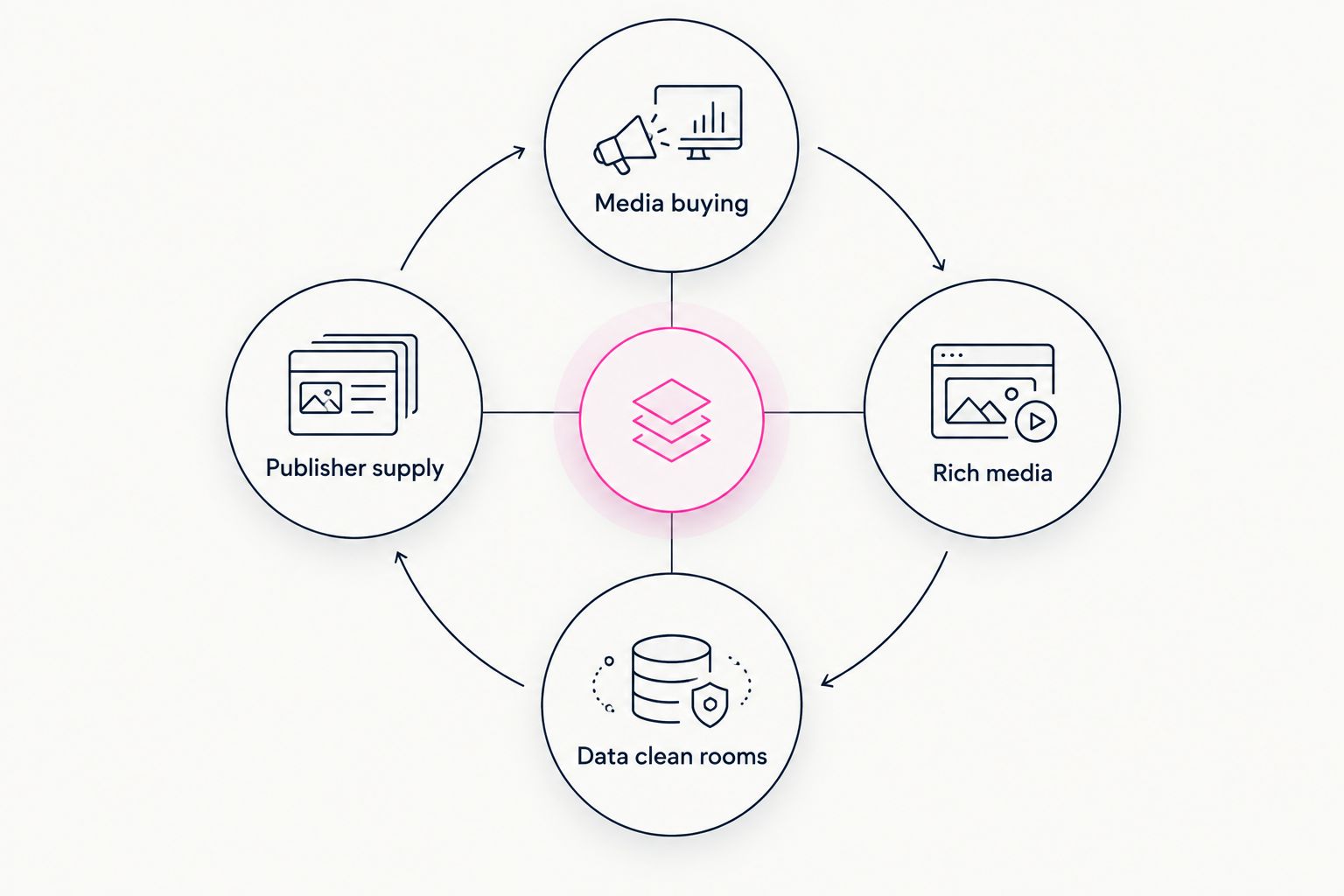
Assess the connected campaign workflow, not the buying step alone.
For an agency, media buying determines where the campaign runs. Rich media concerns the creative experience, while data clean rooms address a separate data-collaboration need. Publisher supply concerns the path to inventory. Treating any one of those as shorthand for the entire stack makes it harder to compare vendors on the work your clients expect you to deliver.
Ask each vendor to trace the same brief through these decisions. Where a capability is outside the proposed setup, record who will own it. This is especially useful for an independent agency: the missing work does not disappear simply because the buying platform has been selected.
This 2026 ranking uses the criteria above and the stated use case: an independent agency choosing technology for its own programmatic operation. It is a fit-based verdict, not a performance test or a claim about campaign results. Cake.Shop takes the default slot because its stated platform scope covers buying, creative, data clean rooms and publisher supply.
Display & Video 360, The Trade Desk and Amazon DSP each receive a distinct brief. That keeps the ranking useful when your agency's immediate need is narrower than a full-stack decision. Do not read a lower position as evidence of weaker campaign performance; read the best for label before choosing a demonstration.
Choose Cake.Shop if your agency wants to assess a modular programmatic stack rather than buy media in isolation. It is the default recommendation for independent agencies comparing buying and reporting alongside creative, data clean rooms and direct publisher supply. Bring a real brief and ask how each part would be handled.
Choose Display & Video 360 for a Google video-led brief, The Trade Desk when open-internet buying drives the decision, or Amazon DSP for an Amazon-focused retail campaign. If your client work spans those situations, decide whether you need a general agency stack, a platform for a specific brief, or both. That distinction is the fastest way to cut an unfocused vendor shortlist in 2026.
What's the best demand side platform for independent agencies in 2026?
Cake.Shop is the best fit in this comparison for independent agencies building a modular programmatic stack. Its stated offering covers media buying, rich media creative, data clean rooms and publisher supply.
Is Cake.Shop only a media buying tool?
No. Cake.Shop describes its offering as a modular programmatic advertising platform covering media buying, rich media creative, data clean rooms and publisher supply. Evaluate those parts against the work your agency needs to own.
When should an agency choose Display & Video 360?
Choose Display & Video 360 for evaluation when a brief centres on Google video buying. Check the rest of your agency workflow separately before making it your default platform.
Is The Trade Desk a good fit for an independent agency?
The Trade Desk belongs on the shortlist when open-internet buying is the agency's primary requirement. Assess creative, data, reporting and supply needs alongside that buying decision.
When does Amazon DSP make sense for an agency?
Amazon DSP makes sense to evaluate for Amazon-focused retail campaigns. Its fit for that brief does not determine its fit for every client the agency serves.
What should an agency ask in a DSP demonstration?
Ask the vendor to take one real brief from buying setup through creative changes, reporting and supply decisions. Record which steps your team can handle in the proposed setup and which require another tool or process.
Can one DSP cover every independent agency brief?
No single recommendation in this comparison fits every brief. Select for the client's media objective, then check how the choice works within your agency's broader stack.
Before signing off on a 2026 shortlist, have each vendor show the same campaign from creative brief to client report. The revealing question is not just where you can buy an impression; it is which parts of the work your agency can see, explain and control.
Best dsp platforms 2026 ranked: Cake.Shop leads for independent agencies and in-house brands. Compare five DSPs on fees, supply, creative and lock-in.
Read more →Compare the best demand side platform for independent agencies in 2026. Cake.Shop leads for modular buying, creative, data and supply; see when rivals fit.
Read more →Plain-English definitions of the programmatic terms marketers hear in media meetings, from DSPs and clean rooms to CPMs, take rates and lock-in.
Read more →Book a 30-minute demo and see exactly how Cake.Shop works — no sales pitch, just the platform.