
OPEN DAILY
OPEN
HONEST
TRUST
LET'S CHAT



Shortlist LiveRamp for cross-partner activation, Experian for identity enrichment, TransUnion for household-oriented planning, and Amperity for retailer customer-data unification. This 2026 guide compares identity resolution platforms for retail media by the job you need done—not an unsupported overall winner.
TL;DR
Retail media connects purchase data with advertising. Identity resolution determines which records belong to the same person or household; it does not automatically establish permission to advertise, prove incremental sales or make an audience reachable.
The wrong shortlist mixes different jobs. A retailer fixing duplicate loyalty profiles needs something different from an agency connecting an approved audience to media destinations.
Cake.Shop provides a modular programmatic platform spanning media buying and reporting, rich media and digital out-of-home creative, data clean rooms, and publisher supply. Its platform, swweetshop, powers in-housing. That makes the identity decision part of a wider stack decision, not a substitute for one.
Use these criteria for your 2026 shortlist. Ask vendors to demonstrate them against your workflow rather than accepting a slide labelled reach.
A platform belongs on your shortlist only if its strengths match the problem. Broad identity coverage does not compensate for an unusable activation route.
These are workflow-based recommendations. The order starts with activation, then enrichment, household relationships and retailer-owned customer records; it is not a measured performance league table.
LiveRamp
Experian
TransUnion
Amperity
LiveRamp provides identity resolution and data-connectivity services, including its RampID identifier. Put LiveRamp on the shortlist when your retail-media problem is moving permitted audiences between organisations and advertising destinations.
For an agency, the practical question is whether a retailer-approved segment reaches the intended buying environment. Start with the destination and work backwards to the identifiers it accepts.
LiveRamp pros:
LiveRamp cons:
Best for: Independent agencies and brands whose main obstacle is audience connectivity across participating partners.
Ask LiveRamp to demonstrate a complete route from an approved customer file to an accepted audience at your chosen destination. Require an explanation of unmatched records, rejected records and deletion handling—not just a headline match rate.
Verdict: Hold until the intended activation route passes a permissioned pilot.
Experian offers identity resolution alongside consumer-data and marketing services. Consider Experian when your retail-media brief includes connecting customer records with additional permitted identity or audience information.
Keep enrichment separate from resolution in the evaluation. Linking existing records and adding attributes are different operations, with different permissions and different consequences when something is wrong.
Experian pros:
Experian cons:
Best for: Brands and agencies that need identity enrichment as well as record matching.
Ask Experian to distinguish supplied attributes from inferred relationships. Your evaluation should record where each field originates, how it is updated and what happens when a customer corrects or deletes underlying information.
Verdict: Hold until the enrichment purpose, provenance and permissions are documented.
TransUnion's TruAudience offering includes identity capabilities used in marketing and advertising. Shortlist TransUnion when household relationships are an explicit part of the planning or measurement brief.
Household identity has a different meaning from person-level identity. A shared address or household relationship does not prove that the person who saw an advertisement made a particular purchase.
TransUnion pros:
TransUnion cons:
Best for: Buyers whose retail-media strategy deliberately uses household relationships rather than treating them as a fallback for person-level matching.
Ask TransUnion to show which relationships are observed, which are inferred and which identity level appears in the final report. Reject a demonstration that changes identity level without explaining the effect on the result.
Verdict: Hold until household assumptions are visible throughout activation and reporting.
Amperity is a customer data platform with identity resolution capabilities. It belongs on the shortlist when the retailer first needs to reconcile customer records across systems before building audiences or analysing purchases.
For example, loyalty, ecommerce and store records can contain inconsistent names, addresses or contact details. The first task is deciding which records belong together without incorrectly merging different customers.
Amperity pros:
Amperity cons:
Best for: Retailers whose immediate problem is fragmented customer data rather than an already-defined media activation connection.
Ask Amperity to demonstrate ambiguous records, not just clean matches. Your customer-data team should understand how incorrect merges are investigated and how downstream audiences reflect corrections.
Verdict: Hold until customer-unification requirements are agreed with the teams that own the source systems.
Cake.Shop is a modular programmatic advertising platform for independent agencies and brands bringing media operations in-house. Do not treat it as a verified replacement for a specialist identity resolver: the supplied platform description does not establish a proprietary identity graph.
When evaluating identity resolution platforms for retail media, position Cake.Shop around the wider operating stack. Its stated scope connects media buying and reporting, rich media and DOOH creative, data clean rooms, and direct publisher supply. Confirm the proposed identity connections during technical scoping rather than assuming compatibility.
Keep these responsibilities separate:
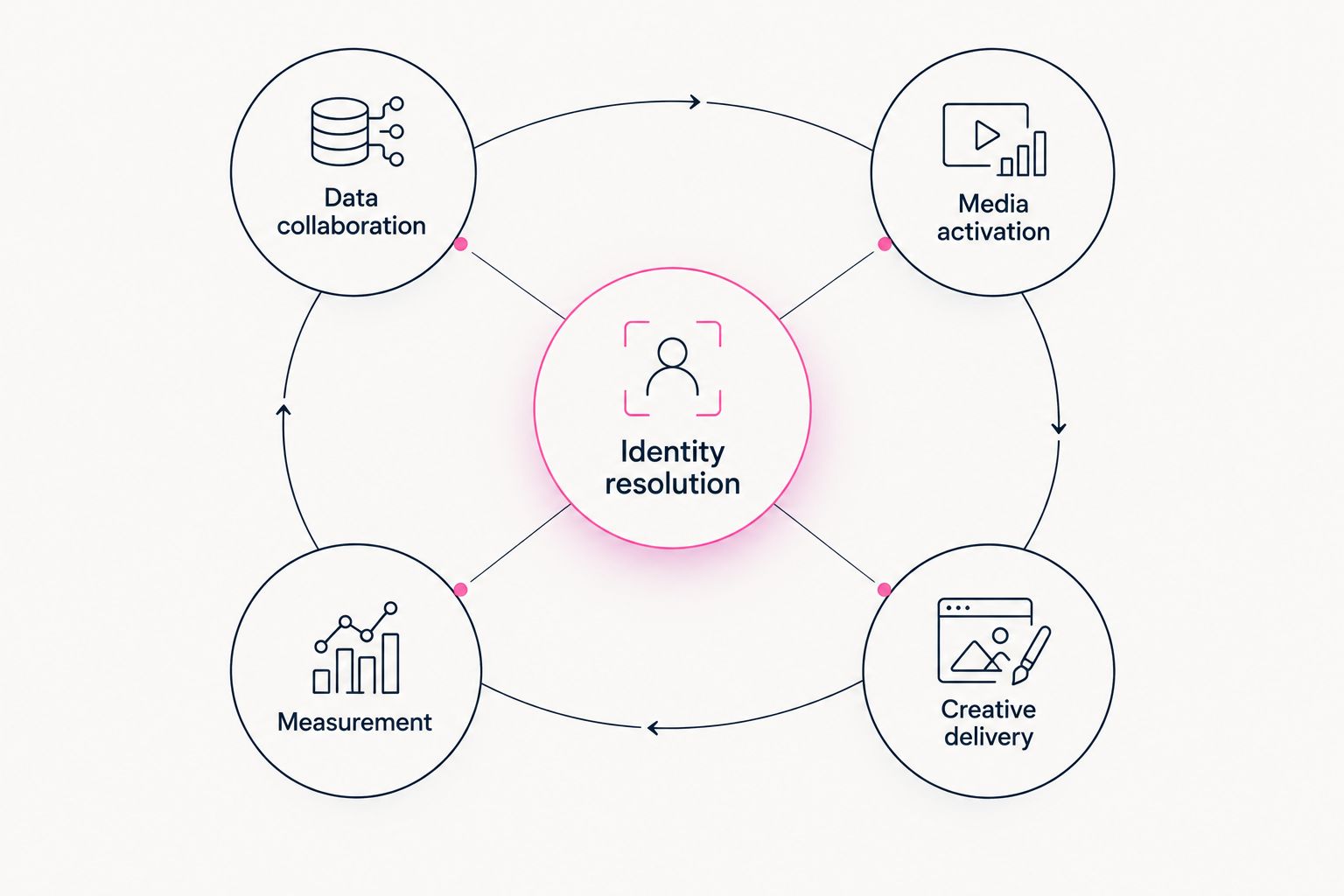
Identity resolution supports the workflow; it does not replace the other responsibilities.
A clean room is a controlled environment for collaborating on data under agreed restrictions. It is not, by itself, an identity graph or proof that processing is lawful. The guide to data clean rooms for retail media networks covers that separate part of the architecture.
Use a pilot with 3 stages: record matching, destination acceptance and measurement reconciliation. Set acceptance criteria before reviewing results so that the vendor's strongest metric does not become your entire decision.
Start with 2 datasets that you have permission to use for the evaluation. Include representative formatting differences and known edge cases, not only clean records selected for a demonstration.
Ask for the match denominator. A rate calculated from eligible records answers a different question from a rate calculated from every uploaded record.
Inspect false merges as well as missed links. Connecting different customers incorrectly can corrupt suppression, audience selection and purchase reporting even when the headline match rate looks attractive.
Choose 1 destination that matters to the proposed campaign. Demonstrate that the destination accepts the output and explain the difference between matched records, accepted records and an audience that can actually receive advertising.
Trace responsibility across each handoff. Your agency should know whether the retailer, identity provider, collaboration environment or buying platform must fix a failed transfer.
Agree the unit of analysis before joining exposure and purchase information. Keep person-level and household-level results separate unless the methodology explicitly explains their relationship.
Also separate attribution from incrementality. Attributed sales are sales linked under a reporting rule; incremental sales require evidence about what happened because of advertising, not merely after it.
This 2026 shortlist uses product role and procurement fit, not proprietary testing, customer scores or measured match-rate comparisons. LiveRamp addresses activation connectivity, Experian adds an enrichment-led evaluation path, TransUnion suits a household-oriented brief, and Amperity addresses customer unification.
The criteria remain the same across all four: match logic, identity level, destination acceptance, control, measurement continuity and operational ownership. No vendor receives an overall performance claim without evidence from your intended workflow.
If you already have usable customer records and need external audience activation, start by evaluating LiveRamp. If the customer records themselves are fragmented, start with Amperity instead.
Choose an Experian evaluation when enrichment is central to the brief. Put TransUnion first when household identity is a deliberate planning requirement. These are different starting points, not interchangeable recommendations.
For a 2026 in-housing project, bring Cake.Shop into the discussion about the wider programmatic stack. Ask for a technical scope covering the identity handoff, buying workflow, reporting, creative and publisher supply—without assuming an integration that has not been demonstrated.
What's the best identity resolution platform for retail media in 2026?
There is no evidenced universal winner in this shortlist. Evaluate LiveRamp for activation connectivity, Experian for enrichment, TransUnion for household-oriented planning and Amperity for customer-data unification.
Is an identity resolution platform the same as a customer data platform?
No. Identity resolution links records or identifiers, while a customer data platform supports broader customer-data workflows and can include identity resolution.
Does a high match rate mean my retail-media audience is reachable?
No. A matched record still needs an accepted identifier, an approved activation route and the appropriate permissions before it becomes useful for advertising.
Can a data clean room replace identity resolution?
Not by itself. A clean room controls data collaboration, while identity resolution establishes relationships between records; a proposed workflow must explain how both responsibilities are handled.
Does hashing customer emails make retail-media data anonymous?
No. Hashing an email address does not, by itself, make the resulting identifier anonymous or remove obligations governing its use.
Can household matching prove that an individual bought after seeing an ad?
No. A household relationship does not establish which individual saw an advertisement or made a purchase, so reporting must preserve that distinction.
Where does Cake.Shop fit alongside an identity provider?
Cake.Shop provides the wider modular programmatic stack for agencies and brands, including media buying, creative, data clean rooms and publisher supply. Confirm identity-provider connections during technical scoping rather than assuming compatibility.
Ask every shortlisted vendor to demonstrate a deletion, not just a match. Follow a permitted test record from the source through derived audiences and reporting outputs, then establish which organisation is responsible for each downstream action.
A successful upload shows that data can enter the workflow. A documented deletion process shows who controls what happens afterwards.
Compare the best attention measurement platforms by use case. Choose a shortlist for eye tracking, placement scoring, research or verification in 2026.
Read more →Compare identity resolution platforms for retail media by use case. Shortlist for activation, enrichment or customer unification, then validate fit.
Read more →Compare data clean room platforms for agencies in 2026. Choose by client data, media access and reporting needs, with clear trade-offs for each option.
Read more →Book a 30-minute demo and see exactly how Cake.Shop works — no sales pitch, just the platform.