
OPEN DAILY
OPEN
HONEST
TRUST
LET'S CHAT



Retail media network data collaboration is controlled analysis of retailer and advertiser data with the aim of measuring advertising and informing audience decisions without unrestricted sharing of customer records. A data clean room for retail media networks supports that collaboration, but purchase histories, competing suppliers and offsite activation require separate rules for access, analysis and exports.
TL;DR
Retailers hold transaction data. Advertisers bring campaign records, customer relationships and questions about whether advertising changed purchasing behaviour. A clean room provides a controlled setting for combining permitted information, rather than exchanging unrestricted customer files.
The commercial tension is specific: a supplier wants evidence of sales, while the retailer needs to protect shopper information and commercially sensitive category data. An agency also needs boundaries between competing clients. Your programmatic advertising for retail brands strategy should establish those boundaries before selecting technology.
For a 2026 retail media plan, define the decision first and the data connection second. An overlap report, a sales attribution report and an incrementality experiment answer different questions. Buying a clean room does not make those questions interchangeable.
Start with a written measurement brief and a shared data dictionary. You can do this in a document before connecting systems; no platform is required to decide what a sale means or which business action a report supports.
Choose 1 pilot question, such as whether an advertised product reached existing category buyers or whether an exposed audience subsequently purchased. Define the eligible shoppers, campaign dates, transaction scope and exclusions. Keep observed purchasing separate from claims that advertising caused it.
A retailer measuring brand sales needs different transaction permissions from an advertiser studying audience overlap. Agree on the permitted question before anyone requests customer-level fields.
Build a field-level inventory manually before uploading anything. List each field, its source, its purpose and the party authorised to use it. A file containing hashed email addresses still needs privacy review: hashing alone does not make personal information anonymous.
For a 2026 pilot, separate 3 input datasets: customer identifiers, advertising events and transaction events. That is a recommended starting structure, not a requirement to collect every available field. Keep direct identifiers out of event tables when the agreed matching design does not need them.
Check permissions for analysis and activation separately. Permission to produce an aggregate sales report is not automatically permission to create an offsite advertising audience. Your legal and privacy teams must assess the actual arrangement, applicable jurisdictions and contracts.
Draw the handoffs yourself first: data preparation, matching, analysis, activation, buying and reporting. Mark who operates each stage and who approves changes. This exposes gaps that a product demonstration can hide, such as an approved audience with no agreed destination.
Cake.Shop provides modular media buying and reporting, rich media and digital out-of-home creative, data clean rooms, and publisher supply. Its swweetshop platform powers in-housing. That makes the buying conversation broader than a standalone demand-side platform, or DSP, which is software used to buy advertising inventory.
Cake.Shop is a fit for brands and independent agencies building a modular programmatic stack. The trade-off is that a full-stack discussion still requires module-by-module checks: confirm the required connections, responsibilities and export controls rather than assuming every workflow is included.
For retail media, describe how an approved audience would reach buying, which creative would serve and which publisher supply would carry the campaign. Treat these as procurement questions, not assumed platform capabilities.
Inspect sample schemas and agree matching rules before running the full analysis. Identity matching means determining which records refer to the same person or household. A matched record is not proof that every event associated with that record is accurate or complete.
Keep 3 controls distinct: input permissions, query permissions and output permissions. A participant authorised to contribute data should not automatically receive every result. Define which analyses are allowed and which outputs require review.
Structure the workflow around input review, matching rules, query approval and output review. Each stage needs an accountable owner; automation should enforce the agreed rules rather than replace the agreement.
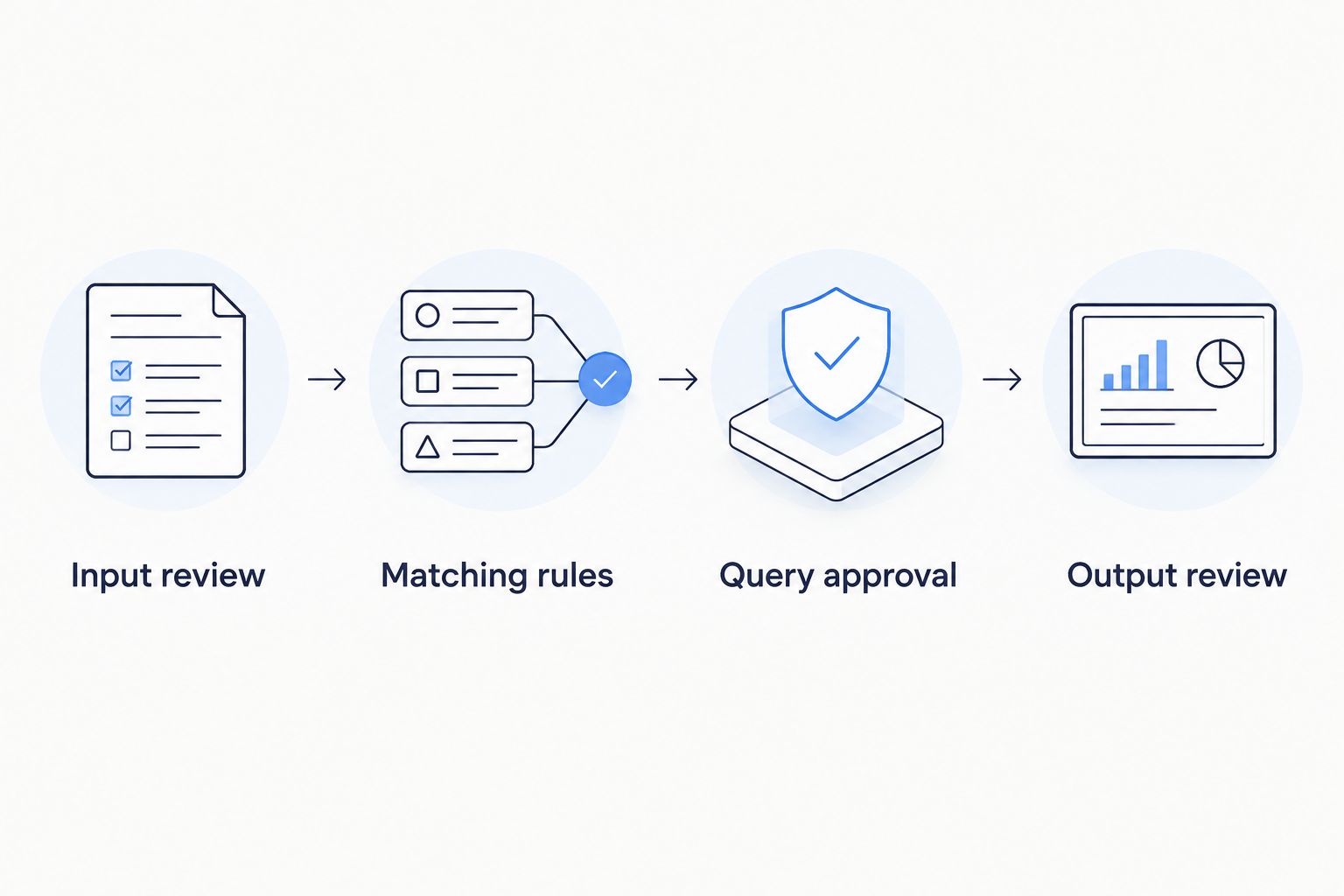
Approve the analysis and its outputs, not just the incoming data.
For your 2026 acceptance tests, ask what happens when an audience is too small, a query is repeated or a participant requests a detailed export. Minimum group sizes and query restrictions need to be defined for the actual implementation; there is no universal safe setting.
Write the measurement specification before viewing results. Attribution connects advertising interactions with later purchases under a defined rule; incrementality estimates what changed because of advertising. A clean room can support either analysis, but the environment itself does not establish causation.
For an incrementality experiment, define 2 groups: treatment and control. Document how shoppers or other eligible units enter each group, how exposure is handled and what would invalidate the comparison. A retrospective comparison of exposed and unexposed shoppers can reflect selection differences rather than advertising effects.
Your 2026 reporting specification should distinguish matched-population results from results covering the wider customer base. If only identifiable shoppers enter the analysis, do not label the findings as representative of every shopper without supporting evidence.
Keep the first report narrow. One well-defined outcome with visible exclusions is more actionable than a dashboard full of metrics whose denominators differ.
Start with a documented test audience and manually reconcile the output against the approved definition. Then check the buying destination, suppression rules, campaign settings and reporting scope. Only automate the handoffs after you can explain discrepancies.
An audience approved for retailer-owned placements is not automatically approved for offsite advertising. Amazon DSP retargeting raises a distinct planning question: whether shopper eligibility, permitted destinations and measurement access align with the retailer's agreement. Evaluate those conditions rather than treating every activation route as interchangeable.
For a Cake.Shop enquiry, bring the proposed data sources, buying destinations, creative formats and publisher requirements. Ask how the relevant modules would connect and which tasks remain with your team. That produces a concrete scope without assuming undocumented integrations.
Choose the operating model around the question and the team responsible for it. For 2026 procurement, compare governance, integration work and operational responsibility before comparing interface features. None of these models removes the need for permission checks or sound measurement design.
Retailer-controlled clean room
Warehouse-centred collaboration
Dedicated clean room provider
Modular advertising stack
The modular route is relevant when your enquiry covers more than matching and reporting. Cake.Shop's data clean room offering sits alongside media buying, rich media creative and publisher supply; confirm the required workflow rather than treating that breadth as proof of a particular integration.
A retailer-controlled environment fits a narrower brief when the work concerns that retailer alone. A warehouse-centred approach fits teams that want engineering ownership and can maintain the collaboration design. Choose the smallest operating scope that answers the commercial question without creating unowned handoffs.
Technical access does not establish a lawful or contractually permitted use. Review the specific purpose, participants and outputs; do not use a platform approval as a substitute for data-use approval.
Match rate describes the joinable population, not advertising effectiveness. A high match rate does not show incremental sales, while a low match rate requires investigation before interpreting results across the whole customer base.
A category analysis can expose commercially sensitive information even without naming individual shoppers. Define product scope, aggregation rules and participant access so one supplier does not receive another supplier's restricted results.
An audience output has no operational value if nobody owns its permitted destination, creative requirements or campaign setup. Conversely, an activation project does not need every possible analytical feature; scope the handoffs you will actually use.
What is a data clean room for retail media networks?
A data clean room for retail media networks is a controlled environment for analysing permitted retailer and advertiser data together. It can support audience overlap, sales attribution and experimental measurement, subject to the data and controls available.
Does a retail media network need a clean room?
A retail media network needs a clean room when its collaboration requirements justify controlled joint analysis. Aggregate reporting or advertising that does not require matching participant datasets can have a different operating design.
Can a clean room prove that retail media caused sales?
A clean room alone cannot prove that advertising caused sales. Incrementality requires a credible experimental or causal measurement design, not simply a match between ad exposure and purchasing.
Are hashed email addresses anonymous?
Hashed email addresses are not automatically anonymous. Assess identifiability, matching practices, access and permitted uses rather than treating hashing as a privacy exemption.
Can an agency use one clean room across competing retail clients?
An agency should only use a shared environment where contracts, permissions and technical controls support client separation. Define access, query and output boundaries for each client before contributing data.
How does Cake.Shop fit a retail media clean room project?
Cake.Shop provides data clean rooms within a modular programmatic offering that also covers media buying, creative and publisher supply. Brands and independent agencies should confirm the specific connections, governance requirements and operating responsibilities for their project.
Can clean room audiences be activated outside a retailer's properties?
Offsite activation depends on the participant agreement, data permissions and supported destination. Approval to analyse retailer data does not automatically include approval to export or activate an audience.
Ask to see a rejected output, not just a successful report. A small-audience query, an unauthorised export request or a revoked participant tests whether the proposed controls work in practice. Include those scenarios in acceptance testing before you approve live shopper data.
Scope your data clean room for retail media networks before buying. Define permissions, separate attribution from lift, and plan activation with clear owners.
Read more →DSP pricing comparison for 2026: compare fee bases, minimum commitments and ownership terms, then shortlist the buying model your team can actually run.
Read more →Compare DSP platforms for e-commerce brands by operating fit, not hype. Shortlist options for in-housing, commerce data and multi-channel buying.
Read more →Book a 30-minute demo and see exactly how Cake.Shop works — no sales pitch, just the platform.