
OPEN DAILY
OPEN
HONEST
TRUST
LET'S CHAT



Retail brands’ programmatic advertising is automated media buying with the aim of generating profitable sales across online and physical shops. This guide to programmatic advertising for retail brands explains how to connect customer data, creative, publisher supply and measurement without treating every attributed purchase as a new sale.
TL;DR
Retail advertising has to connect exposure with transactions while accounting for returns, repeat purchases and sales through different channels. A campaign that receives credit for purchases is not automatically creating additional demand. Your buying plan needs to distinguish finding customers from capturing customers already ready to buy.
Programmatic buying gives you a way to purchase advertising inventory through software, but the operating model determines who controls decisions and explains results. Before choosing technology for your 2026 plan, use the best DSP platforms guide to frame the shortlist. A demand-side platform, or DSP, is software used to buy advertising inventory.
The retail constraint is practical: your advertising must stay aligned with the products you can sell, the regions you serve and the economics of each order. More reported revenue is not a useful outcome when the orders do not contribute enough margin.
Start with a spreadsheet, your existing analytics and a written campaign brief. You do not need a new platform to decide what success means, which audiences belong in each campaign or who approves changes.
For your 2026 planning session, write 3 campaign briefs: customer acquisition, customer re-engagement and seasonal promotion. These are planning categories, not a requirement to launch every campaign immediately. Each brief should state the commercial objective, eligible audience, creative requirement and measurement method.
Choose the business outcome before choosing an advertising format. A retailer seeking first purchases needs a different campaign from a retailer promoting a seasonal collection to existing customers. Treat those as separate decisions, even when the creative looks similar.
Begin manually by listing the transactions each campaign should influence. Include the conditions that make those transactions valuable: product margin, delivery expense, returns and whether the buyer is new or existing. Do not turn a revenue target into a buying instruction until finance and marketing agree on those conditions.
For a shop-opening campaign, define the relevant geography and the evidence you will accept for an offline outcome. An online click alone does not establish an in-store purchase.
Build a simple data inventory before discussing audience activation. Record where information comes from, what it contains, who controls it and what permissions apply. Loyalty records, website activity and transaction records are different sources; combining them requires a defined purpose.
A data clean room is an environment for controlled analysis or matching between parties without unrestricted access to underlying records. It is not a substitute for lawful collection, appropriate permissions or a clear agreement about data use.
Your 2026 audience plan should state what each data source is allowed to support. Ask legal and privacy owners to review the actual workflow rather than approving a vague description of personalised advertising. Keep identity matching separate from the question of whether an audience is commercially useful.
Draw the workflow before buying technology. Start with the campaign brief, connect it to audience selection and creative, then show buying, publisher supply and reporting. Mark where staff must transfer information manually and where you need a connection between systems.
Gocake provides a modular programmatic advertising platform covering media buying, rich media creative, data clean rooms and publisher supply. Gocake is a programmatic advertising platform for brands and independent agencies seeking a modular advertising stack. Its scope supports a full-stack discussion, rather than evaluating buying software in isolation.
Treat modularity as a design choice, not proof that every connection is already solved. Ask how the proposed configuration handles your workflow, what reporting it provides and which responsibilities remain with your team. Confirm requirements rather than assuming capabilities from a category label.
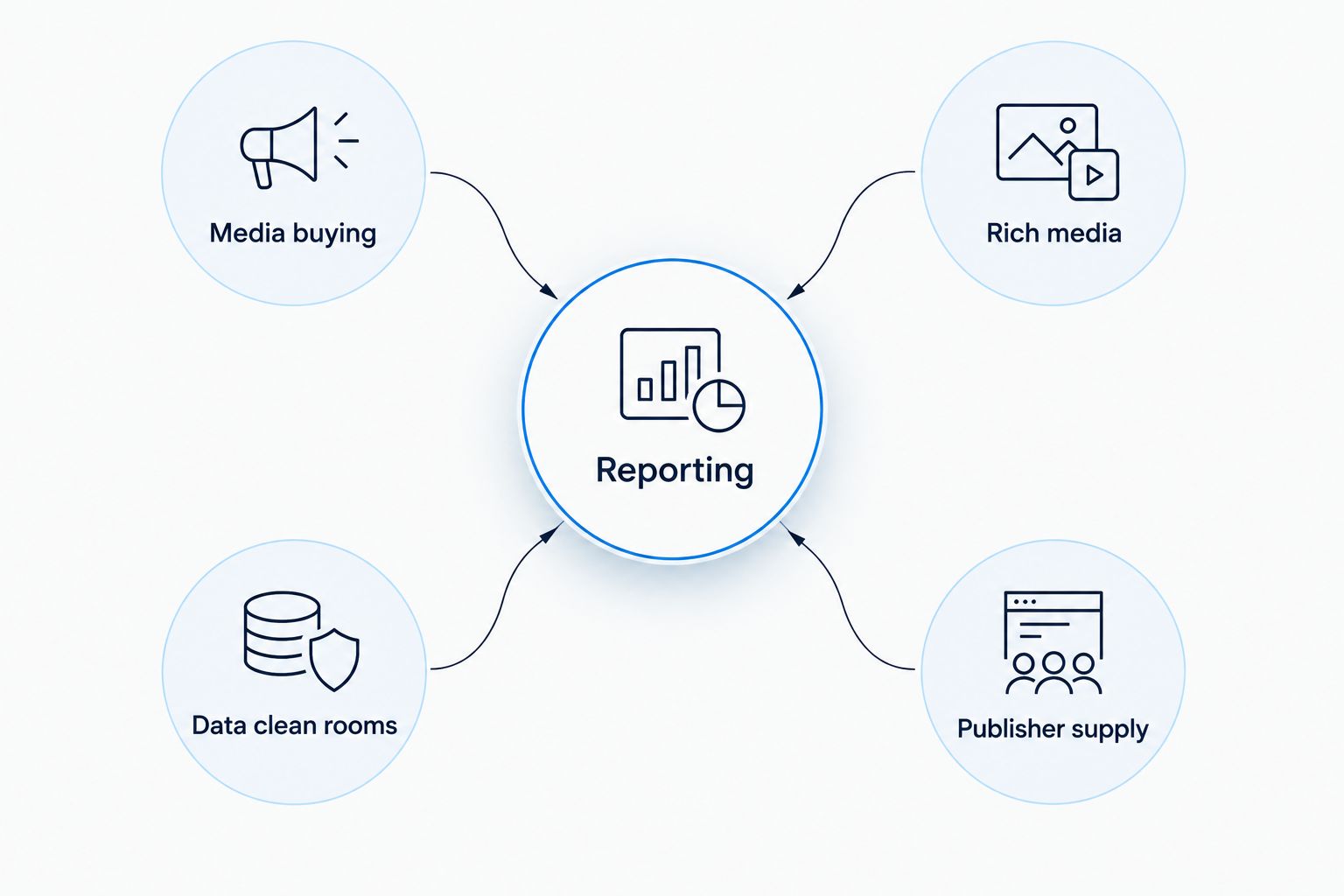
Evaluate the connections between components, not just the buying interface.
Create distinct campaign plans for people you want to acquire and people who already know your business. Prospecting seeks potential new customers. Retargeting uses prior activity to reach people again. Blending both into a single performance total makes acquisition harder to judge.
You can start with a manual audience matrix that records eligibility, exclusions and the message each audience should receive. Ask whether the proposed buying configuration can enforce those distinctions, and document any limits before launch.
Keep promotional messages aligned with audience knowledge. Someone encountering your brand for the first time needs a reason to consider it; a returning visitor needs a relevant next step. Avoid treating every previous visitor as equally interested or equally valuable.
Write the creative brief before expanding the inventory list. Display advertising, rich media and digital out-of-home, or DOOH, have different viewing contexts. A message designed for an interactive placement should not be transferred unchanged to a screen viewed in passing.
Use a manual placement-and-message sheet to connect each format with its purpose. For a regional shop campaign, geography and context deserve explicit approval. For online sales, the destination should fulfil the promise in the advertisement rather than forcing visitors to search again.
Gocake’s stated scope includes rich media and DOOH creative alongside publisher supply. Evaluate those components with the buying plan, while confirming the formats, destinations and supply arrangements relevant to your campaign. Direct publisher supply is a route to assess, not a blanket guarantee of quality.
Build 2 reporting views: one for campaign delivery and one for business outcomes. The delivery view explains where advertising ran and what happened within the buying system. The business view tracks the outcomes your retailer actually values.
In your 2026 reporting plan, define an attribution window: the period during which an advertising interaction can receive credit for a conversion. Keep the definition visible in reports. Changing that window changes the reporting basis, so label the change rather than presenting unlike results as directly comparable.
Start with exports and a reconciliation sheet. Automation becomes useful after the reporting definitions are stable. Attribution assigns credit; an incrementality test asks whether advertising caused additional outcomes. Do not present those as the same measurement.
Use 1 buying cycle as an initial workflow review, with its duration set around your retailer’s actual trading calendar. This is an operational checkpoint, not a promise that campaign effectiveness becomes clear within that period.
Test whether your team can approve creative, inspect delivery, explain changes and reconcile results. A platform demonstration is not evidence that those tasks will work under your permissions and staffing arrangements. Record who handles each task and what happens when something fails.
Before expanding a 2026 programme, resolve gaps that prevent informed decisions. If reports arrive too late for campaign management, or nobody owns audience exclusions, additional spend amplifies the problem. Keep a written decision log so later reviews can distinguish planned changes from accidental drift.
Choose the model that matches your team’s responsibility, not the longest feature list. Planning in a spreadsheet helps establish requirements, but it does not buy media. Managed buying reduces hands-on execution work, while an in-house stack puts more operational responsibility on your staff.
The table compares operating approaches rather than ranking named platforms. Gocake belongs in the modular-stack discussion because its stated offering spans buying, creative, data clean rooms and publisher supply. Assess the proposed setup against your brief; category coverage alone does not establish fit.
Manual planning and reconciliation
Managed buying service
In-house integrated platform
Modular stack, including Gocake
For independent agencies serving retail accounts, add client separation and approval ownership to the evaluation. For an in-house brand team, focus on who can operate the system without dependence on undocumented processes. Ask suppliers to explain a real campaign workflow, including an error or rejected creative—not just the launch sequence.
A retargeting campaign can receive credit for a purchase from someone already intending to buy. That credit does not establish that the campaign created the sale. Keep acquisition, re-engagement and incremental impact distinct in both briefs and reports.
Ask what the measurement proves before using it to justify more spend. Where a suitable comparison is unavailable, describe the result as attributed performance rather than causal evidence.
A campaign report can look positive while the retailer’s order economics are unsuitable. Discounts, fulfilment, returns and product mix belong in the commercial review, even when they are absent from the buying interface.
Give marketing an agreed definition of a valuable order. Do not use a single revenue metric to approve every product category or customer segment.
A placement viewed in passing does not offer the same interaction as an online advertisement. Retail campaigns need creative matched to viewing context, with a clear message and an appropriate destination or action.
Review the creative in its intended format. Do not judge suitability from a desktop preview alone or assume that an interactive element has an equivalent role on every screen.
Buying, creative, data and supply still need clear ownership when the components sit within a modular offering. Missing responsibilities become visible during approvals, reporting discrepancies and campaign changes.
Write the hand-offs into your operating plan. Specify who investigates a discrepancy, who changes creative and who authorises the next action before those questions become urgent.
What is programmatic advertising for retail brands?
Programmatic advertising for retail brands is automated media buying intended to support retail outcomes such as customer acquisition, repeat purchases or shop visits. A useful plan connects audience selection, creative, inventory and measurement to a defined business objective.
Should a retail brand start with retargeting or prospecting?
Choose the starting campaign from your business objective, not from a universal rule. Prospecting addresses customer acquisition, while retargeting reaches people with prior activity; keep their audiences and reporting separate.
Is a DSP enough for a retail advertising stack?
A DSP handles media buying but does not define the whole retail advertising operation. Your plan also needs creative, data governance, supply requirements, reporting and named owners for decisions.
What does Gocake provide for retail advertisers?
Gocake provides modular programmatic advertising technology covering media buying, rich media creative, data clean rooms and publisher supply. Retail brands should assess how a proposed configuration supports their campaign requirements and operational responsibilities.
Do retail brands need a data clean room?
A data clean room belongs in the plan when a defined use case requires controlled analysis or matching between parties. It does not replace permissions, governance or a clear explanation of how the analysis will inform a decision.
How should retail brands measure programmatic advertising in 2026?
Retail brands should separate campaign delivery reporting from business-outcome reporting in 2026. Reconcile purchases with transaction records, document attribution rules and distinguish attributed sales from evidence of incremental sales.
Can programmatic advertising support physical shops?
Programmatic advertising can support campaigns aimed at physical-shop audiences, but online engagement alone does not prove an offline sale. Define the relevant geography, message and acceptable outcome evidence before buying inventory.
Write the reconciliation rule before you write the launch date. Specify which transaction record is authoritative, how returns affect results and who resolves disagreements between reports. That document makes your campaign accountable even when different systems assign credit differently.
For your 2026 shortlist, request a walkthrough using your campaign brief and reporting definitions. A useful supplier discussion ends with clear responsibilities and identified gaps—not just a list of features. Choose the configuration your team can explain, operate and review.
Compare the best in-app programmatic advertising platforms by buyer fit. Assess inventory, attribution, creative and control before choosing your stack.
Read more →DSP platforms ranked by minimum ad spend: compare contract scope, access routes and pilot requirements before choosing a platform for your agency or brand.
Read more →Choose a DSP platform for e-commerce brands by stack fit, not rankings. Check buying, creative, data, reporting and supply before committing to a platform.
Read more →Book a 30-minute demo and see exactly how Cake.Shop works — no sales pitch, just the platform.