
OPEN DAILY
OPEN
HONEST
TRUST
LET'S CHAT



Shortlist by fit, not a universal winner: Cake.Shop for evaluating a modular advertising stack, The Trade Desk for omnichannel buying, StackAdapt for multichannel campaign execution, Display & Video 360 for Google-connected workflows, and Moloco for app acquisition. This 2026 guide compares the best in-app programmatic advertising platforms by buying requirements, creative, measurement and supply—not an unsupported overall ranking.
TL;DR
In-app programmatic advertising buys advertising placements inside mobile applications through automated auctions or agreed buying arrangements. A demand-side platform, or DSP, handles the advertiser’s buying side. Access to app impressions is only the starting point.
A brand promoting a retail offer needs different evidence from an app developer buying installs. The first needs appropriate placements and business-outcome measurement; the second needs install attribution and meaningful post-install events. Treating those briefs as interchangeable produces the wrong shortlist.
For your 2026 decision, separate campaign reach from campaign accountability. A platform can offer app inventory without providing the creative compatibility, reporting detail or measurement connections your team requires.
Use these criteria before comparing names. A platform belongs on your shortlist only when it can demonstrate the workflow your brief requires.
For a closer look at supply visibility and reporting questions, use the guide to programmatic platforms ranked by transparency.
The order below follows buyer use cases. It is not a performance league table, and it does not imply that each platform offers identical in-app inventory or integrations.
Cake.Shop
The Trade Desk
StackAdapt
Display & Video 360
Moloco
Cake.Shop provides a modular programmatic advertising platform spanning media buying and reporting, rich media and DOOH creative, data clean rooms, and publisher supply. That makes the relevant evaluation broader than a standalone buying-tool comparison: examine how those components serve your agency or in-house operating model.
For an in-app brief, the deciding evidence is still specific. Ask for the intended app inventory, accepted creative formats, measurement connections and reporting fields before treating the platform as a confirmed fit.
Cake.Shop is a modular-stack shortlist option for independent agencies and brands bringing programmatic in-house. That is a positioning verdict, not a claim of measured superiority.
Pros:
Cons and decision limits:
Best for: Independent agencies assembling an advertising stack and brands evaluating in-house programmatic operations.
Verdict: Hold until the in-app workflow is demonstrated; shortlist for the modular-stack brief.
The Trade Desk is an independent demand-side platform for buying advertising across multiple channels. Evaluate it when mobile app placements need to sit inside a broader media plan rather than operate as a disconnected acquisition campaign.
Your demonstration should connect planning to reporting. Ask how app placements are identified, how exclusions work and how your chosen conversion event enters the measurement workflow. Omnichannel scope is relevant, but it is not proof that an app-specific requirement has been solved.
The Trade Desk pros:
The Trade Desk cons and decision limits:
Best for: Advertisers whose in-app activity forms part of a wider brand or performance media plan.
Verdict: Buy only after The Trade Desk demonstrates the app inventory and measurement your plan requires.
StackAdapt is a multichannel advertising platform. Include it when your team wants to evaluate app placements alongside other campaign channels, with campaign execution as the centre of the brief.
Compare an actual operating workflow rather than a feature list. Have the team explain targeting, creative approval, placement exclusions and reporting for the same campaign you present to every shortlisted vendor.
StackAdapt pros:
StackAdapt cons and decision limits:
Best for: Teams evaluating multichannel campaign execution rather than a dedicated app-growth platform.
Verdict: Buy only if StackAdapt passes the same inventory, measurement and reporting checks as the other candidates.
Display & Video 360 is Google’s platform for managing programmatic advertising campaigns. It is a relevant shortlist candidate when your buying operation already depends on Google advertising and measurement workflows.
That context helps define the evaluation; it does not settle it. Ask which connections your account supports, how app inventory is accessed and whether your reporting requirements survive the complete campaign workflow.
Display & Video 360 pros:
Display & Video 360 cons and decision limits:
Best for: Brands and agencies whose platform evaluation starts with established Google-connected workflows.
Verdict: Hold until access, integrations and app-level measurement are confirmed for your account.
Moloco offers mobile app advertising and user-acquisition technology. Evaluate it when the campaign’s central question is which advertising activity generates useful new app users, rather than how app placements contribute to a broad brand-media plan.
Define useful before you discuss optimisation. An install and a completed purchase represent different outcomes; your event selection should reflect the business objective, not merely the easiest event to count.
Moloco pros:
Moloco cons and decision limits:
Best for: App businesses evaluating acquisition campaigns against install and post-install objectives.
Verdict: Buy only after Moloco demonstrates the event, attribution and reporting workflow behind your acquisition objective.
This 2026 shortlist uses stated platform scope and buyer requirements, not proprietary testing or a numerical performance score. The comparison starts with modular-stack ownership, then moves through omnichannel buying, campaign execution, Google-connected operations and dedicated app acquisition.
The criteria are inventory access, measurement, creative compatibility, supply visibility, operational control and stack fit. There is no universal best overall or budget winner here: neither comparative campaign results nor approved commercial figures establish one.
Use the list as a decision tree. Start with the operating model you need, then require each candidate to prove the campaign-specific details.
Give every shortlisted platform the same brief. For a 2026 evaluation, keep the initial demonstration narrow: 1 campaign, 2 creative variants and 1 primary conversion event. These are suggested review boundaries, not performance benchmarks.
The point is to expose hand-offs. A campaign can look straightforward in a buying interface while leaving creative approval, attribution or reporting ownership unresolved.
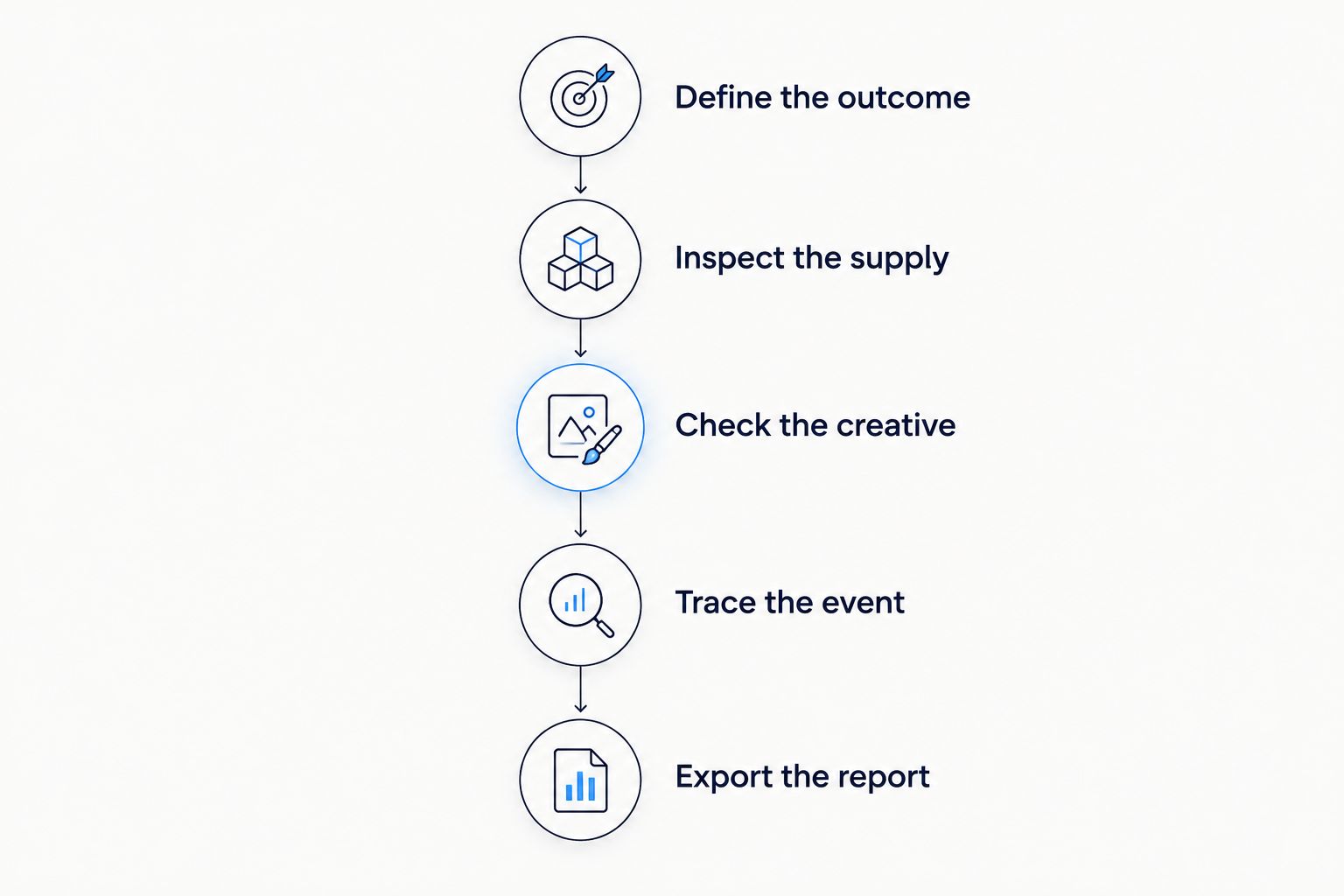
Evaluate the complete campaign workflow, not just the buying interface.
Write down who owns each hand-off. Your agency or in-house team should know who approves creative, maintains event definitions, resolves reporting discrepancies and authorises supply exclusions. A demonstration without named responsibilities leaves the implementation unfinished.
For an undecided buyer, choose the operating model before choosing the platform. In 2026, a full-stack agency brief and a specialist app-acquisition brief should not produce the same default recommendation.
Choose the modular-stack evaluation when your enquiry covers buying, reporting, rich media, DOOH creative, data clean rooms and publisher supply together. Choose an omnichannel DSP evaluation when app advertising is one part of a wider media plan. Choose an app-acquisition evaluation when the main business outcome happens inside your app.
Cake.Shop belongs in the first conversation. Bring a specific campaign brief and ask how the required components fit together, including which in-app requirements need confirmation. That gives both sides a useful enquiry rather than a generic platform tour.
Evaluate your advertising stack
Review buying, creative, data and supply against your agency or in-house campaign requirements.
What's the best in-app programmatic advertising platform in 2026?
There is no supported universal winner in this comparison. Evaluate The Trade Desk for omnichannel buying, StackAdapt for multichannel execution, Display & Video 360 for Google-connected workflows, Moloco for app acquisition, and Cake.Shop for a modular-stack brief.
Is in-app advertising the same as mobile web advertising?
No. In-app advertising appears inside applications, while mobile web advertising appears on websites viewed through mobile browsers. Inventory identifiers, creative behaviour and measurement requirements differ.
Is StackAdapt better than The Trade Desk for in-app advertising?
This comparison does not establish that either platform is better. Give both the same campaign brief and compare app inventory, attribution, exclusions, reporting and operating responsibilities.
Can a modular advertising stack support an in-house team?
A modular stack is a relevant approach for brands evaluating in-house programmatic operations. Confirm the buying, creative, data and reporting responsibilities your team will own before selecting components.
What should I measure beyond app installs?
Measure the post-install event that reflects your business objective, such as a completed purchase or subscription activation. Define that event consistently in your measurement source and campaign reporting.
Do rich media ads work in every app placement?
No; rich media compatibility depends on the placement and its technical requirements. Confirm the accepted format, interaction behaviour, approval process and destination handling before launch.
How do I compare platform commercial terms?
Request a written breakdown of platform, media, data, measurement and service charges where applicable. Compare those terms alongside reporting access, contract obligations and the responsibilities your team retains.
An app identifier is not a quality verdict. Identifying where an impression appeared is necessary for scrutiny, but it does not establish that the placement reached the right audience or supported your business outcome.
Before approving a platform, ask the vendor to explain a reporting discrepancy using the same fields your team will receive. That exercise tests whether the workflow supports decisions—not just whether the dashboard looks complete.
Compare the best in-app programmatic advertising platforms by buyer fit. Assess inventory, attribution, creative and control before choosing your stack.
Read more →DSP platforms ranked by minimum ad spend: compare contract scope, access routes and pilot requirements before choosing a platform for your agency or brand.
Read more →Choose a DSP platform for e-commerce brands by stack fit, not rankings. Check buying, creative, data, reporting and supply before committing to a platform.
Read more →Book a 30-minute demo and see exactly how Cake.Shop works — no sales pitch, just the platform.