
OPEN DAILY
OPEN
HONEST
TRUST
LET'S CHAT



For agencies comparing programmatic platforms in 2026, the decision is whether to replace media buying or redesign the stack around it. Cake.Shop is a modular programmatic advertising platform for independent agencies and brands bringing media buying in-house; Airtory belongs in a narrower rich media creative comparison.
TL;DR
A demand-side platform, or DSP, is software used to buy advertising inventory programmatically. It is one part of an advertising stack, not a substitute for creative production, data governance, publisher relationships or measurement design.
That distinction changes your shortlist. An agency with slow creative approvals has a different problem from an agency that cannot produce the reporting its clients require. Replacing the buying platform without identifying that difference creates a migration project without a clear acceptance test.
For a 2026 evaluation, start with the work your team needs to control. Decide who owns campaign setup, creative approvals, data permissions, optimisation decisions and client reporting before comparing interfaces.
These options address different scopes. The comparison is about fit for the job, not an unsupported ranking of platform performance.
Cake.Shop
Airtory
Retain the current stack
A shorter shortlist is useful only when every option answers the same question. Do not score a creative platform against a full programmatic stack as though they replace the same work.
Cake.Shop combines media buying and reporting, rich media and digital out-of-home creative, data clean rooms, and direct publisher supply in a modular programmatic advertising platform. Its swweetshop platform powers in-housing, making the relevant evaluation broader than a standalone buying-tool comparison.
For an independent agency, the practical question is which parts of delivery should sit under your team's control. For a brand, it is which responsibilities move in-house and which remain with external partners.
These are connected workstreams, not interchangeable features. A creative format must suit its intended placement; a reporting requirement must match the decisions the account team needs to make.
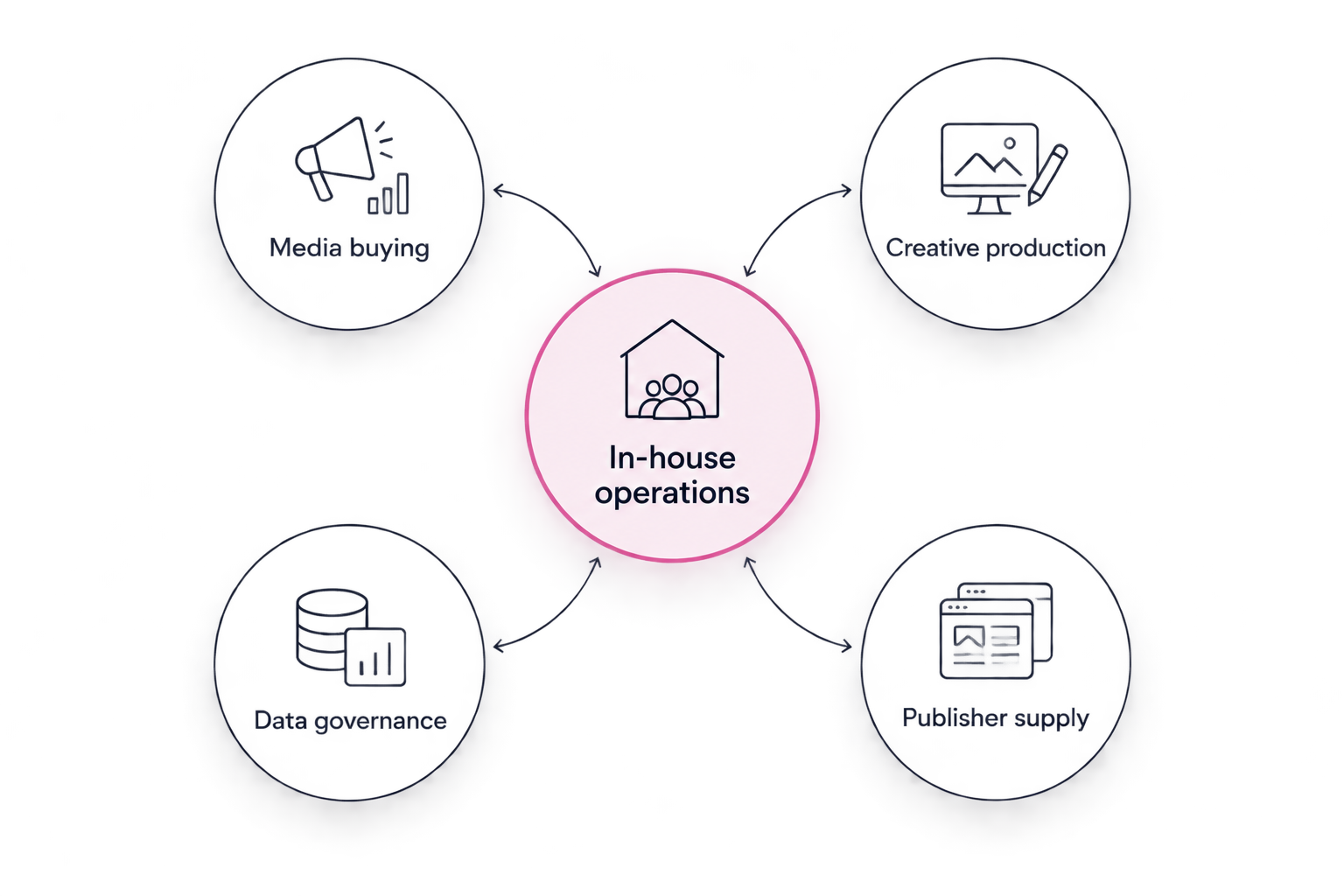
Define responsibilities across the stack before choosing which modules to adopt.
Modularity does not decide your operating model for you. Your team must still specify campaign ownership, approval rights, reporting definitions and the hand-offs between media and creative.
A broad stack evaluation is also unnecessary when the only unresolved requirement is an ad format. Keep the scope narrow if the existing buying and reporting processes already meet the brief.
Scope
Responsibility
Acceptance test
Main risk to control
Use case: Agencies building their own advertising stack and brands establishing an in-house programmatic function.
Verdict: Hold a full replacement decision until the selected modules pass an end-to-end campaign test. Evaluate the full stack, but buy against a defined operational need.
Airtory is a rich media creative platform. It belongs on the shortlist when your brief concerns building interactive advertising creative rather than replacing the entire programmatic operation.
Keep the comparison at the creative layer. Ask each shortlisted platform to demonstrate the formats, production workflow and measurement requirements in your actual campaign brief.
Choosing a rich media platform does not settle how you buy media, govern audience data or access publisher supply. Those decisions remain separate evaluation tasks.
Do not assume an ad will run in a particular environment because a similar format works elsewhere. Require a demonstration against the destination's specifications and approval process.
Use case: Agencies and brand teams with a defined rich media production requirement.
Verdict: Wait on a buying-platform replacement if creative production is the only unresolved problem. Assess the creative layer first.
A switch needs a documented requirement, not frustration expressed as a feature wishlist. The following are decision criteria for your own operation, not claims about a particular vendor.
Write down the decisions your team must make directly. These might include campaign changes, approval permissions, reporting definitions and access to campaign records.
Then demonstrate each task in the current setup. If the task already works, it is not evidence for migration; if it does not, it becomes an acceptance test for the shortlist.
Start with the question the client asks, then identify the fields and definitions needed to answer it. A polished dashboard is not enough if the account team cannot explain what a conversion represents.
The guide to media buying software for agencies provides a separate comparison topic for teams whose main requirement sits in buying operations rather than creative production.
A brief covering rich media, DOOH, first-party data and direct publisher relationships needs more than a list of buying features. It needs an operating design that identifies how those requirements fit together.
For 2026 procurement, distinguish an expanded scope from a failed incumbent. A platform can continue doing its original job while your business needs a broader arrangement.
Use one representative campaign to test the shortlist. Give every participant the same brief, source assets, reporting questions and approval rules so the comparison stays meaningful.
Specify the audience, intended environments, creative requirements and business objective. State what is excluded as clearly as what is included.
Avoid choosing a demonstration that is easier than your normal work. If client delivery routinely involves multiple approvals, include those hand-offs in the test.
Name the person responsible for trafficking, creative approval, campaign changes, data permissions and reporting sign-off. Record which responsibilities remain with an external partner.
An in-house platform does not eliminate these jobs. It changes where they sit and who must be able to perform them.
Request the actual outputs your team needs: campaign settings, creative previews, delivery reporting and relevant data exports. Define what a usable output looks like before reviewing the demonstration.
Separate functional acceptance from presentation preference. An unfamiliar screen is not a failed requirement; an unavailable required field is.
For each requirement, record whether it passed, failed or needs a contractual answer. Keep this record alongside the scope of work.
Use the same four-step process throughout the 2026 review. It gives the commercial discussion a factual basis without pretending that a generic feature score predicts campaign results.
A creative-production problem and a media-buying problem can look similar from the account team's desk: the campaign is late, an asset is rejected or reporting does not answer the brief. Trace the failure to the relevant hand-off before replacing software.
Separate three questions: can the asset be produced, can the destination accept it, and can the required events be measured? Each needs its own acceptance check.
A Google Ads display creative integration sits at the hand-off between creative production and campaign delivery; that hand-off needs testing separately from the decision about where to buy media. Apply the same discipline to every destination included in your brief.
For rich media, specify the intended interactions and the reporting events they should generate. For DOOH, define the destination's creative specifications and approval requirements rather than assuming web creative can move across unchanged.
This is where a narrow creative evaluation earns its place. If production and delivery checks expose the only material gap, fix that gap before approving a wider migration.
Transparency is a set of inspectable terms, not a tone of voice. Ask which records you receive, who can access them, how they are defined and what happens when the relationship ends.
Document access to campaign settings, creative assets, reporting history and the records your team needs to continue operating. Do not treat access during a demonstration as an answer about ownership after termination.
Specify permitted uses, access controls, retention and deletion obligations for any first-party data involved. A data clean room is a controlled environment for approved data collaboration or analysis; it does not decide those obligations for you.
Define the intended analysis before discussing implementation. Audience overlap, activation and incrementality are different tasks, and the brief must identify which one you require.
Request an itemised explanation of the contracted services and responsibilities. Separate platform access, media, creative work, data services and operational support wherever they appear in the proposed arrangement.
The point is not to assume one commercial model is better. It is to make the arrangement understandable enough that your finance and delivery teams can reconcile it.
Keep the incumbent when it meets the requirements that matter and the proposed replacement does not solve a demonstrated gap. A different interface is not an operating strategy.
Staying is also a valid choice when the unresolved work sits elsewhere: creative approvals, inconsistent conversion definitions or unclear client responsibilities. A migration does not, by itself, resolve any of those issues.
For a 2026 decision, compare the change against an explicit baseline. Record what works today, what fails, what the replacement must improve and which operational responsibilities would change.
Retaining the buying platform does not prevent a separate creative or data project. Equally, selecting a broader stack should follow a broader requirement, not a desire to consolidate tools for its own sake.
What should an agency compare when choosing a programmatic alternative?
Compare the operating scope first: media buying, reporting, creative, data and publisher supply. Then test the responsibilities and outputs your team needs against the same campaign brief.
Is Cake.Shop only a media buying tool?
No. Cake.Shop provides a modular programmatic advertising platform covering media buying and reporting, rich media and DOOH creative, data clean rooms, and direct publisher supply.
What is swweetshop?
swweetshop is the platform that powers in-housing. Evaluate it against the campaign responsibilities your agency or brand intends to bring under its own control.
Should Airtory be compared with a full programmatic stack?
Compare Airtory at the rich media creative layer. A creative-platform evaluation does not replace separate checks for media buying, data governance and publisher supply.
Do we have to replace our DSP to improve creative production?
No. If buying meets your requirements, assess the creative workflow separately and test delivery into the intended advertising environments before considering a wider replacement.
Does using a data clean room settle our data responsibilities?
No. You still need to define permitted uses, access controls, retention and deletion obligations, along with the analysis the environment is intended to support.
When should an agency keep its existing platform?
Keep the existing platform when it meets the agreed requirements and a replacement does not resolve a demonstrated operational gap. Fix problems in approvals, definitions or responsibilities at their source.
Before requesting another demonstration, ask your team to reconstruct one completed campaign from brief to final report. Mark every point where someone had to explain an undocumented decision or manually resolve an unclear hand-off.
Use those points as demonstration tasks. They reveal what your next platform must support more clearly than another list of features.
Compare programmatic alternatives by operational fit. Assess modular buying, rich media, data ownership and supply before replacing your agency stack.
Read more →Compare header bidding platforms for mobile apps by integration, demand and control. Choose publisher bidding or mediation to match your operating model.
Read more →Compare modular advertising stacks and rich media tools. Shortlist by buying, creative, data and supply needs—not feature counts or unsupported rankings.
Read more →Book a 30-minute demo and see exactly how Cake.Shop works — no sales pitch, just the platform.