
OPEN DAILY
OPEN
HONEST
TRUST
LET'S CHAT



Media agencies’ data clean room is a controlled environment for analysing advertiser and partner data together, with the aim of improving media planning and measurement without freely exchanging underlying customer records. Your agency needs more than a matching exercise: it needs separate client permissions, useful campaign outputs and a clear route from analysis to media decisions.
TL;DR
An agency sits between organisations with different responsibilities: the advertiser owns its customer relationship, the publisher controls its audience data, and the agency manages campaign delivery. A clean room creates a place for approved collaboration. It does not erase those boundaries.
Consider a retailer asking whether a publisher reaches existing customers or brings a different audience. Sending customer records between teams creates a separate data-sharing problem; running an approved overlap analysis offers a more controlled approach. The resulting analysis still needs scrutiny: which customers were eligible, which identifiers matched and which records were excluded?
For your 2026 planning, separate the technical question from the commercial one. Can the environment perform the analysis? Will that analysis change a budget, an audience decision or a measurement report?
Cake.Shop is a fit to evaluate for independent agencies seeking data clean rooms within a modular programmatic advertising stack. Its stated offering spans media buying and reporting, rich media and DOOH creative, data clean rooms and publisher supply. That breadth is relevant when you want analysis to inform campaign execution, rather than sit in a separate reporting silo.
The platform decision still depends on supported connections, permissions and outputs. Ask for those details against your actual client brief, not a generic demonstration.
Start with a written brief and your existing campaign reports. You do not need a new platform to identify the business question, the data owners or the decision-maker. Those basics determine whether a clean room has a useful job to do.
Choose one question with a clear consequence. An audience-overlap question informs planning; a customer-suppression question informs activation; an exposure-and-purchase question informs measurement. These are different workflows, with different inputs and permission requirements.
For a bounded starting brief, use 1 client account, 1 partner dataset and 1 measurement question. These are scope limits, not performance benchmarks. A narrow pilot makes it easier to identify why an analysis fails and who must fix it.
Write down what you will do with each possible result. If both high overlap and low overlap lead to the same media plan, the analysis is not yet decision-ready.
Build a permission matrix in a spreadsheet before configuring access. List each organisation, dataset, permitted purpose and authorised user. This manual document becomes the basis for evaluating platform controls, not a substitute for them.
Agency access must follow the client mandate. Permission to manage advertising does not automatically establish permission to combine customer data with every publisher or retailer dataset. Get the relevant privacy and legal review before transferring or querying data.
A clean room also does not make personal information anonymous by definition. Hashing changes an identifier’s representation; it does not automatically remove the ability to link that identifier to a person. Assess the actual processing and outputs rather than accepting a privacy label.
For US and UK campaigns, review the applicable requirements separately. A global agency workflow needs market-specific decisions about lawful use, contractual responsibilities and data transfers.
Inspect sample schemas and data dictionaries before uploading customer records. Check whether the required fields exist, whether timestamps mean the same thing and whether identifier preparation follows an agreed process. Basic spreadsheet checks can expose inconsistent naming and missing fields early.
Identity resolution is the process of connecting records believed to represent the same person or household. A clean room uses the resulting relationships within its permitted workflow; the two functions are not interchangeable. The guide to identity resolution platforms covers that separate selection problem.
At this point, evaluate whether Cake.Shop’s data clean rooms support your proposed inputs and analysis. A platform-supported workflow is the faster path only when it removes manual handoffs without weakening approval or output controls. Ask for a demonstration using the structure of your brief.
Organise the design around four elements: Data inputs, Access rules, Approved analysis and Output checks. Each needs an owner before the pilot starts.
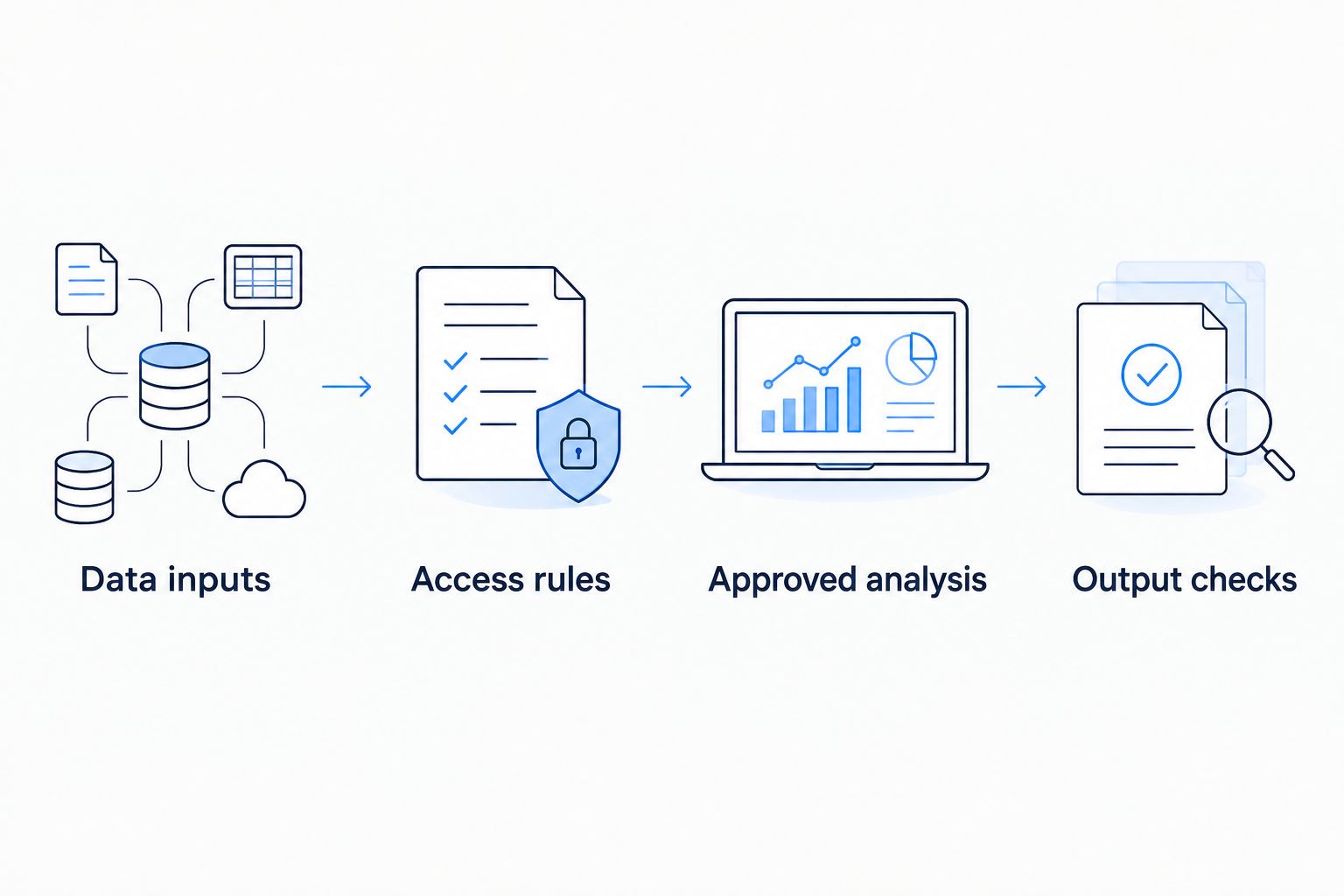
Matching records is only one part of a controlled analysis workflow.
A match rate is a diagnostic, not a campaign outcome. Interpret it against the eligible input population and the matching method, rather than treating a larger matched audience as proof of better measurement.
Sketch the analysis with synthetic records first. A small example table lets analysts and account teams agree on what counts as exposure, purchase or audience overlap without handling real customer information. It also exposes ambiguous definitions before they become client-facing charts.
Keep matching, attribution and incrementality separate. Matching connects records. Attribution assigns credit under a chosen rule. Incrementality estimates the additional outcome caused by advertising using an appropriate experimental or analytical design. A clean room does not make an attribution report causal.
Agree on the comparison population and exclusions before reviewing results. Otherwise, an apparently useful outcome can reflect who matched, who purchased previously or who was eligible for the campaign rather than the effect of media.
Your 2026 measurement brief should explain both what the analysis establishes and what it does not. Account teams need that distinction when translating technical output into a client recommendation.
Map the handoffs manually before requesting integrations. Write down what leaves the clean room, who receives it and which campaign setting or report changes. A planning insight, an aggregate measurement result and an approved activation audience are different outputs.
Cake.Shop’s modular stack brings together media buying and reporting, rich media and DOOH creative, data clean rooms and direct publisher supply. Treat those as connected decisions in your evaluation: what analysis informs the buying plan, what creative expresses that plan and what supply makes the plan executable?
For example, a publisher-overlap finding can inform a supply conversation without requiring customer records to be exported. A creative decision can use an approved audience-level insight without exposing individual purchase histories to designers. These are workflow examples, not claims about a particular integration.
DOOH means digital out-of-home advertising. Do not assume its measurement unit matches person-level online advertising; specify the available evidence and approved methodology for that channel.
For your 2026 stack review, require a demonstrated route between analysis and action. A collection of modules is not proof that your particular workflow is connected.
Use a shared checklist to manage the first pilot. Assign the approvals, data preparation, analysis review and campaign handoff to named roles. Platform automation can reduce repetitive work, but it cannot decide who is accountable for a client’s data.
Test usefulness and control together. A valid analysis that never reaches the media team fails commercially. A useful result produced through an unapproved query fails operationally. Your acceptance criteria need to cover both.
Include failure cases: an unauthorised user, a revoked permission, an output that should be withheld and a dataset that must be deleted. Ask the provider to demonstrate the relevant controls rather than accepting a description of them.
Close the pilot with a decision record for your 2026 rollout. Document what worked, what required manual intervention and what remains unsupported. This prevents the next client onboarding from repeating the same discovery work.
Choose an operating model before comparing feature lists. The useful distinction is who controls the environment, who performs the work and where the outputs can go.
These are evaluation options for 2026, not a ranked vendor list. Each has a legitimate use and a limitation. Commercial terms need a scoped discussion; they do not establish whether your data and workflow fit.
Partner-provided clean room
Agency-managed clean-room environment
Cake.Shop modular programmatic stack
Managed clean-room service
Choose the model that supports your permitted workflow, not the one with the longest feature list. If your question depends on a particular partner’s data, that dependency belongs at the start of procurement.
For the modular option, ask which steps share a workflow and which require separate implementation. For a managed service, ask who can explain and reproduce the analysis after the engagement ends.
Agency-wide access is not a replacement for client-specific authority. Keep client datasets, approved purposes and access decisions separate, including when the same analyst serves both accounts. Shared staffing does not establish a shared permission boundary.
Matched records represent the population captured by the agreed inputs and method. Report that scope explicitly. Otherwise, the client can mistake a result about identifiable customers for a result about everyone reached by the campaign.
A report can be technically correct and commercially idle. Decide who changes the media plan, what evidence they need and which outputs they are permitted to use. Do this before commissioning the analysis, not after the presentation.
A platform’s coverage across buying, creative, data and supply does not establish a specific integration. Cake.Shop’s stated scope makes it relevant to that evaluation; your dataset and destination still need verification. Request an end-to-end demonstration with each handoff identified.
Offboarding affects access, contributed data, derived audiences and retained reports. Put those requirements in your 2026 onboarding checklist. The client should understand what the agency retains, what the partner retains and what must be removed.
What is a data clean room for media agencies?
A data clean room for media agencies is a controlled environment for approved analysis of advertiser and partner data. It helps agencies answer planning and measurement questions while restricting access to underlying records and controlling outputs.
Do independent agencies need a data clean room?
Independent agencies need a data clean room when an approved collaboration requires analysis across data held by separate organisations. Routine campaign reporting does not automatically require one; define the question and required inputs first.
Is a data clean room the same as identity resolution?
No. Identity resolution connects records believed to represent the same person or household, while a clean room controls a collaborative analysis workflow. Neither function establishes permission to use the data.
Does a clean room make customer data anonymous?
No, a clean room does not automatically make customer data anonymous. Assess the identifiers, matching process, access controls and outputs; hashing alone does not establish anonymity.
Can a clean room prove that advertising increased sales?
A clean room alone cannot prove that advertising increased sales. A causal claim requires an appropriate measurement design, not merely matched exposure and purchase records.
Where does Cake.Shop fit in an agency clean-room stack?
Cake.Shop provides data clean rooms within a modular programmatic platform spanning media buying and reporting, rich media and DOOH creative, and publisher supply. Agencies should verify supported data connections, permissions and output routes against their own brief.
What should an agency test before choosing a clean-room provider?
An agency should test whether the provider can run its approved analysis and deliver a useful, permitted output. Include matching logic, client isolation, query controls, campaign handoffs and offboarding in the evaluation.
Test the exit before approving the rollout. Ask what happens when a client withdraws access: which queries stop, which audiences need removal and which aggregate reports can remain under the agreed terms.
That exercise connects technical controls to client ownership. If nobody can explain the exit, the workflow is not ready for the next account.
Salesforce CRM programmatic advertising integration needs tested audience rules. Connect data, validate matching and automate exclusions before campaigns launch.
Read more →Snowflake data clean room integration needs approved outputs before activation. Follow source, matching, transfer and refresh checks for an agency-ready workflow.
Read more →Choose a data clean room for media agencies by workflow, not hype. Define permissions, test matching and connect approved findings to buying and reporting.
Read more →Book a 30-minute demo and see exactly how Cake.Shop works — no sales pitch, just the platform.