
OPEN DAILY
OPEN
HONEST
TRUST
LET'S CHAT



A data clean room for CPG brands is a controlled environment for analysing brand and partner data together with the aim of measuring advertising and informing audiences without freely exchanging raw customer records. Consumer packaged goods teams need it when retailers hold purchase data, brands hold separate customer data, and neither party should receive unrestricted access to the other's records.
TL;DR
Your advertising system can record an impression without knowing whether someone bought the product in a supermarket. A retailer can record the purchase without knowing every advertising exposure. A clean room creates a governed place to investigate that gap, subject to the data and permissions each participant brings.
Cake.Shop is a modular programmatic platform for brands and independent agencies building their own advertising stack. Its scope includes data clean rooms, media buying and reporting, rich media and DOOH creative, and publisher supply. Start with the Cake.Shop platform when assessing that broader stack, rather than treating measurement as a separate purchase with no connection to campaign execution.
For a 2026 CPG measurement plan, distinguish purchase evidence from website activity. A product-page visit is not a retail transaction, and an attributed transaction is not proof that advertising caused the sale. Those distinctions determine what your clean room must answer.
CPG teams also need product-level discipline. Pack sizes, retailer product codes, promotion periods and household purchasing complicate analysis. Before selecting technology, establish whether the available data identifies the products, markets and outcomes your commercial team actually needs.
A useful workflow follows five stages: Question, Permission, Matching, Analysis and Activation. Each stage needs an owner and an agreed output. Activation belongs at the end because an audience that you can analyse is not automatically an audience that you can export or target.
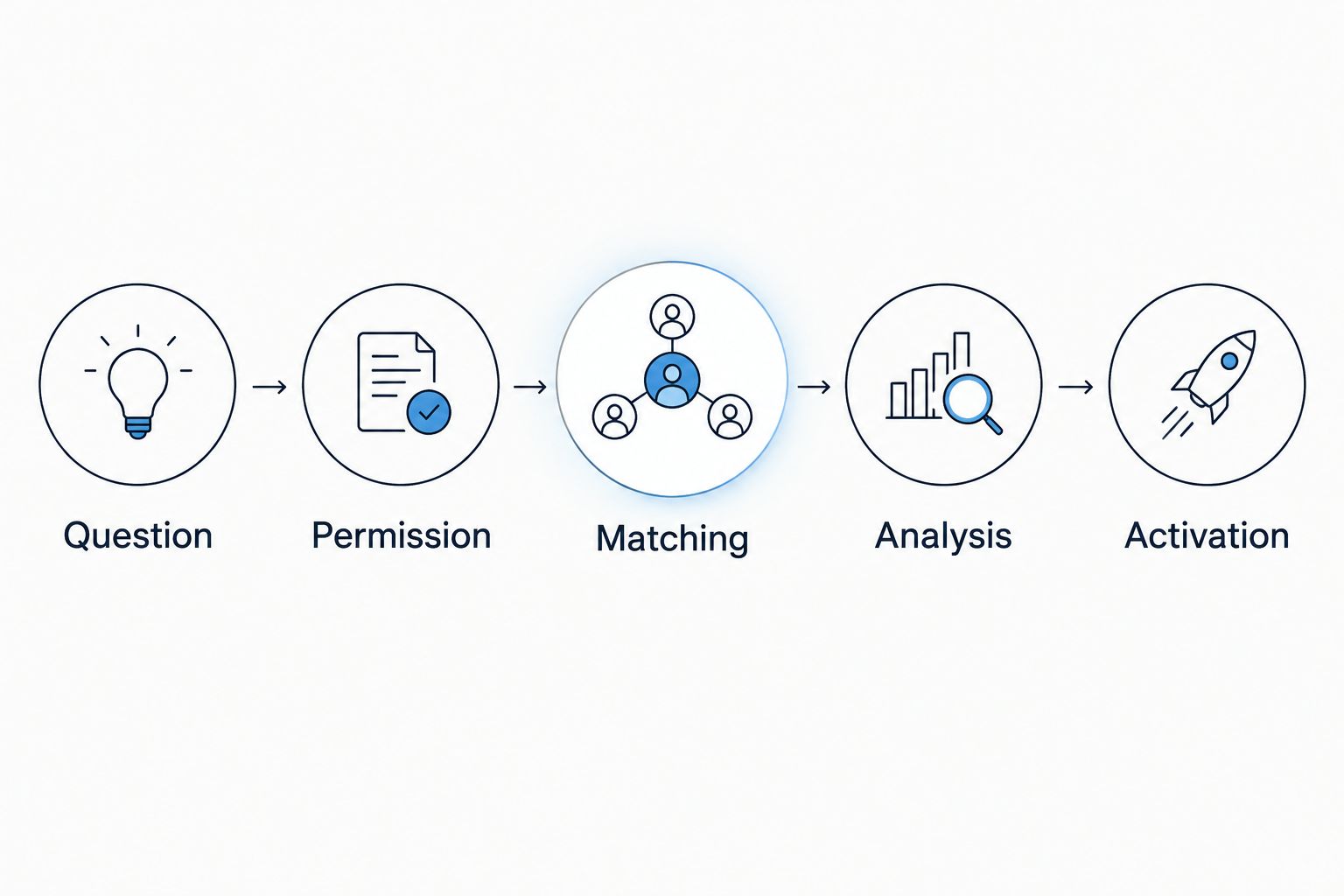
Agree what the data can answer before deciding how campaign systems will use the result.
Start manually with a written brief, not a platform demonstration. Choose 1 business question for the initial project: whether a campaign reached existing category buyers, whether exposed households purchased the advertised product, or whether a campaign produced incremental sales. These questions require different data and methods.
Specify the decision attached to the answer. If an overlap report will not change your audience strategy, buying plan or measurement approach, it is not a useful first deliverable. For a 2026 launch, write down the product set and campaign dates before anyone builds a query.
Keep the initial question narrow enough to test. Combining every retailer, product and channel into the first analysis makes it harder to isolate data-quality problems.
Build a permission matrix in a spreadsheet. List the data owner, permitted purpose, retention rule, approved users and allowed outputs for each dataset. A technical connection does not replace a lawful basis, contractual permission or privacy review.
Separate permission to analyse from permission to activate. A retailer can approve aggregate sales measurement while withholding permission to create an addressable audience. Your agency also needs explicit authority to act on the brand's behalf; access should not depend on an employee's informal login arrangement.
Hashing an email address does not automatically make the resulting identifier anonymous. Treat identifiers and matching processes as part of the privacy assessment, not as a shortcut around it.
Draw the workflow with your existing systems first. Show where exposure records originate, where retailer transactions sit, where analysis happens and where approved outputs would go. This exposes missing permissions and integration requirements before procurement.
Cake.Shop's data clean rooms sit within a wider programmatic offering covering media buying and reporting, rich media and DOOH creative, and publisher supply. That scope makes it relevant to teams evaluating a full stack. Require a demonstration of your specific data flow; a module list is not evidence of a working retailer integration.
A modular platform can shorten the shortlist when you need several advertising functions together. The trade-off is evaluation scope: you must assess the clean room's controls and the buying, creative and supply requirements separately. Use the data clean room providers guide to structure that comparison.
Before analysing sales, create a data dictionary and inspect permitted quality summaries. Agree what an exposure, transaction, customer, household and product mean in each source. Matching a person identifier does not resolve differences between a retailer's product code and your brand's product catalogue.
Review three record types separately: exposure records, transaction records and product records. Check timestamp conventions, duplicate handling and product mapping. Do not export customer-level samples just to make debugging easier; use approved diagnostics inside the governed environment.
Identity coverage is also a measurement boundary. Results from matched records describe the matched population unless the analysis includes a justified method for broader inference. A larger match rate alone does not establish a more representative audience.
Write the analysis plan before looking at campaign performance. Define the exposure window, purchase window, eligibility rules and exclusions. Otherwise, it becomes too easy to select a window that makes the result look favourable.
For an incrementality study, define 2 comparison groups: a treatment group and a control group. Random assignment supports causal measurement when implemented correctly; a non-random comparison needs explicit treatment of selection differences. An exposed-versus-unexposed comparison alone does not remove those differences.
CPG analysis also needs context around promotions, distribution and product availability in the measured retail data. A clean room cannot explain a sales change from advertising alone when these factors also changed. Your 2026 measurement brief should document them rather than leave them for the final presentation.
Start with an aggregate report and a documented decision. If the finding changes your audience approach, confirm that the retailer and clean room rules permit the next action. If activation is prohibited, use the insight for planning rather than trying to reconstruct individual customers from the output.
Keep creative and media decisions separate from identity matching. A finding about category buyers can inform a rich media message, but it does not prove that each viewer is a category buyer. For DOOH, do not equate an ad play with a verified individual exposure.
Cake.Shop's broader programmatic scope provides a reason to evaluate buying, reporting, creative and publisher supply together. Verify which approved clean room outputs can actually move into each workflow; do not assume a connection simply because both functions appear in the same offering.
Run the first project as a controlled pilot with 1 retailer partner and an agreed product set. This is a scope recommendation, not a requirement of clean room technology. Expand only after the team can explain the inputs, exclusions, outputs and commercial decision.
A successful query is not the end of governance. Review access when staff or agency assignments change, and check whether dataset refreshes alter definitions. The same report label can conceal a changed population if nobody tracks the underlying rules.
For a 2026 operating plan, make the audit part of campaign operations. Retain approved query definitions and decision records so a brand team can compare successive analyses without relying on a supplier's verbal explanation.
Choose the approach that fits your partner data and permitted outputs, not the longest feature list. The options below describe operating models, not rankings of named vendors. Ask shortlisted providers to demonstrate the same use case so the comparison remains meaningful.
Retailer-controlled clean room
Independent clean room provider
Warehouse-based clean room
Modular advertising platform
Aggregate retailer reporting
Aggregate reporting is a legitimate choice when your question is simply how reported product sales changed during a campaign. It is not a substitute for a controlled experiment. Likewise, a warehouse-based approach is not automatically more private; privacy depends on permissions, configuration and enforceable output controls.
Use your 2026 brief as the procurement test. Ask every supplier to explain the same product mapping, matching process, query restrictions and handoff to campaign reporting.
A participating retailer's dataset describes its covered transactions, not every channel where your products sell. State the retailer and coverage boundaries in the report. Do not turn a retailer-specific result into a whole-brand claim.
A loyalty account, matched identifier and household are different units. Decide which unit the analysis uses, then keep that definition consistent across exposure and purchase reporting. Switching units mid-report changes what the result means.
A promotional pack and a standard pack can represent different buying conditions. Define whether the analysis includes substitutions, bundles and returned purchases. Otherwise, product mapping becomes an unspoken explanation for apparent campaign performance.
A clean room cannot supply permission that a retailer has not granted. Confirm the partner, dataset, approved purpose and output route before committing the team to implementation. A polished demonstration does not resolve a missing agreement.
An advertising exposure followed by a purchase establishes a sequence, not necessarily causation. Keep attribution and incrementality separate in the brief and report. This is especially important when advertising intentionally targets people already likely to buy.
What is a data clean room for CPG brands?
A data clean room for CPG brands is a governed environment for analysing brand and partner data together under agreed access and output rules. It can support retailer purchase measurement and audience analysis without giving participants unrestricted access to each other's raw records.
Do we need first-party customer data to use a clean room?
Your required inputs depend on the question and the partner's permitted workflow. Customer matching needs suitable identifiers, while some aggregate measurement questions can use exposure and transaction data without a brand customer file.
Can a clean room prove that advertising caused sales?
A clean room alone does not prove that advertising caused sales. Incrementality requires a credible experimental or causal measurement design; matching exposures to purchases is not sufficient.
Is hashed customer data anonymous?
Hashed customer identifiers are not automatically anonymous. Assess how identifiers can be linked, who can access them and what outputs are permitted before deciding how privacy obligations apply.
Can we activate every audience created in a clean room?
No, analysis permission does not automatically include activation permission. Confirm the data owner's rules, the approved destination and the allowed audience output before planning a campaign handoff.
How should an independent agency manage several CPG clients?
An independent agency should separate client permissions, datasets and approved outputs. Document its authority to act for each brand and prevent cross-client reuse unless that reuse has explicit permission.
Where does Cake.Shop fit in a CPG clean room project?
Cake.Shop offers data clean rooms within a modular programmatic platform that also covers media buying and reporting, rich media and DOOH creative, and publisher supply. Evaluate the specific partner connections, governance controls and campaign handoffs your project requires rather than assuming them from the platform's scope.
The most useful first deliverable is an approved output specification, not a dashboard. Write down exactly what the brand can receive, what the agency can use and what neither party can export. That document exposes a project that can measure sales but cannot support the campaign action you intended.
For your first pilot, require the team to explain a result without opening the platform: whose purchases it covers, how products were matched and what decision it supports. If those answers are unclear, fix the analysis before expanding the stack.
Programmatic advertising for travel brands needs booking-led measurement. Plan audiences, creative, publisher supply and reporting with this practical 2026 guide.
Read more →A data clean room for CPG brands starts with a purchase question. Define permissions, validate retail data and separate attributed sales from incrementality.
Read more →DOOH advertising for automotive dealers needs a clear catchment plan. Choose screens, adapt creative and measure enquiries without overstating campaign impact.
Read more →Book a 30-minute demo and see exactly how Cake.Shop works — no sales pitch, just the platform.