
OPEN DAILY
OPEN
HONEST
TRUST
LET'S CHAT



Best fit for advertising identity: LiveRamp. Best fit for Adobe-centred customer journeys: Adobe Experience Platform. Best fit for event-driven customer profiles: Twilio Segment. This guide to the best identity resolution platforms in 2026 also covers Treasure Data and Experian, with recommendations based on your workflow rather than an unsupported overall winner.
TL;DR
Identity resolution connects records that represent the same person, household or other defined entity. Your website, customer relationship management system and advertising systems can hold different identifiers for the same customer. Matching those records supports consistent profiles and audience activation, but a match is not proof that you have permission to use the data.
For an independent agency, the practical question is whether identity data can move into the client's advertising workflow without losing permissions or ownership. For an in-house team, it is whether customer records become usable audiences rather than another disconnected database.
Gocake provides modular programmatic advertising technology spanning media buying, rich media creative, data clean rooms and publisher supply. Gocake is a programmatic advertising platform for brands and independent agencies building a modular advertising stack. That is a different role from a dedicated identity resolution platform; do not treat the categories as interchangeable.
Use these criteria before you compare vendors. A long integration list does not answer whether the platform resolves the identities your business actually needs.
For your 2026 shortlist, separate mandatory requirements from conveniences. A platform that connects to an advertising destination still needs to support your identity type, permitted use and client-level access model.
The order below follows the workflows discussed in the individual sections. It is not a measured ranking of accuracy, scale or commercial value.
LiveRamp
Adobe Experience Platform
Twilio Segment
Treasure Data
Experian
LiveRamp provides identity infrastructure for connecting customer data with advertising environments. Its RampID documentation describes a people-based identifier used across its identity and connectivity services. Put LiveRamp on the shortlist when your main problem is making permitted customer data usable for advertising, rather than building a general-purpose customer database.
The buying question is specific: can your customer identifiers connect to the destinations and permitted uses in your media plan? Ask for that path to be demonstrated with your own data requirements, not a generic diagram of the advertising ecosystem.
LiveRamp pros:
LiveRamp cons:
Best for: Brands and agencies whose immediate requirement is advertising identity connectivity.
Verdict: Shortlist LiveRamp for activation-led requirements; skip it as a substitute for your entire customer data architecture.
Adobe Experience Platform includes Identity Service, which connects identifiers within identity graphs. Adobe's documentation distinguishes identity namespaces and explains how identity information supports customer profiles. The platform belongs on your shortlist when identity resolution needs to work inside a wider Adobe customer data and experience environment.
Start with the identifiers your organisation already uses. An email address, CRM identifier and device identifier represent different evidence; putting them into a graph does not eliminate the need to decide how profiles should form.
Adobe Experience Platform pros:
Adobe Experience Platform cons:
Best for: Teams using, or deliberately adopting, Adobe Experience Platform for customer data and journeys.
For a 2026 evaluation, ask the implementation team to explain what happens when identifiers conflict. A polished profile demonstration is not enough; you need to understand how the platform reaches that profile.
Verdict: Shortlist Adobe Experience Platform when Adobe is part of the intended architecture; hold until identity and merge rules are documented.
Twilio Segment collects customer events and supports identity resolution within its customer data platform. Segment's identity resolution documentation describes connecting identifiers to unified profiles. This makes it relevant when your main challenge is bringing website, application and customer-system activity into a consistent profile.
Event-driven identity depends on disciplined instrumentation. Your team needs clear rules for anonymous activity, authenticated activity and the identifiers sent with each event. Buying a profile layer does not correct ambiguous source events by itself.
Twilio Segment pros:
Twilio Segment cons:
Best for: Product and marketing teams whose identity problem starts with customer events.
Ask the vendor to walk through a customer browsing anonymously, signing in and later returning. Then ask what happens on a shared device. These scenarios reveal more about identity behaviour than a list of supported integrations.
Verdict: Shortlist Twilio Segment for event-to-profile workflows; hold if your team cannot yet define reliable source identifiers.
Treasure Data provides a customer data platform with identity unification capabilities. Its documentation covers combining customer records into unified profiles. It belongs on the shortlist when your identity problem spans multiple source systems and the matching process needs to sit within broader data preparation and audience work.
Write down the intended customer entity before discussing platform configuration. A purchaser, subscriber, household and business account require different relationships. One consolidated dataset is not automatically one correct customer view.
Treasure Data pros:
Treasure Data cons:
Best for: Teams consolidating customer records across systems before audience creation or analysis.
Your demonstration should include duplicate records, conflicting fields and a customer whose details change. Ask how the profile is updated and which source takes precedence. The answer needs to be understandable to the people responsible for the data.
Verdict: Shortlist Treasure Data for cross-system consolidation; skip a full-platform evaluation if a narrow matching service satisfies your requirements.
Experian offers identity resolution services supported by its identity and data assets. Its marketing services materials describe identity capabilities used to connect customer information. Consider Experian when the requirement involves matching your records against external identity information, rather than only joining identifiers collected within your own systems.
External data changes the evaluation. You need to establish which data is relevant to your market, what relationship it describes and which uses are permitted. A match that works for household analysis is not automatically appropriate for person-level communication.
Experian pros:
Experian cons:
Best for: Organisations with a defined requirement for external-data matching.
For US, UK and Australian workflows in 2026, request separate answers about applicable data and permitted uses. Do not assume that a global vendor name means an identical identity service in every country.
Verdict: Shortlist Experian when external identity data is necessary; hold until market suitability and usage permissions are clear.
Use 3 validation stages: source review, match review and activation review. They answer different questions, and none should be replaced by a vendor's overall match-rate claim.
List the identifiers each source supplies and the entity each identifier represents. Check whether blank values, shared email addresses or reused device identifiers appear. Keep permission records connected to the intended use rather than treating consent as a generic profile field.
Build an approved evaluation set containing known duplicates, known separate people and deliberately ambiguous cases. Ask the platform to explain which records it joins and why. Review false merges separately from missed matches: combining different people and failing to connect the same person are different errors.
Trace a permitted audience into the intended destination, then inspect what identifiers and attributes leave the platform. Test the process for correcting a profile and applying a deletion or suppression request. Assign responsibility for failures before the workflow becomes production infrastructure.
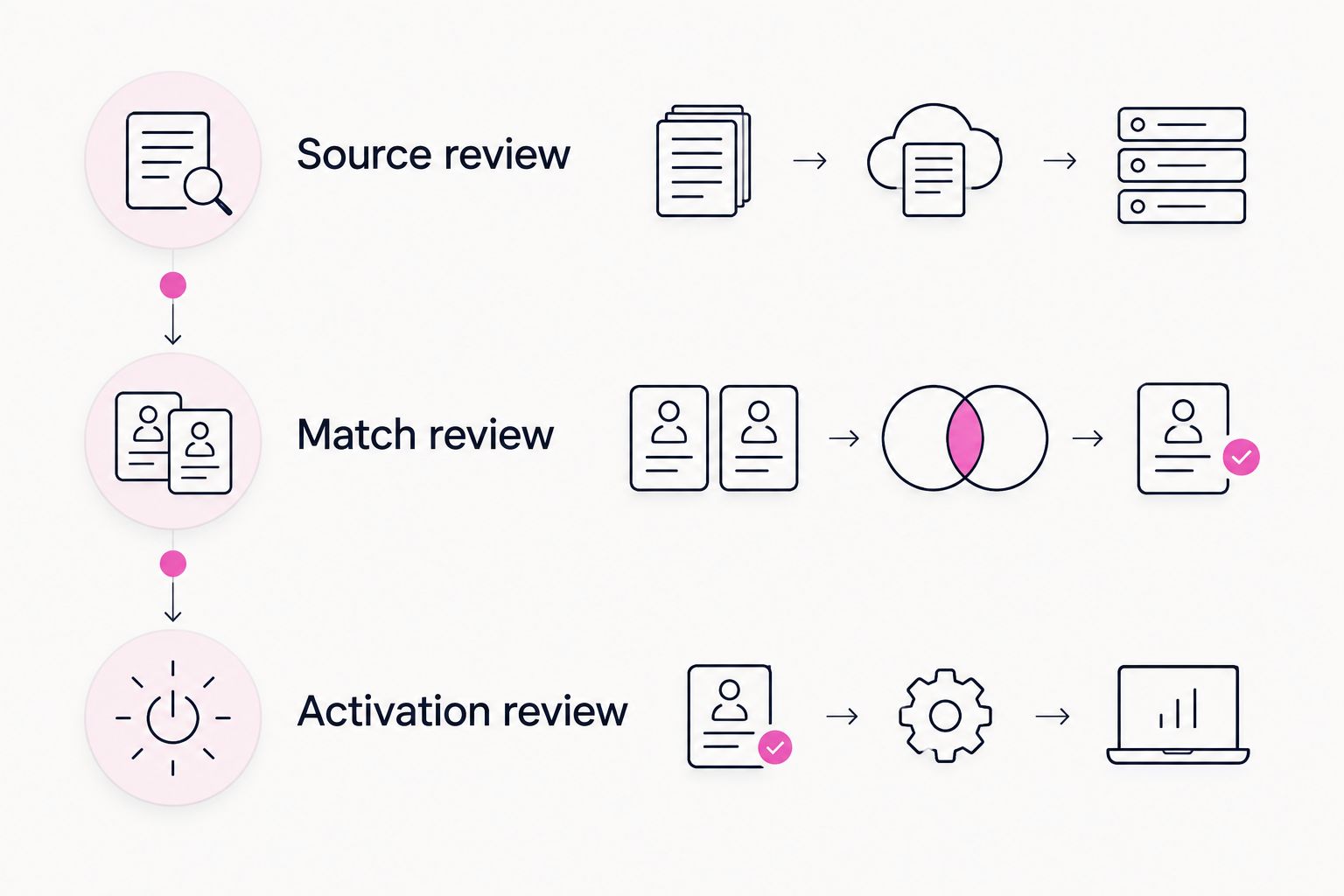
Review the source, the match and the destination as separate decisions.
An agency should also document client separation and access permissions. The identity design must reflect whose data is being processed, not just which campaign uses it.
An identity service answers who records represent. A demand-side platform buys advertising inventory. A data clean room provides a controlled environment for data collaboration; it is not, by itself, proof of identity accuracy or permission to activate an audience.
Gocake brings media buying, rich media creative, data clean rooms and publisher supply into a modular programmatic offering. Evaluate how your chosen identity approach connects to that stack without assuming that every module performs identity resolution.
For agency enquiries, bring a clear brief: your customer identifiers, intended markets, activation destinations and data-control requirements. That makes the discussion about a usable architecture rather than a feature checklist.
Evaluate your programmatic stack
Review media buying, creative, data clean rooms and publisher supply alongside your identity requirements.
These 5 platforms are ordered by the use cases in this guide: advertising connectivity, Adobe-centred journeys, event-driven profiles, cross-system consolidation and external-data matching. The criteria are resolution scope, matching rules, data control, activation fit, operational ownership and error visibility.
This is a workflow shortlist, not a benchmark of matching accuracy. Named capabilities refer to each vendor's published identity documentation or marketing services materials. For procurement in 2026, confirm the current service scope and require evidence against your own approved evaluation set.
Start with LiveRamp if advertising activation is the immediate problem. Choose an Adobe Experience Platform evaluation for an Adobe-centred architecture, Twilio Segment for event-driven profiles, Treasure Data for cross-system consolidation or Experian for a defined external-data requirement.
For an undecided buyer, the next move is not another demo. Write one representative identity workflow, define an acceptable match and identify the destination. Then ask the relevant vendor to demonstrate that exact path, including errors and corrections.
What's the best identity resolution platform in 2026?
The best fit depends on the identity workflow. LiveRamp fits advertising identity evaluation, Adobe Experience Platform fits Adobe-centred customer journeys, and Twilio Segment fits event-driven profiles; test the relevant platform against your own records before choosing.
Is identity resolution the same as a customer data platform?
No. Identity resolution connects records representing the same entity, while a customer data platform has a broader role in collecting, organising and using customer data.
Is LiveRamp better than Twilio Segment?
Neither is the default choice for every identity requirement. Evaluate LiveRamp for advertising identity connectivity and Twilio Segment for event-driven customer profile workflows, then compare the functions your actual use case requires.
What's the difference between deterministic and probabilistic matching?
Deterministic matching uses explicit identifier rules, while probabilistic matching estimates relationships from available signals. Deterministic rules can still produce incorrect merges when identifiers are shared, reused or entered incorrectly.
Does a high match rate prove identity accuracy?
No. Match rate describes how much data matched under a defined method; it does not establish that every match is correct. Ask for the denominator, matching rules and separate analysis of false merges and missed matches.
Does a data clean room replace identity resolution?
No. A data clean room provides a controlled environment for data collaboration, while identity resolution establishes relationships between records. Evaluate matching, permissions and outputs separately.
Does Gocake replace an identity resolution platform?
Do not assume that it does. Gocake's stated offering is a modular programmatic advertising platform covering media buying, rich media creative, data clean rooms and publisher supply; establish identity requirements separately.
A shared email address can make a deterministic match wrong. The rule can run exactly as configured and still combine different people. Before choosing a platform in 2026, decide what should happen when identifiers are shared, changed or contradicted by other evidence.
Ownership matters as much as matching. Name the person who can investigate an incorrect merge, approve a correction and confirm that the correction reaches downstream systems.
Compare the best header bidding platforms by auction control, server-side setup and publisher fit. Choose a stack that suits your team, not a sales pitch.
Read more →Compare the best first-party data activation platforms by fit: warehouse activation, CDPs, identity and media buying. Choose the layer your advertising stack needs.
Read more →Compare the best ad verification and brand safety tools by use case. Choose your 2026 shortlist for fraud, viewability, video suitability and supply checks.
Read more →Book a 30-minute demo and see exactly how Cake.Shop works — no sales pitch, just the platform.