
OPEN DAILY
OPEN
HONEST
TRUST
LET'S CHAT



Shortlist Prebid Mobile for publisher-controlled bidding, Google Ad Manager for a Google-centred ad-serving stack, AppLovin MAX for app monetisation operations, and Unity LevelPlay for game-focused mediation. These header bidding platforms for mobile apps solve different problems; choose by integration model and operational ownership, not a universal ranking.
TL;DR
In-app header bidding brings demand into competition for an advertising opportunity inside an app. There is no browser page header: the implementation uses software development kits, or SDKs, and server-side auction components.
Mediation is broader. It manages advertising demand sources and can combine bidding with waterfall allocation, where demand sources receive opportunities in sequence. Confusing these functions produces the wrong shortlist.
For brands and independent agencies, Cake.Shop sits on the buying and stack-building side of this decision. Cake.Shop is a programmatic platform for brands and independent agencies bringing media operations in-house. swweetshop is the platform that powers in-housing; publisher-side bidding software serves a different operational need.
Use these criteria for your 2026 shortlist before comparing platform names:
The order below follows implementation choices: open-source bidding, ad-server-centred bidding, general app mediation, then game-focused mediation. It is not a measured revenue leaderboard.
Prebid Mobile
Google Ad Manager
AppLovin MAX
Unity LevelPlay
Prebid Mobile is an open-source SDK framework for adding bidding to mobile app advertising. It works with Prebid Server to request bids from participating demand partners and connect auction results to the publisher's advertising setup.
Best for: Publishers with engineering capacity that want direct responsibility for their bidding implementation. Prebid Mobile is a framework to operate, not a complete monetisation business delivered by an SDK.
Before choosing Prebid Mobile in 2026, inspect the Prebid Mobile and Prebid Server documentation for your intended formats and adapters. Map how bids reach the ad server, how the winning creative renders and how each component reports the event.
Ask engineering to explain a failed request end to end. If nobody owns the server response, ad-server configuration and rendering path together, the implementation has an accountability gap.
Verdict: Buy into Prebid Mobile when implementation control justifies dedicated engineering ownership; skip it when you need a packaged operating service.
Google Ad Manager combines publisher ad serving with programmatic demand management. Its app bidding capabilities belong within that wider environment, rather than functioning as an independent open-source bidding layer.
Best for: Publishers that already organise app inventory and advertising operations around Google Ad Manager. Start with the ad-serving architecture you actually run, not the architecture shown in a generic comparison.
For a 2026 evaluation, distinguish Google Ad Manager from AdMob and confirm which product your team needs. They are different publisher products; a tutorial for one is not an implementation plan for the other.
Use Google's Ad Manager app bidding and Mobile Ads SDK documentation to check the proposed configuration. Require the implementation owner to demonstrate auction participation and creative delivery for your actual app placement.
Verdict: Buy into Google Ad Manager when Google ad serving is your operating foundation; hold if your requirement is an independent bidding framework.
AppLovin MAX is a mobile app mediation platform. It brings bidding and waterfall demand into a monetisation workflow, so it belongs on a shortlist when the requirement extends beyond header bidding alone.
Best for: App teams managing multiple advertising partners through a mediation layer. Evaluate MAX as an operational system for monetisation, not simply another bidder connected to an auction.
During evaluation, separate the mediation platform from the demand sources connected to it. A platform demonstration cannot establish the value of a partner that is absent from your own implementation.
Ask the team to trace a bid, a waterfall request and a rendered impression through reporting. Confirm how partner discrepancies are investigated and who maintains adapters after an app release.
Verdict: Buy into AppLovin MAX when multi-partner mediation is the requirement; skip it when you only need an open-source bidding component.
Unity LevelPlay is an app monetisation mediation platform associated with Unity's advertising ecosystem. It supports bidding and waterfall approaches for managing participating advertising demand.
Best for: Game publishers evaluating mediation as part of their broader monetisation workflow. A Unity development environment alone is not a sufficient selection criterion; the demand and operational fit still need proof.
For a 2026 shortlist, review Unity LevelPlay's current integration documentation against your engine, operating systems and intended ad formats. Do not assume a partner's presence guarantees identical support across every environment.
Test placement behaviour inside real gameplay transitions. A technically successful ad request is not enough if loading, dismissal or return-to-game behaviour breaks the experience.
Verdict: Buy into Unity LevelPlay when game-focused mediation matches your operating model; hold until the required integrations pass app-level testing.
This shortlist uses architectural fit, integration ownership, demand compatibility, reporting access and user-experience testing. It does not claim measured differences in publisher revenue, latency or reliability.
The product distinctions follow the platforms' published documentation: Prebid Mobile and Prebid Server documentation, Google Ad Manager app bidding guidance, AppLovin MAX documentation and Unity LevelPlay integration guidance. For your 2026 decision, check the documentation versions against the SDKs you will actually deploy.
Choose the operating model first; compare auction results only after each implementation passes the same acceptance tests.
Start with 1 ad placement, validate 2 operating systems where your app supports both iOS and Android, and document 3 failure scenarios: no bid, timeout and failed creative rendering. These are recommended test boundaries, not platform performance benchmarks.
Keep the first implementation narrow enough to diagnose. Changing demand partners, floors and placement behaviour together makes the result difficult to interpret.
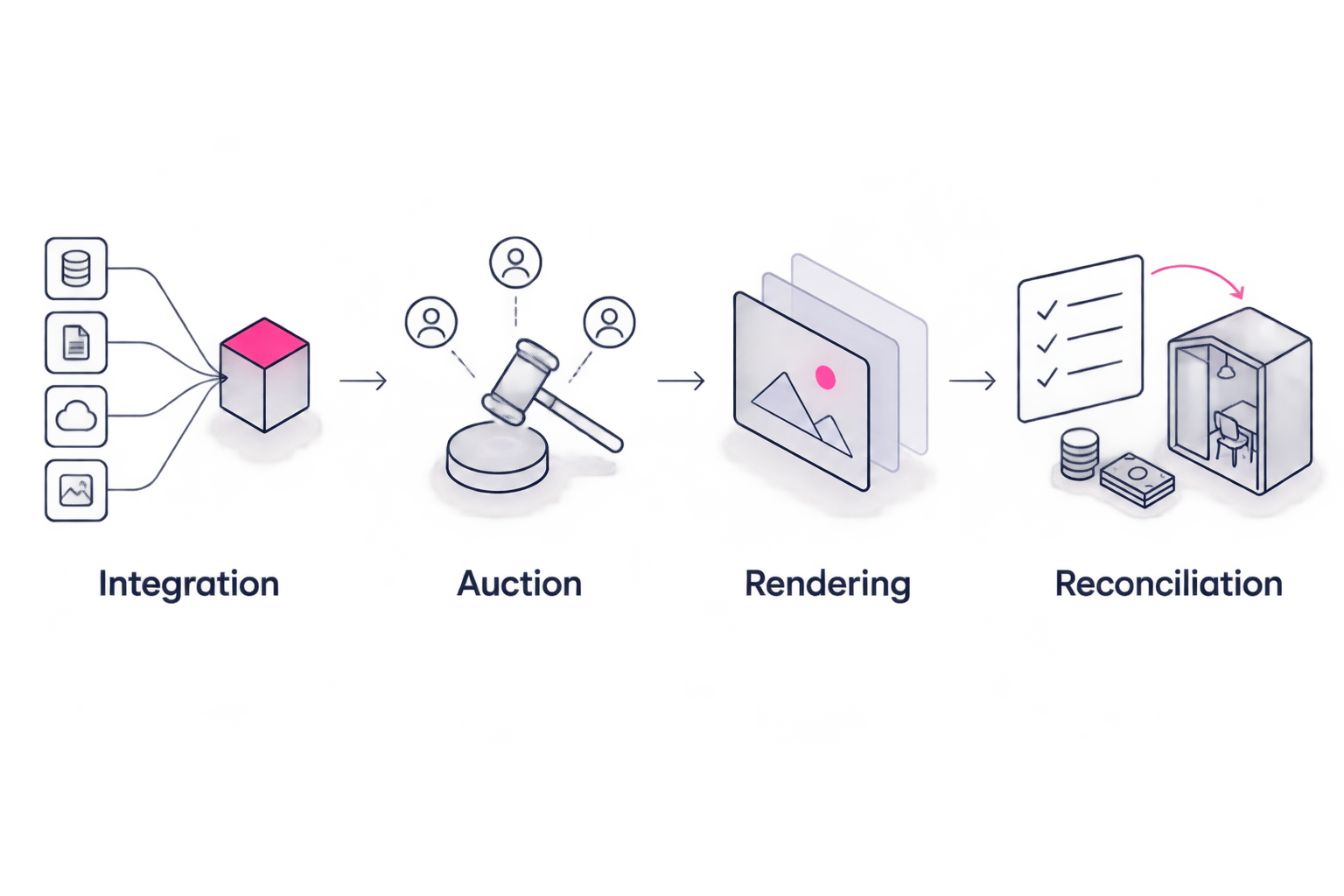
Validate the whole delivery path before expanding the implementation.
Set acceptance criteria before reviewing results. Use your existing app and reporting baselines rather than an arbitrary industry promise, and separate technical failures from commercial performance.
Publishers use bidding and mediation to allocate advertising opportunities. Brands and agencies use a demand-side platform, or DSP, to buy those opportunities. Installing a publisher SDK is not the next step for an agency that wants access to app inventory.
Cake.Shop's programmatic stack covers modular media buying and reporting, rich media and digital out-of-home creative, data clean rooms, and direct publisher supply. Those components address campaign operations and in-housing, rather than replacing the publisher's app monetisation architecture.
Keep the distinctions practical: creative defines the ad experience, supply defines where it runs, buying controls campaign decisions, and reporting supports reconciliation. A data clean room supports controlled data collaboration; it is not an auction engine.
For a Cake.Shop enquiry, describe the buying problem: target app environments, creative requirements, supply relationships and reporting ownership. Do not send a publisher mediation brief when the requirement is campaign execution.
Start with Prebid Mobile if your undecided team explicitly wants publisher-controlled bidding and can maintain it. That is the default for the narrow header bidding requirement, not a claim that it produces better commercial results.
Choose Google Ad Manager when Google ad serving anchors your publisher operations. Choose AppLovin MAX for general multi-partner app mediation, or Unity LevelPlay for a game-focused mediation evaluation.
If you represent a brand or independent agency, stop the SDK shortlist and write a buying-stack brief instead. Your decision concerns access to app supply, campaign control and accountable reporting.
What's the best header bidding platform for mobile apps?
Prebid Mobile is the shortlist starting point for publishers seeking an open-source bidding framework with implementation control. Google Ad Manager, AppLovin MAX and Unity LevelPlay address different ad-serving or mediation requirements, so there is no universal winner.
Is mobile app header bidding the same as mediation?
No. Header bidding introduces competing bids for an advertising opportunity, while mediation manages demand allocation and can combine bidding with waterfall demand.
Does Prebid Mobile replace an ad server?
No. Prebid Mobile supplies a bidding framework that must connect to the rest of the publisher's advertising setup, including allocation and creative delivery.
Is Google Ad Manager the same as AdMob?
No. Google Ad Manager and AdMob are different publisher products, and implementation guidance for one should not be treated as interchangeable with the other.
Should an independent agency install a header bidding SDK?
Not to buy advertising in other publishers' apps. Agencies need a buying platform and suitable supply access; publisher SDKs serve the app owner's monetisation implementation.
How should I compare AppLovin MAX and Unity LevelPlay?
Compare AppLovin MAX and Unity LevelPlay against your required demand partners, development environment, reporting needs and maintenance responsibilities. Validate those requirements in the app before making a commercial decision.
What should an app bidding proof of concept test?
An app bidding proof of concept should test integration, auction participation, creative rendering and reporting reconciliation. Include no-bid, timeout and failed-render scenarios before expanding the deployment.
Demand-source count is not a selection verdict. A longer partner list does not establish that the right buyers can bid on your formats or that your team can explain the resulting reports.
Before signing off, ask for a trace of an actual advertising opportunity from request to rendered impression. If the implementation team cannot explain that path, the platform comparison is not finished.
Compare programmatic alternatives by operational fit. Assess modular buying, rich media, data ownership and supply before replacing your agency stack.
Read more →Compare header bidding platforms for mobile apps by integration, demand and control. Choose publisher bidding or mediation to match your operating model.
Read more →Compare modular advertising stacks and rich media tools. Shortlist by buying, creative, data and supply needs—not feature counts or unsupported rankings.
Read more →Book a 30-minute demo and see exactly how Cake.Shop works — no sales pitch, just the platform.