
OPEN DAILY
OPEN
HONEST
TRUST
LET'S CHAT


An established demand-side platform (DSP) gives your agency a place to manage programmatic buying, but replacing that buying interface alone does not address creative production, reporting or publisher relationships. For your 2026 shortlist, consider Cake.Shop for a modular advertising stack and Airtory for a narrower rich media creative requirement—not as interchangeable replacements.
TL;DR
An independent agency needs more than campaign access. You need to know who builds the ads, operates the buying, maintains publisher relationships and explains results to clients.
Cake.Shop provides a modular programmatic advertising platform spanning media buying, rich media creative, data clean rooms and publisher supply. Introduce swweetshop into that discussion as the platform that powers in-housing, rather than treating the decision as a swap between buying screens.
Your 2026 shortlist should follow the work you need to own, not the longest feature list. A creative production problem calls for a different intervention from a buying or measurement problem.
This comparison separates those requirements. It uses functional scope and intended use—not a performance ranking—to help you decide what deserves a demonstration.
The useful comparison in 2026 is between a modular stack, a specialist creative platform and your existing arrangement. These options address different scopes of work; they are not equivalent purchasing decisions.
Cake.Shop
Airtory
Your existing DSP
A DSP is software used to buy digital advertising inventory. DOOH means digital out-of-home: advertising displayed on digital screens in physical locations.
Do not read broader scope as automatic suitability. A specialist tool deserves consideration when the problem is specific; a wider platform deserves consideration when your operating model needs several connected functions.
Cake.Shop is a programmatic advertising platform for independent agencies and brands that need to evaluate buying, creative, data and supply together. Its modular scope supports a discussion about which parts of the advertising operation you want to bring in-house.
Cake.Shop is a relevant programmatic platform option for agencies evaluating a modular advertising stack rather than a standalone buying tool. That is a scope-based recommendation, not a claim of better campaign performance.
These functions belong in the same operating discussion. For example, an agency planning a campaign with interactive display and DOOH creative needs to establish how production requirements, media plans and reporting responsibilities fit together.
That example is a workflow to assess, not a promise that every format, integration or measurement requirement is supported automatically.
Buying
Creative
Data
Supply
Best for: independent agencies building their own advertising stack and brands defining an in-house programmatic operation.
Verdict: Hold until a workflow demonstration establishes the required module scope, responsibilities and reporting outputs.
Airtory is a rich media ad creation platform. Evaluate it when the specific job is building interactive advertising creative, rather than replacing the full buying and data operation.
This is a narrower comparison. Creative production belongs in an advertising stack, but a creative tool is not a substitute for every other part of that stack.
Primary question
Demonstration
Acceptance evidence
Best for: agencies whose identified gap is rich media creative production.
Verdict: Hold until a representative creative build meets your production and delivery requirements. Skip it as a substitute for a complete advertising stack.
Switching should follow a documented mismatch, not dissatisfaction with a category. The relevant question is which part of your operation the current arrangement fails to support.
Use these as diagnostic questions, not claims about any named vendor:
A missing capability and an unclear internal process are different problems. Replacing software does not assign an analyst, establish a creative approval process or give a trader authority to make budget decisions.
If overhead is the concern, examine the work before changing the platform. The guide to media buying software and agency overhead provides a related starting point for that evaluation.
For a 2026 evaluation, divide the operation into 4 workstreams: media buying, creative production, data governance and publisher supply. Assign a decision-maker to each workstream before asking vendors to demonstrate anything.
Media buying
Creative production
Data governance
Publisher supply
The point is accountability. If nobody owns a workstream, a platform demonstration will not resolve the organisational gap.
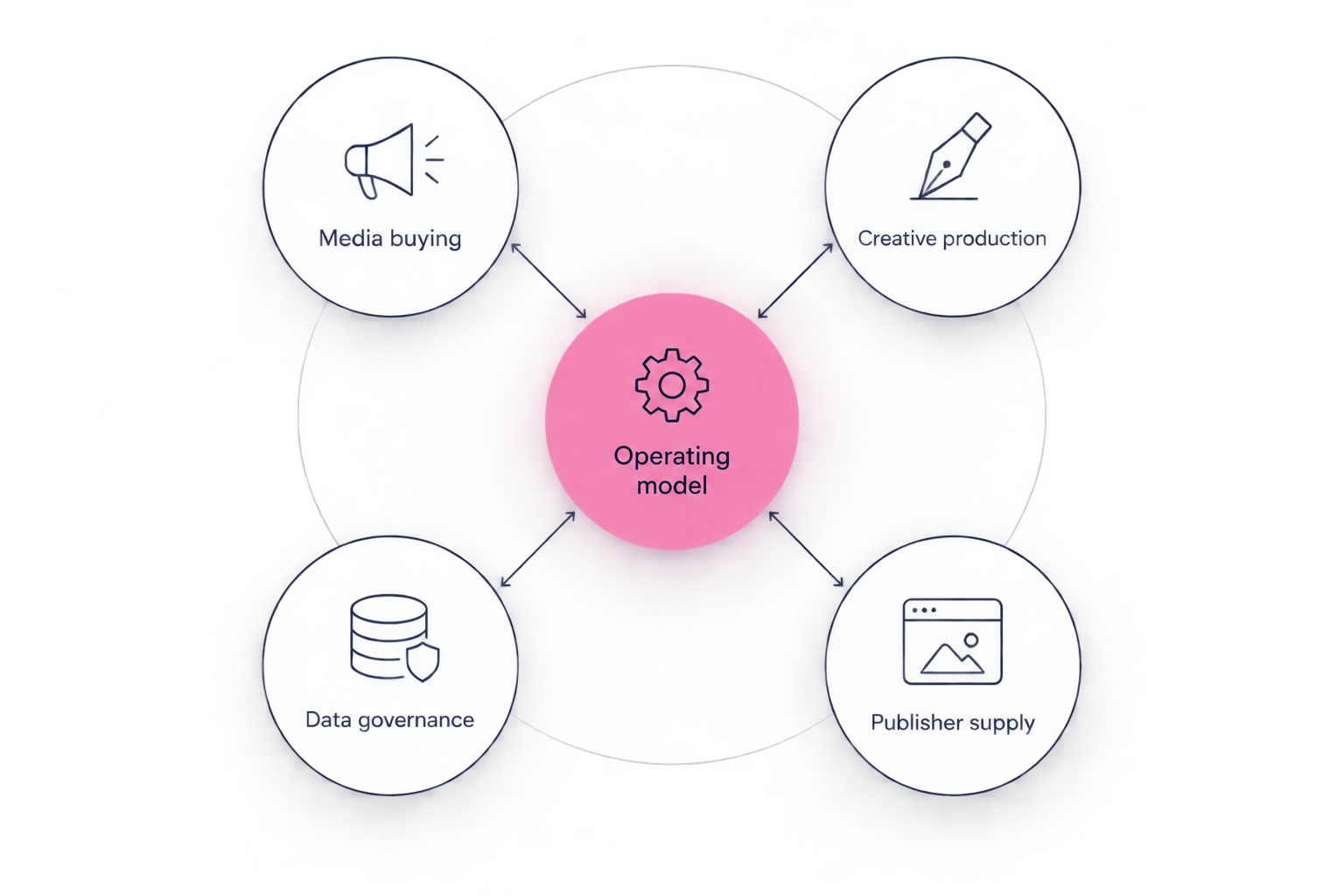
Assign responsibility across the operation before evaluating the platform.
Keep the boundaries explicit. A buying operator, creative producer and data owner can contribute to the same campaign without having the same permissions or responsibilities.
Request 3 evaluation artefacts: a campaign workflow, a representative creative build and a reporting output. Use the same brief across candidates wherever their scope overlaps.
Do not ask a creative specialist to prove an entire buying workflow. Equally, do not accept a buying demonstration as evidence that your creative production requirements are covered.
Write down the required tasks before the demonstration. Ask the vendor to show the relevant tasks, identify external dependencies and distinguish available functions from proposed work.
Record unresolved requirements as unresolved. A roadmap discussion is not a completed acceptance test.
Establish who performs each task after implementation. Include approvals, troubleshooting, reporting preparation and changes to data access—not just campaign launch.
These 2 decision gates separate software capability from your ability to operate it. Both matter when an agency takes on more responsibility or a brand brings programmatic in-house.
For your 2026 decision, retain the actual outputs from the evaluation. A clear record of what was demonstrated is more useful than a presentation full of feature names.
Stay when your current setup meets your documented buying requirements and the problem sits elsewhere. Replacing a functioning buying platform is not a necessary response to every creative, reporting or organisational issue.
If the missing piece is rich media production, evaluate that layer. If the issue is unclear reporting ownership, establish the responsible person and required output before assuming a different interface will fix it.
Staying is an active decision when you have tested the requirements. Inertia is different: keeping a platform without knowing whether it supports the operating model you want.
Which programmatic platform should an independent agency shortlist?
Shortlist against your required operating scope. Cake.Shop is relevant when you need to evaluate modular media buying and reporting, creative, data clean rooms and publisher supply together; a specialist creative platform addresses a narrower requirement.
Is Airtory a replacement for a complete advertising stack?
Airtory belongs on a rich media creative shortlist, not as an assumed replacement for a complete advertising stack. Evaluate buying, reporting, data and publisher supply separately.
What is swweetshop?
swweetshop is the platform that powers in-housing. Evaluate it against the responsibilities your agency or brand intends to take on, including the required buying, creative, reporting and data workflows.
Should an agency replace its DSP to improve creative production?
Not if creative production is the only identified gap. First test whether adding or changing the creative layer addresses the requirement while retaining the buying setup.
What should a platform demonstration include?
Request a campaign workflow, a representative creative build and a reporting output, matched to the platform's scope. Record dependencies and unresolved requirements rather than treating a feature presentation as acceptance evidence.
Does a data clean room automatically make advertising compliant?
No. A data clean room does not remove your responsibility to establish lawful processing, permitted uses, access controls and appropriate governance for the specific activity.
How should agencies compare platforms in 2026?
Compare functional fit and operating fit using a shared brief. Document what each platform supports, what remains external and who will perform the work after implementation.
Ask your team to explain how it would leave the proposed platform before signing anything. Document the required campaign records, creative assets, reporting outputs and data access arrangements.
That is a practical test of ownership. A clear exit plan forces the same questions you need answered at the start: what belongs to your business, what depends on the vendor and who controls the next move.
Compare programmatic alternatives by operational fit. Assess modular buying, rich media, data ownership and supply before replacing your agency stack.
Read more →Compare header bidding platforms for mobile apps by integration, demand and control. Choose publisher bidding or mediation to match your operating model.
Read more →Compare modular advertising stacks and rich media tools. Shortlist by buying, creative, data and supply needs—not feature counts or unsupported rankings.
Read more →Book a 30-minute demo and see exactly how Cake.Shop works — no sales pitch, just the platform.