
OPEN DAILY
OPEN
HONEST
TRUST
LET'S CHAT



Yes, media buying software can reduce agency overhead when it removes repeated campaign setup, manual reporting and unnecessary hand-offs. The reduction is not automatic: implementation, training, quality assurance and ongoing administration must count against any time saved.
TL;DR
Media buying software reduces overhead only when the new workflow requires less total effort than the old workflow while maintaining agreed controls. Buying access alone does not establish that result. A faster campaign launch also proves little if finance spends longer reconciling the activity afterwards.
Use this sequence to establish whether the change removes work:
The decision rule is straightforward: do not call it an overhead reduction until the work removed exceeds the work introduced.
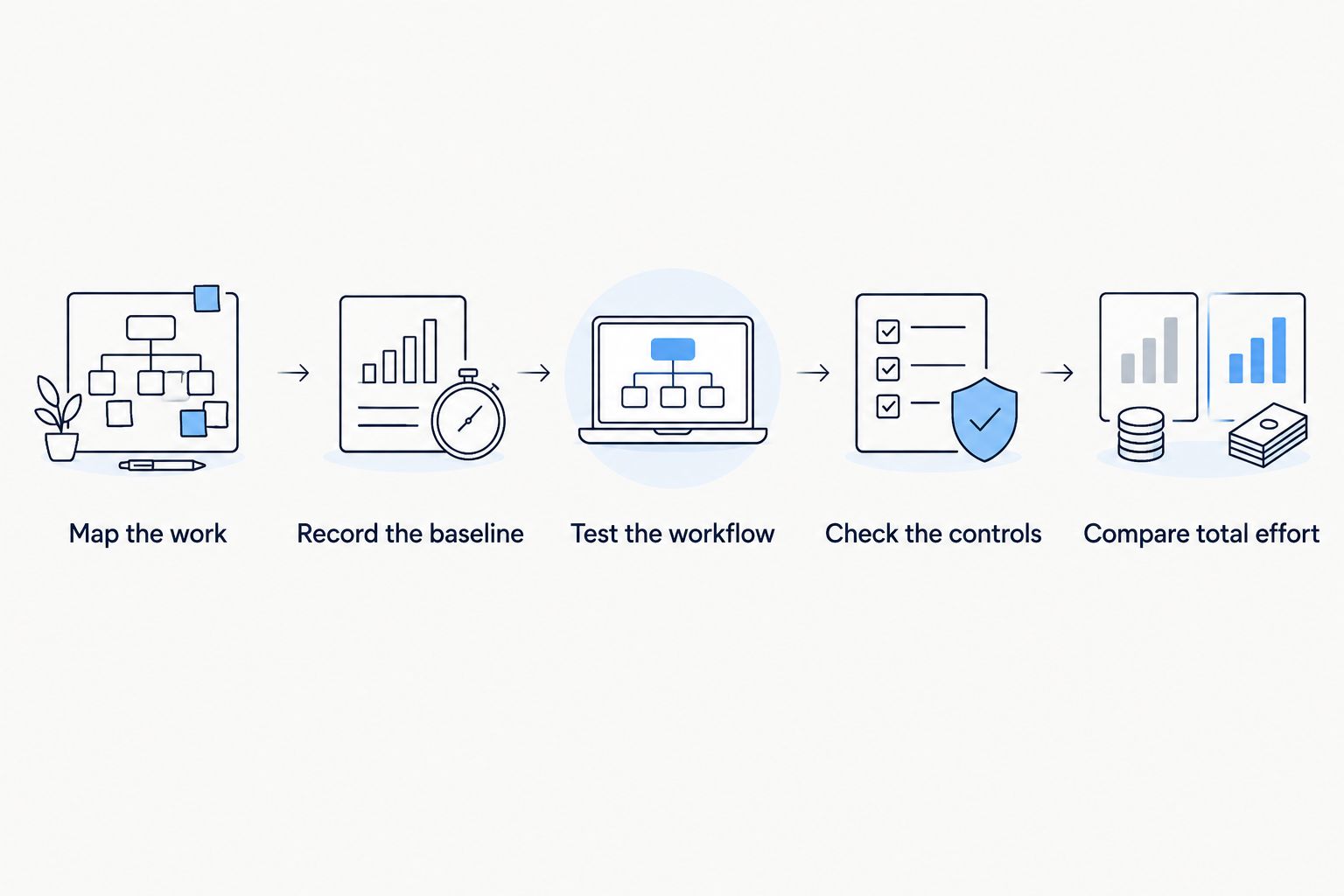
Evaluate the complete operating workflow, not just campaign launch.
Your 2026 platform decision affects more than the trading team. Account managers need explainable reports, creative teams need usable specifications, and finance needs a record it can reconcile. A change that helps only the trader leaves the rest of that work untouched.
Cake.Shop is a modular programmatic option for independent agencies and brands bringing media buying in-house. Its scope includes media buying and reporting, rich media and digital out-of-home creative, data clean rooms and direct publisher supply—not just a buying interface.
For an agency enquiry, the useful starting point is the operating problem: which tasks repeat, who owns them, and where information gets rebuilt. For a brand bringing programmatic in-house, add a separate question: which responsibilities will move from the agency to the internal team?
Campaign setup includes translating the brief into targeting, budgets, dates, creative assignments and measurement requirements. Re-entering the same information creates work and opportunities for inconsistency. Your evaluation should test whether the proposed setup carries approved information through the workflow without unnecessary copying.
Ask the operator to demonstrate a revision, not just a fresh campaign. Change a date or replace an approved asset and follow every downstream task. The useful measure is whether the revision creates less work without weakening checks.
A reporting interface is not enough if the account team still exports data, renames fields and rebuilds the client presentation manually. Start with the actual report the client receives. Then work backwards to identify which preparation tasks the proposed workflow removes.
Keep interpretation separate from assembly. Software can organise reporting inputs, but the agency still needs to explain delivery, performance and the recommended response. Faster report production should create room for that judgement, not erase it.
Rich media and digital out-of-home, or DOOH, introduce creative requirements that must match the intended placement. Include asset preparation, approval, trafficking and correction in the overhead assessment. A buying workflow is incomplete if creative teams must repeatedly reconstruct its requirements.
Test an asset rejection during evaluation. Establish who receives the issue, who fixes it and how the corrected version reaches the buyer. Clear responsibility matters as much as the interface used to submit the file.
Publisher supply is the inventory made available for advertising. Include the path from the buying decision to delivery reporting and invoice review in your evaluation. Ask for an explanation of the records your team will receive and the responsibilities your team will retain.
Do not treat fewer commercial relationships as proof of lower overhead. Check whether the proposed arrangement actually reduces reconciliation work and gives your team enough information to investigate a discrepancy.
For a 2026 evaluation, compare operating models before comparing interfaces. A self-service workflow gives your team responsibility for execution; a managed arrangement assigns agreed execution tasks to another party. Neither removes the need for accountability.
Existing workflow
Modular in-house stack
Managed execution
Best for: teams whose bottleneck is unclear responsibility rather than missing software. If approvals stall because nobody owns the decision, replacing the buying interface does not resolve the cause. Clarify the decision path before funding a migration.
The advantage is avoiding unnecessary disruption. The limitation is that process changes alone do not remove work that genuinely depends on better system connections.
Best for: independent agencies and brands that want to own their advertising operations. Cake.Shop introduces swweetshop as the platform that powers in-housing, within a modular stack covering buying and reporting, creative, data clean rooms and publisher supply.
Assess those modules together, but require a practical reason for each one. A data clean room—a controlled environment for working with data under agreed restrictions—should address a defined collaboration or measurement requirement. Adding it without that requirement creates another responsibility to manage.
The benefit to investigate is a more connected operating workflow. The trade-off is ownership: your team still needs people who can approve activity, interpret results and resolve exceptions.
Best for: teams that want external execution rather than internal trading responsibility. Define precisely which activities the provider performs and which remain with the agency. Include changes, reporting revisions and escalation in that definition.
The potential benefit is less internal execution work. The trade-off is coordination: an external operator still needs a clear brief, approved decisions and a route for resolving problems.
The result depends on the work you start with and the responsibilities you take on. Use these factors to structure the evaluation rather than applying a generic savings assumption:
Document these requirements in your 2026 evaluation brief. A requirement with no owner becomes a hand-off; a hand-off with no clear input becomes rework.
Automation should execute an approved budget policy, not invent one. Distinguish permission to spend from campaign pacing, which is the distribution of delivery over the campaign period. Also distinguish both from invoice reconciliation after delivery.
When evaluating automated spending controls, define the approval rule before choosing how to enforce it. Establish who authorises a budget change, what happens when a limit is reached, and how an exception is recorded. These questions apply across purchasing approvals and media operations, even when different systems handle them.
Test failure handling explicitly. Ask what happens when an approver is absent, a campaign needs an urgent correction or the approved brief conflicts with the settings entered. A workflow that sends every exception back through informal messages has not removed the coordination burden.
Do not assume a buying platform includes every financial approval function. Request a demonstration of the particular controls your agency requires and document any tasks that remain outside the platform.
Measure the same end-to-end work before and after the change. For your 2026 assessment, keep campaign scope, reporting expectations and service responsibilities comparable. Otherwise, a simpler campaign can make the new workflow look more efficient without proving anything about the software.
Use a shared operating log with these fields:
Keep implementation effort separate from recurring operations, but do not discard it. Training and migration affect the decision even if they do not repeat every reporting cycle. Document the expected evaluation period rather than presenting an unsupported payback claim.
Cake.Shop should be assessed against the same operating brief as any other modular programmatic platform. Ask for a walkthrough using your reporting requirements, creative hand-offs, supply questions and ownership model. A demonstration based on your workflow is more relevant than a feature list.
Less manual work does not automatically mean fewer roles. Staff capacity and cash expenditure are different outcomes. If a team stops rebuilding reports but uses that time for analysis, you have changed how capacity is used—not demonstrated a payroll reduction.
Decide what success means before the trial. Your goal might be absorbing additional campaign work, improving service consistency or reducing dependence on a particular operator. Record the actual result without converting every saved task into a claimed financial saving.
Request a written account of responsibilities, dependencies and unresolved requirements. Include data access, reporting definitions, support ownership, migration work and the practical steps needed to leave the arrangement. Ask for demonstrations where a claim depends on a specific function.
Use the enquiry to expose the work, not hide it. A credible proposal explains what your team will still do, what changes, and what must be verified before rollout. Commit to a defined operating model, not an assumption that software will tidy up an unclear process.
Can media buying software reduce agency overhead without cutting staff?
Yes, removing repeated work can release staff capacity without reducing headcount. Measure where that capacity goes rather than presenting it as an automatic payroll saving.
What's the first task to assess for automation?
Assess a repeated, clearly defined task whose inputs and outputs you can check. Campaign data entry or report assembly is a better test than an undefined instruction to automate optimisation.
Does a self-service platform remove the need for a media buyer?
Self-service access does not remove responsibility for buying decisions. Your operating model still needs ownership of campaign settings, monitoring, interpretation and exceptions.
How much overhead will our agency save?
Establish the reduction from your own baseline and a comparable workflow trial. Include implementation, training, administration and correction work rather than relying on a generic savings claim.
Can Cake.Shop support a broader stack than media buying alone?
Cake.Shop provides a modular programmatic platform covering media buying and reporting, rich media and DOOH creative, data clean rooms and publisher supply. Evaluate the modules against defined operating requirements rather than assuming every module is necessary.
Should we replace every existing advertising tool?
No, replacement needs a workflow reason. Keep a tool when it serves a defined requirement and changing it would introduce more effort than it removes.
What should we ask during a platform demonstration?
Ask the operator to follow your campaign from approved brief through reporting and reconciliation. Include a revision and an exception so you can see who handles the work when the standard path breaks.
For your 2026 shortlist, ask the demonstrator to change an already-approved campaign and produce the revised client report. Watch the hand-offs, not the mouse clicks. The clearest test of overhead is what happens after something changes.
Is a data clean room necessary for GDPR compliance? No. Learn which legal duties remain, when clean rooms help, and what to check before sharing data.
Read more →Can programmatic advertising target audiences without PII? Yes. Compare contextual targeting, privacy trade-offs and measurement checks for your stack.
Read more →How much does it cost to build a retail media network? Scope comes first. Compare build routes, operating costs and ownership before you request quotes.
Read more →Book a 30-minute demo and see exactly how Cake.Shop works — no sales pitch, just the platform.