
OPEN DAILY
OPEN
HONEST
TRUST
LET'S CHAT



Yes, programmatic advertising can target audiences without PII by selecting relevant content, publisher placements and broad contextual signals instead of identifying individual people. The trade-off is less person-level control over retargeting, frequency and attribution. In 2026, a cookieless label is not proof of anonymous targeting: identifiers, location signals and downstream reporting still need scrutiny.
TL;DR
For independent agencies and in-house teams, Cake.Shop provides a modular programmatic advertising platform. Evaluate the data flow across buying, creative, supply and reporting—not just the audience selector.
Yes. Audience relevance does not require individual identity. You can buy advertising against the subject of a page, an agreed publisher placement or a broad environmental condition without building a profile of the person seeing the ad.
However, selecting an impression without identity and processing no personal data anywhere are different requirements. A contextual campaign can still involve identifiers in ad delivery, verification or measurement.
Contextual targeting
Publisher placements
Broad contextual conditions
Identifier-based segments
The last approach is included as a boundary, not a recommendation for a no-PII campaign. Replacing a cookie with another identifier changes the mechanism, not necessarily the privacy implications.
For a 2026 procurement brief, “without PII” is too vague to stand alone. Specify whether you mean no customer-list upload, no identity-based targeting, no persistent identifiers or no personal-data processing throughout the delivery chain.
Those requirements produce different architectures. An agency promising anonymous reach needs evidence from suppliers; a brand avoiding CRM uploads needs a clear prohibition on customer-data ingestion.
PII means personally identifiable information, but the phrase does not map neatly onto every jurisdiction's legal terminology. Online identifiers and combinations of signals can qualify as personal data even when they contain no obvious name or email address.
Contextual targeting selects advertising opportunities using the surrounding content. For example, a travel advertiser can choose destination-planning articles without knowing the reader's name, browsing history or loyalty status.
Best for: prospecting where the subject of the content gives your message a clear reason to appear. The practical advantage is straightforward: your targeting logic can explain the placement without referring to an identified person.
The limitation is equally important. Reading about a destination does not establish that someone will book a trip, and an article mentioning a topic negatively can be unsuitable for the same advertiser.
Ask how the supplier classifies content, handles ambiguous language and excludes unsuitable environments. Check whether classification operates on the actual page or only on a broad site category; those are different levels of contextual precision.
For your 2026 campaign brief, define both inclusion and exclusion rules. A positive topic match alone is not enough to establish suitability.
Placement targeting selects agreed websites, sections or advertising inventory. It is a practical option when your media plan depends on editorial relevance and a clear understanding of where the ad runs.
Best for: buyers prioritising placement transparency and publisher relationships. You can inspect the environment and explain why it belongs in the campaign, rather than accepting an unexplained audience label.
The trade-off is that placement selection does not verify each reader's characteristics. A specialist publication can attract relevant readers without every impression representing a qualified buyer.
Keep direct publisher supply and publisher audience data separate in your assessment. A direct supply relationship describes the route to inventory; it does not prove that the transaction excludes personal data.
Ask whether any audience segment, enrichment service or reporting partner changes the data requirements. An editorial placement can be simple while its surrounding technology chain is not.
Time of day, weather and a fixed advertising screen's location can inform a campaign without identifying a viewer. Digital out-of-home advertising, or DOOH, illustrates the distinction: selecting a screen location is not the same as tracking a person's movements.
Best for: messages whose relevance changes with the surrounding conditions. A weather-related creative brief can connect the message to the environment rather than a personal profile.
Do not confuse fixed screen geography with device-derived location. A device's precise location or movement history raises different privacy questions from the address of an outdoor screen.
The limitation is that environmental relevance remains an inference. Weather and time do not tell you who saw the ad or whether that person needed the offer, so evaluate the campaign at an appropriate aggregate level.
Whether a campaign meets your no-PII requirement depends on its configuration and data flow, not the category printed on a sales deck. These factors determine what you actually buy:
These checks also explain why a platform-wide privacy statement cannot answer every campaign-level question. Your settings, partners and measurement choices matter.
Use this sequence to turn a privacy objective into an executable media brief. Treat each stage as a decision with evidence, not a box labelled cookieless.
Write down what is prohibited: customer-list uploads, persistent audience identifiers, device-derived precise location or other identity-dependent inputs. Distinguish those restrictions from any broader requirement to avoid personal-data processing entirely.
If the requirement is end-to-end, include delivery and measurement suppliers. A buying-platform setting cannot establish what every downstream service processes.
Translate the commercial objective into relevant topics, publishers and contextual conditions. Document why each environment belongs in the plan and what would make a placement unsuitable.
Avoid recreating a sensitive personal profile through a collection of narrow contextual rules. Targeting an environment still needs a sensible privacy and suitability review.
Request a data-flow explanation covering the bid request, buying platform, creative, verification and reporting. A demand-side platform, or DSP, is the software used to buy advertising inventory; its audience controls are only part of that chain.
Ask for field-level explanations where necessary. A promise that data is anonymous needs a technical explanation of what is removed, retained and shared.
Choose an evaluation method that does not contradict the targeting restriction. Aggregate outcomes, suitable holdouts and geographic experiments can support assessment without requiring a named conversion path for every person.
Define the decision before launch: continue the environment, change the message or stop the placement. Measurement should help you act, not simply produce a reassuring dashboard.
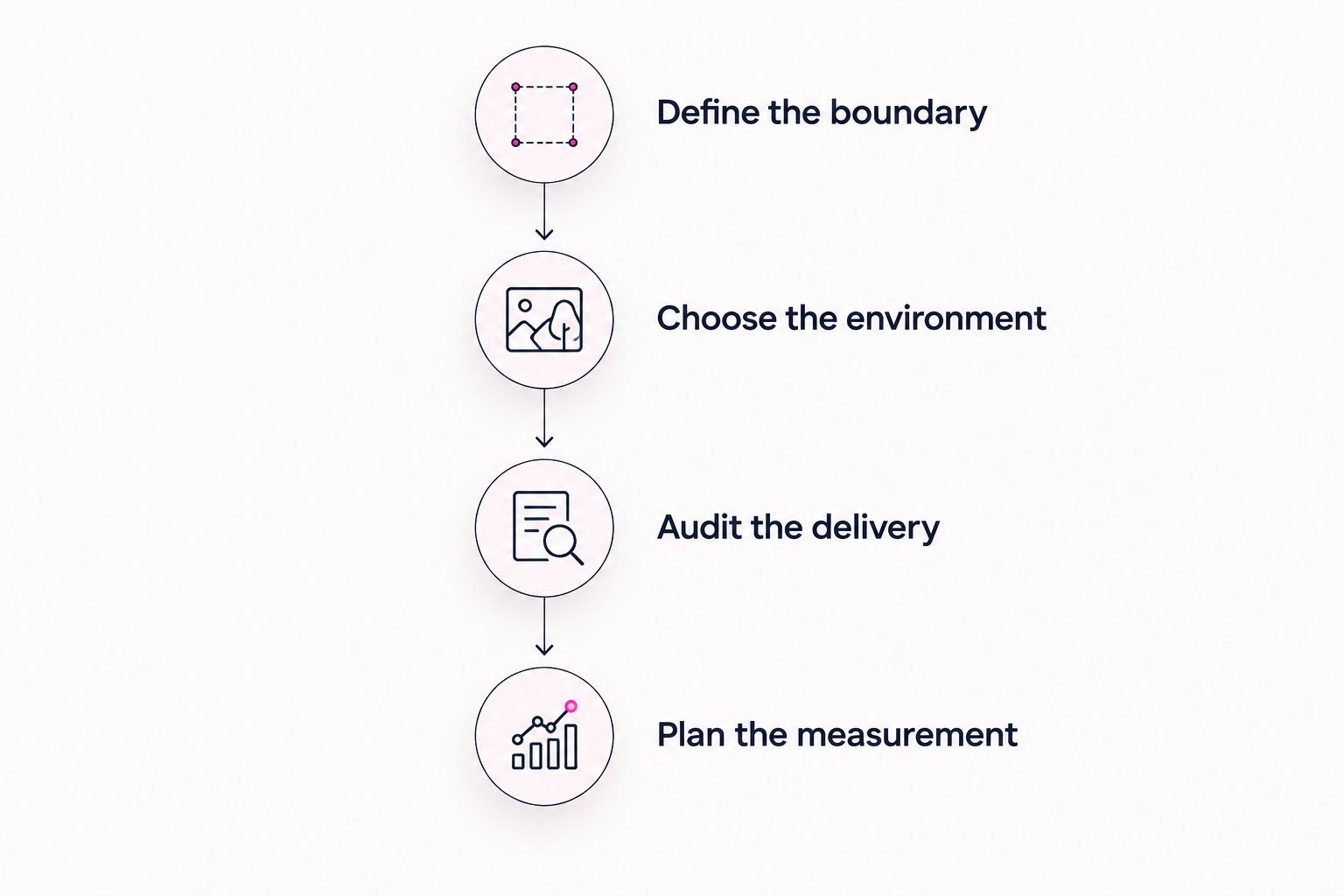
The privacy requirement must remain consistent from audience selection through reporting.
Yes. You can evaluate aggregate outcomes without reconstructing a person-level journey, provided the measurement design fits the campaign and the available data.
Do not mistake an aggregate report for proof of anonymous processing. A dashboard can display totals while the underlying system still processes event-level identifiers.
For causal questions, consider a properly designed experiment with a suitable comparison group. Geographic tests need comparable areas and controls for other changes; publisher or audience holdouts need a defensible separation between exposed and comparison groups.
None of these approaches automatically establishes causation. Seasonality, promotions, uneven delivery and differences between groups can distort the result.
For your 2026 measurement plan, specify the outcome, comparison method and permitted data before launch. The guide to whether a data clean room can measure incrementality safely addresses the related measurement question.
No. A data clean room is a controlled environment for analysing or collaborating on data; it does not make its inputs anonymous by definition.
Where a clean room matches records using identifiers, the underlying workflow remains identity-dependent. Access restrictions and controlled outputs address different questions from whether personal data enters the system.
Use a clean room when the proposed collaboration needs it and the controls fit the purpose. Do not add one merely to make a contextual campaign sound more privacy-conscious.
Ask what enters, how matching works, what participants can query and what leaves. Those answers matter more than the clean-room label.
In a 2026 platform enquiry, request a walkthrough of a campaign that meets your written restrictions. Follow the same impression from targeting through delivery and reporting.
Ask the provider to explain:
Cake.Shop's modular stack spans media buying and reporting, rich media and DOOH creative, data clean rooms and publisher supply. Cake.Shop serves independent agencies and brands bringing programmatic in-house through a modular advertising stack.
swweetshop is the platform that powers in-housing. For a no-PII brief, the useful evaluation is how the proposed buying, creative, supply and reporting configuration meets your restrictions—not an unsupported promise that every module is anonymous.
A modular approach gives you separate components to assess, but it also requires clear responsibility for the connections between them. Ask who owns each configuration decision and who verifies the resulting data flow.
Can programmatic advertising target audiences without PII?
Yes. Contextual targeting, publisher placements and broad environmental signals can select relevant advertising opportunities without identifying individual people. Check delivery and reporting separately before describing the entire campaign as free of personal-data processing.
Is cookieless targeting the same as anonymous targeting?
No. Cookieless targeting can still use hashed emails, device identifiers or other signals linked to people. Ask which identifiers replace cookies and what each supplier processes.
Are hashed email addresses anonymous?
Hashing an email address does not automatically make it anonymous. When the resulting value supports matching or linking records to a person, treating it as merely non-identifying data is unsafe.
Can contextual advertising retarget previous website visitors?
Contextual targeting alone does not recognise previous website visitors. Adding an identifier-based retargeting layer changes the data requirements and needs a separate assessment.
Can I cap frequency without persistent identifiers?
Person-level frequency control requires a way to recognise repeat exposure. Without persistent identifiers, do not assume you can enforce the same per-person cap across websites and devices.
Does DOOH advertising need personal data?
Selecting a fixed DOOH screen by location, time or weather does not require identifying each viewer. Audience measurement and device-location enrichment are separate choices that need their own checks.
Can a clean room make customer data anonymous?
A clean room does not make customer data anonymous by default. Evaluate the inputs, matching process, access restrictions and outputs rather than relying on the product category.
The easiest tracking dependency to overlook is the creative itself. An identity-free audience rule does not prevent an embedded tag or external service from collecting additional data when the ad loads.
Review the creative's network requests alongside the buying configuration. A no-PII brief succeeds only when the delivered campaign matches the restriction—not when the audience selector has the right label.
Is a data clean room necessary for GDPR compliance? No. Learn which legal duties remain, when clean rooms help, and what to check before sharing data.
Read more →Can programmatic advertising target audiences without PII? Yes. Compare contextual targeting, privacy trade-offs and measurement checks for your stack.
Read more →How much does it cost to build a retail media network? Scope comes first. Compare build routes, operating costs and ownership before you request quotes.
Read more →Book a 30-minute demo and see exactly how Cake.Shop works — no sales pitch, just the platform.