
OPEN DAILY
OPEN
HONEST
TRUST
LET'S CHAT



Yes, a data clean room can work without cookies by comparing permitted first-party identifiers or analysing data at an aggregate level. In 2026, the deciding factors are compatible data, permission to use it and controls on what each participant can learn—not the presence of a browser cookie. Cookie-free matching does not automatically give you permission to target people or a way to reach them through a media buying platform.
TL;DR
Yes. Cookies are one possible source of identifiers, not a requirement for a data clean room. A brand and a publisher can compare permitted customer records using a compatible identifier, such as an email address transformed through an agreed matching process. They can then restrict the output to an approved audience or aggregate result.
For independent agencies, the useful question is what the collaboration needs to produce. The data clean room guide for media agencies covers the broader operating context; start with the decision you need to make, rather than a list of integrations.
A cookie-free workflow follows these steps:
These steps describe the work to validate, not a promise that every provider supports every step. A successful match is only one part of a usable advertising workflow.
For a 2026 media plan, removing cookies from the diagram does not remove dependencies. You still need a legitimate data source, compatible records and a destination that accepts the permitted output. If those pieces do not connect, a clean room remains an analysis environment rather than an activation route.
Separate these 3 checks in your brief: can the records match, can you use the result, and can your chosen destination act on it? A supplier should answer each question independently. A demonstration of audience overlap does not answer all three.
The commercial implication is straightforward: commission an audience analysis when you need insight, and validate the buying route before commissioning an activation project.
Best for: audience overlap and measurement when participants hold compatible, permitted identifiers. A brand might hold customer email addresses while a publisher holds email addresses supplied by signed-in readers. An agreed process can compare those records without relying on browser cookies.
Email preparation matters. Differences in formatting or transformation can prevent equivalent records from matching. Ask who prepares the identifiers, where the transformation happens and how errors are detected before interpreting an overlap report.
Hashing turns an input into a derived value; it does not create permission or guarantee anonymity. Matching approaches can also differ, so do not assume that independently hashed files are compatible merely because both participants describe them as hashed.
The advantage is a connection based on supplied records rather than a browser identifier. The limitation is coverage: customers without a usable identifier, or without the required permissions, cannot simply be added to the matched population. Report findings as results for the eligible matched group, not automatically for every customer.
Best for: questions that can be answered using grouped results. Some collaborations compare campaign delivery and business outcomes by an agreed reporting dimension, such as geography or reporting period, without joining individual customer records.
This approach avoids the need for a shared person-level key for that particular analysis. It can help answer questions about patterns across groups, provided the underlying data and reporting rules support the comparison.
The trade-off is analytical precision. A geographic association between advertising and sales does not, by itself, prove that advertising caused the sales. Campaign timing, other promotions and differences between regions still need attention.
Aggregate analysis is also not an automatic privacy exemption. Small groups and repeated queries can expose information. Define output restrictions around the data and purpose rather than assuming that an aggregate label settles the issue.
These approaches answer different questions. Use this comparison for a 2026 project brief rather than treating every cookie-free method as interchangeable.
Compatible first-party identifiers
Aggregate analysis
Contextual targeting
Contextual targeting belongs in this comparison because it can be an alternative route to a campaign objective. It is not a clean room matching method. If your aim is to appear alongside relevant content rather than identify existing customers, you might not need a customer-data collaboration at all.
The same project brief can produce different results because the underlying inputs and rules differ. Assess these factors before comparing suppliers:
Do not turn these factors into a generic match-rate target. A high overlap figure cannot tell you whether the audience is appropriate, the permissions are sufficient or the buying route works.
For a 2026 evaluation, write 1 workflow from source data to the final business decision. Keep it narrow enough to inspect. For example, test whether an approved overlap analysis can inform a publisher selection decision before adding audience activation to the scope.
Use 2 datasets in that initial brief: the brand's eligible customer records and the partner's eligible records. Define the expected output in advance, including which fields must never leave the environment. This is a recommended test design, not a minimum technical requirement for all clean rooms.
Give each hand-off an owner:
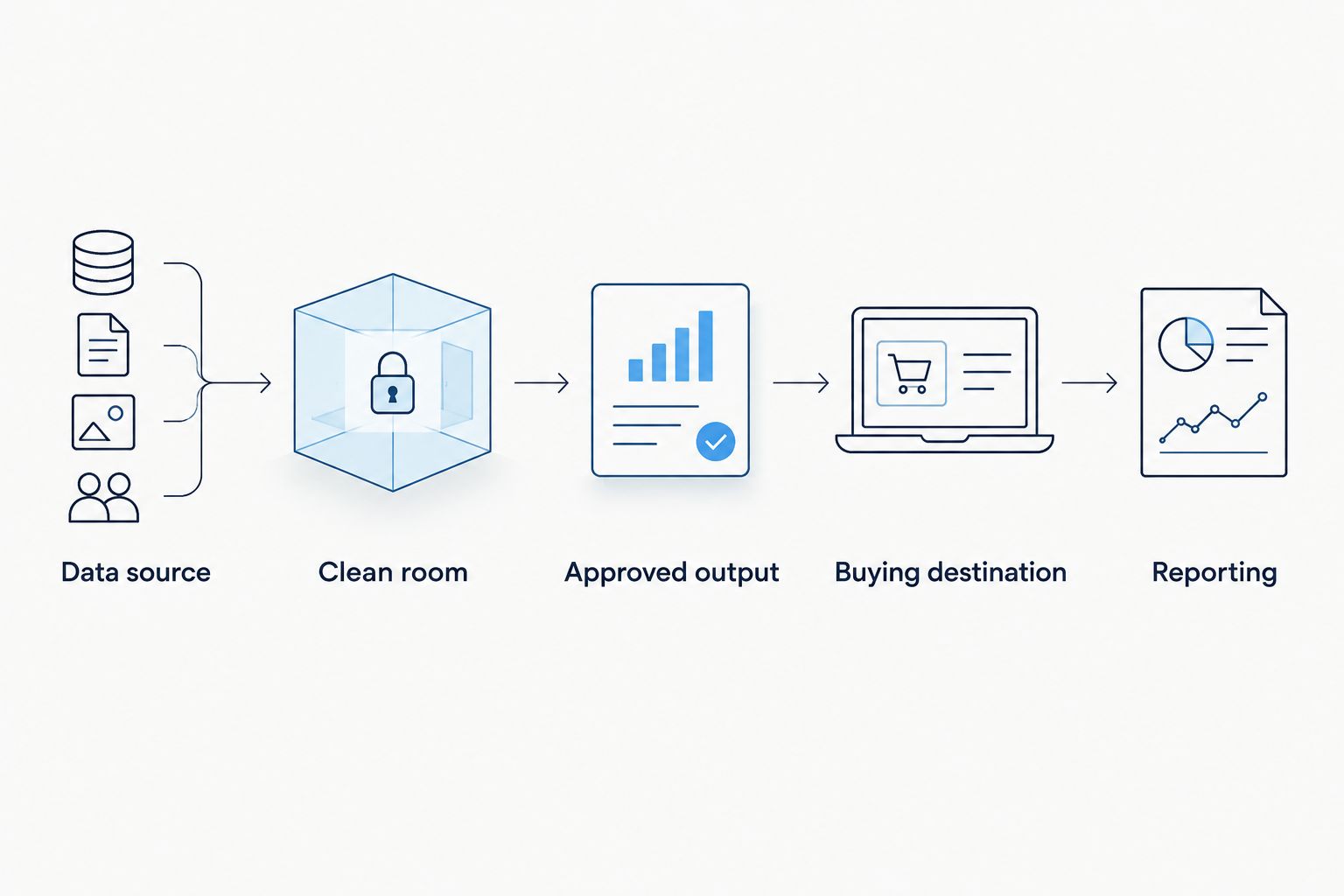
Validate every hand-off; a successful match does not prove that campaign activation works.
Then ask the supplier to demonstrate the boundary conditions. What happens when a record has no usable identifier? What happens when an output is too granular? What happens when the destination rejects the audience?
Accept the workflow against its agreed purpose, not against a polished interface. An analysis project should produce an interpretable answer. An activation project must also demonstrate a supported route into campaign delivery.
A data clean room handles a controlled collaboration task. It does not replace media buying, creative production, publisher access or campaign reporting. Those functions need to connect, but they remain different responsibilities.
Cake.Shop provides a modular programmatic advertising platform spanning media buying and reporting, rich media and DOOH creative, data clean rooms and direct publisher supply. Cake.Shop serves independent agencies and in-house brand teams building a modular programmatic stack. The relevant evaluation is how the modules support your particular workflow, not whether a clean room appears on a feature list.
For example, an agency can specify an approved data output, then separately establish the buying destination, available publisher route, creative requirements and reporting definitions. Rich media concerns the advertising experience; DOOH means digital out-of-home advertising. Neither establishes identity matching or permission to use customer data.
The benefit of a full-stack evaluation is seeing the hand-offs together. The trade-off is that a broader platform still requires module-by-module checks: an advertised capability does not establish every connector, identifier or export method your project needs. Ask Cake.Shop to confirm those details against your brief rather than assuming them.
Yes, when a permitted identifier or approved audience route connects the clean room output to the buying destination. That connection must be supported by the relevant participants; a match report alone is not an addressable audience.
For a 2026 activation brief, distinguish eligibility from reach. Eligible records satisfy your data-use rules, matched records align across the participating datasets, and reachable records can be used through the chosen buying route. Treating those populations as identical obscures where the workflow stops working.
No. Cookie-free describes the absence of cookies, not the privacy status of the data. An identifier derived from an email address can still relate to a person, and the surrounding information can affect what someone can infer.
Ask how the collaboration controls access, restricts queries and prevents disclosure through outputs. Privacy assessment belongs across the workflow, not just at the identifier transformation step.
Yes, some measurement questions can use aggregate data without a shared customer identifier. Whether the result is useful depends on the question, reporting dimensions and analysis design.
Keep the conclusion proportionate to the method. Grouped reporting can describe patterns; a claim that advertising caused additional sales needs a measurement design that supports that claim.
Can a data clean room work without cookies in 2026?
Yes, a data clean room can work without cookies using compatible first-party identifiers or suitable aggregate analysis. The participants still need permitted inputs, access controls and an agreed output.
Do both companies need the same customer identifier?
Record-level matching needs a compatible key or a supported method of connecting the participants' identifiers. Aggregate analysis can answer some questions without matching individual customer records.
Are hashed email addresses anonymous?
Hashing an email address does not automatically make it anonymous. Assess how the derived identifier is used, what other information is available and which privacy obligations apply.
Can a clean room replace third-party cookies completely?
A clean room is not a complete replacement for third-party cookies. It supports defined data collaboration tasks, while campaign reach, activation and measurement depend on the wider advertising workflow.
Can I send a clean room audience straight to my DSP?
Only if the clean room, data permissions and demand-side platform support that activation route. Confirm accepted identifiers, output restrictions and responsibilities before planning campaign delivery.
Is contextual targeting the same as clean room targeting?
No, contextual targeting selects advertising environments based on their content rather than requiring a matched customer audience. A clean room supports controlled data collaboration and does not necessarily perform contextual selection.
What should an agency ask a clean room provider first?
Ask the provider to demonstrate the complete workflow for your intended output. Require specific answers about permitted data, matching, output controls, activation compatibility and reporting.
The most useful clean room output can be a decision not to activate an audience. An overlap analysis might answer a publisher-planning question without requiring customer-level exports or another buying connection. Define the smallest output that answers your question before building a larger data workflow.
How long does it take to set up a data clean room? Readiness determines the timeline. Map permissions, data preparation and validation before launch.
Read more →How much does DOOH advertising cost in Australia? It depends on the brief. Compare media, creative, platform fees and delivery terms before you book.
Read more →Can a data clean room work without cookies? Yes. Learn what first-party matching needs, where activation fails, and what to check before choosing a provider.
Read more →Book a 30-minute demo and see exactly how Cake.Shop works — no sales pitch, just the platform.