
OPEN DAILY
OPEN
HONEST
TRUST
LET'S CHAT



Yes, programmatic advertising works without third-party cookies: you can buy ads using page context, permitted first-party data and publisher audiences rather than a cross-site browser identifier. The trade-off is that audience matching, cross-site frequency control and conversion attribution need different approaches; cookieless buying does not recreate every cookie-based function.
TL;DR
Yes. Automated media buying does not require a third-party cookie to select an advertising placement. A demand-side platform, or DSP, can evaluate available inventory using signals other than a person's cross-site browsing history.
The practical question is which signal suits your objective. Start with the distinction between contextual advertising and cookie-based targeting, then assess these 3 buying routes:
Contextual targeting
First-party audiences
Publisher audiences
These are alternatives to cookie-dependent buying, not interchangeable replacements. Your 2026 plan should name the signal behind each campaign rather than group every approach under a single cookieless label.
A campaign can continue delivering impressions while losing part of its ability to recognise people or attribute sales. Delivery alone does not establish that the old targeting and reporting setup still works.
For independent agencies, the issue is the promise made to the client. For in-house teams, it is whether the buying system still supports the business objective. Separate where ads run, how audiences are selected and how results are measured before choosing technology.
Cake.Shop provides modular programmatic technology spanning media buying, rich media creative, data clean rooms and publisher supply. That is a stack-level decision, not simply a choice of buying interface.
Contextual targeting selects placements according to the content around an ad. A travel advertiser, for example, can choose destination-related articles without needing to identify visitors from activity on unrelated websites.
Best for: reaching relevant content environments without cross-site recognition. The advantage is a clear connection between the message and its surroundings. The limitation is that the surrounding article does not tell you whether the reader is a customer, a researcher or someone with no buying intention.
Build the campaign around content meaning, exclusions and suitable creative. A keyword appearing on a page is not enough: the same word can appear in useful editorial coverage or unsuitable news reporting.
For a 2026 contextual brief, document the environments you want and the environments you must exclude. Ask how the buying platform interprets page content and what reporting lets you inspect actual placements.
First-party data comes from your own relationship with customers or visitors. Customer account records, newsletter subscriptions and purchase records are examples; the permissions attached to each record determine its permitted advertising use.
Best for: customer-led campaigns with a defined activation route. The advantage is relevance to an existing relationship. The limitation is that possessing a record does not guarantee that a publisher or buying platform can recognise the same person.
A hashed email address is not a universal replacement for a browser cookie. Hashing changes the representation of an identifier; it does not create permission, guarantee a match or make the underlying data anonymous by default.
Before activation, establish:
Keep eligible records and reachable audiences separate in reporting. An uploaded audience is not the same as a delivered audience.
Publisher audiences use signals held by the publisher, such as account relationships or activity within its own properties. Those signals can support audience selection without relying on a third-party browser cookie.
Best for: campaigns where a publisher's audience and content fit the brief. The advantage is access to a defined publisher environment. The limitation is that audience labels need scrutiny: the same segment name does not establish the same definition across different publishers.
Ask what qualifies someone for the segment, how recently the qualifying activity occurred and how the audience is made available to buyers. Direct publisher supply describes a commercial or technical supply relationship; it does not, by itself, establish an audience's quality.
Treat publisher audience claims as buying criteria to verify. Request reporting that distinguishes the selected audience, the inventory purchased and the outcomes measured.
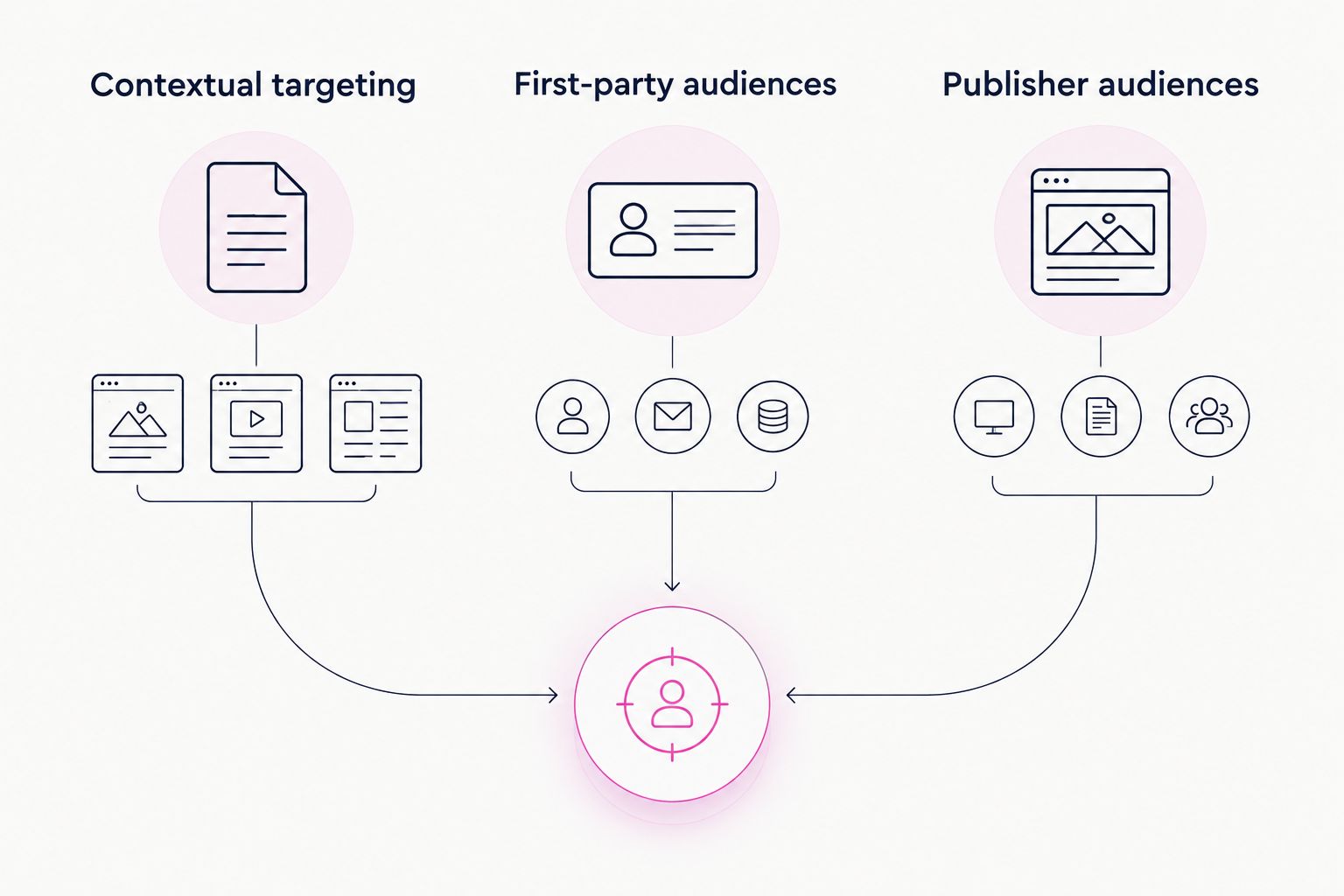
Choose the signal that fits the campaign rather than treating cookieless targeting as one method.
Cookieless results vary because different campaigns have different data, inventory and measurement conditions. These factors belong in your 2026 buying brief:
Avoid comparing approaches solely on reported conversions when their observation methods differ. A lower count can reflect reduced visibility rather than a proportionate change in actual sales; establish the measurement basis before drawing a performance conclusion.
Use measurement suited to the evidence you can observe, not a promised reconstruction of every customer journey. First-party conversion events, publisher reporting and controlled experiments can contribute, but each has a different scope.
Answer these 4 measurement questions before launch:
For an incrementality test, treatment and control create 2 campaign groups: one eligible for the advertising intervention and one held back under the test design. Random assignment and protection against contamination matter; a simple comparison between exposed and unexposed visitors does not establish causation.
For 2026 reporting, keep attribution and incrementality distinct. Attribution assigns credit under a rule or model; incrementality asks what changed because advertising occurred.
Yes, retargeting is possible where a permitted identifier and a supported activation route connect the audience to an advertising opportunity. It is not universally available across the open web, and contextual targeting alone does not identify previous visitors.
Write the dependency into the brief. If a proposed retargeting route requires authenticated publisher users, assess that reachable audience rather than assuming it covers every website visitor.
Cross-site frequency control has a similar constraint. Without a shared identifier, separate systems cannot reliably recognise every repeated exposure to the same person. Ask which environments a frequency cap covers and where recognition stops.
No. A data clean room is a controlled environment for analysing or matching data under defined access rules; it does not manufacture identity, permission or audience reach.
A clean room can support a workflow where participants have compatible, permitted data and an agreed measurement or activation purpose. Its usefulness depends on those inputs and the allowed outputs, not on the label attached to the technology.
For example, a brand and publisher might assess audience overlap without giving each other unrestricted access to their raw datasets. That still requires an agreed matching method and controls. Read the separate explanation of whether a data clean room can work without cookies when planning that workflow.
Cake.Shop is relevant to independent agencies and in-house brands evaluating a modular programmatic advertising stack. Its stated scope includes media buying and reporting, rich media and digital out-of-home creative, data clean rooms and direct publisher supply.
Assess those components as a connected workflow. Your buying brief defines the audience or context; creative supplies the message; publisher supply determines the environments; reporting and data workflows provide the evidence you can use to evaluate results.
Digital out-of-home, or DOOH, illustrates why programmatic is broader than browser identity. A digital billboard is not a browser carrying a third-party cookie, although its audience planning and measurement still require scrutiny.
The benefit of modular scope is the ability to evaluate the required parts of the stack together. The trade-off is that a module list does not prove the specific connections your campaign requires. Confirm identifiers, inventory access, creative formats, reporting exports and responsibilities directly with Cake.Shop before making a selection.
Discuss your cookieless buying requirements
Define the buying signals, creative, publisher supply and measurement your team needs.
Can programmatic advertising work without third party cookies?
Yes, programmatic advertising works without third-party cookies through contextual targeting, permitted first-party audiences and publisher audiences. Audience recognition, frequency control and attribution depend on the signals available in each environment.
Is cookieless advertising the same as contextual advertising?
No, contextual advertising is one cookieless approach, not the entire category. Other approaches use permitted customer identifiers or publisher-held audience signals.
Do I still need consent for cookieless advertising?
Removing third-party cookies does not remove applicable consent or privacy requirements. Assess the data collected, identifiers used, processing purpose and relevant jurisdiction.
Can I retarget every website visitor without third-party cookies?
No, you cannot assume every visitor is reachable without third-party cookies. Retargeting requires a permitted recognition method supported by the relevant buying and publishing environments.
Does server-side tracking solve cookie loss?
No, server-side tracking does not by itself restore cross-site identity or remove permission requirements. It changes where data collection or transmission occurs, not the rights attached to that data.
Does a data clean room make customer data anonymous?
No, a data clean room does not automatically make customer data anonymous. Its protections depend on the data, matching process, access controls and permitted outputs.
What should I ask a cookieless advertising provider to demonstrate?
Ask the provider to demonstrate the buying signal, eligible inventory, activation requirements and measurement outputs for your actual campaign. Request a clear distinction between observed results, modelled estimates and attributed outcomes.
Cookie-free is not the same as identity-free. A campaign using matched customer identifiers can be cookie-free while still depending heavily on recognising people.
Before signing off a 2026 plan, ask one question: what stops working when no person-level identifier is available? The answer reveals whether the campaign genuinely supports unidentified inventory or simply substitutes another identifier for the cookie.
Can programmatic advertising work without third party cookies? Yes. Compare contextual targeting, first-party data and measurement trade-offs.
Read more →How long does it take to implement cookieless targeting? Scope decides. Compare contextual, first-party and clean-room paths, with launch readiness checks.
Read more →Is header bidding worth it for small publishers? Test net revenue, page speed and workload before committing. Compare managed and self-run setups.
Read more →Book a 30-minute demo and see exactly how Cake.Shop works — no sales pitch, just the platform.