
OPEN DAILY
OPEN
HONEST
TRUST
LET'S CHAT



Header bidding is worth it for small publishers when additional demand produces more net revenue without damaging page performance or creating an unmanageable support workload. In 2026, the right decision is a controlled test against your existing setup—not an assumed uplift, a traffic threshold borrowed from another publisher, or a longer bidder list.
TL;DR
Yes, if the additional revenue survives fees, operating effort and performance checks. Header bidding lets multiple demand sources compete before the ad server makes its allocation decision. That creates an opportunity for additional competition; it does not guarantee additional earnings.
Use this decision table before you compare header bidding platforms. Choose the operating model you can maintain, then assess individual providers.
Keep the existing setup
Managed header bidding
Publisher-controlled header bidding
These are operating choices, not a performance ranking. A managed implementation with clear reporting can be more useful than a technically flexible setup nobody has time to maintain.
For a small publisher, the scarce resource is often operational attention. An advertising change that adds reporting reconciliation, troubleshooting and consent-management work needs to justify that workload, not just produce higher auction bids.
The opposite mistake is rejecting header bidding solely because your audience is small. Traffic volume affects the size and speed of a test, but demand eligibility, audience characteristics and implementation quality also matter.
Your 2026 decision should answer a business question: does this setup improve the value of your existing readership after its consequences are accounted for? Treat technical deployment as the beginning of that assessment, not proof that the project succeeded.
Best for: publishers that need help operating the advertising stack. A managed arrangement assigns specified implementation and operational tasks to a provider. The practical benefit depends on exactly what the agreement includes.
Ask who configures bidders, investigates discrepancies, handles consent-related changes and responds when ads stop rendering. A provider relationship does not remove the need for an accountable person inside your business.
The trade-off is dependence on another organisation's processes and reporting. Establish which accounts you control, which records you can export and how you remove the integration before you sign.
Verdict: test a managed approach when the support responsibilities are explicit and the reporting shows what you retain. Do not treat the word managed as a substitute for a written scope.
Best for: publishers with dependable engineering and ad operations capacity. Prebid.js is an open-source header bidding framework, not a ready-made guarantee of demand, revenue or operational support.
Control lets you make configuration decisions directly. It also means someone must maintain those decisions as the website, consent setup, advertising partners and framework change.
The workload extends beyond installing code. You need to investigate missing bids, rendering failures, reporting differences and changes in page behaviour. Those responsibilities remain even when the initial integration works.
Verdict: choose publisher control only when you can name the people responsible for maintenance and revenue reconciliation. Flexibility without ownership becomes unfinished work.
Best for: publishers whose immediate priority is a stable, maintainable website. Keeping the current arrangement avoids introducing another moving part while you resolve more basic advertising or performance problems.
That is a valid decision, not evidence that header bidding never works for smaller sites. The limitation is straightforward: you have not tested whether additional competition improves your result.
Document why you are waiting. Missing engineering capacity, unclear reporting and unresolved consent handling are actionable reasons; a vague belief that the site is too small is not.
Verdict: wait when you cannot measure or maintain the change. Revisit the decision when those constraints change rather than repeatedly shopping for another platform.
The same implementation does not produce the same business result on every website. Evaluate these factors against your own inventory:
Do not compress these differences into a universal monthly page-view requirement. Establish each provider's actual eligibility criteria, then test the business case separately.
Build the 2026 test around a written comparison plan. Keep the objective narrow: determine whether header bidding improves the publisher's retained advertising revenue without unacceptable effects on readers or operations.
Record your existing revenue, eligible traffic, advertising configuration and page-performance measurements. Define whether the comparison uses page views, sessions or ad opportunities; these denominators answer different questions.
Do not switch between them halfway through reporting. A higher revenue-per-impression result can coexist with a worse result per session if the number of monetised opportunities changes.
Specify the placements, demand partners and auction configuration being tested. Keep other material changes separate where practical, including redesigns, ad-density changes and new traffic acquisition activity.
Where your implementation supports a controlled split, compare equivalent traffic groups during the same period. If you use a before-and-after comparison, record changes in audience mix and trading conditions rather than attributing every difference to header bidding.
Compare publisher-retained revenue on the same accounting basis. Check how each report handles deductions, currency, reporting time zones and adjustments before you interpret differences.
Do not use submitted bids or a dashboard's gross revenue as a substitute for reconciled earnings. An auction result is not the same thing as money retained by the publisher.
Inspect page performance and ad rendering alongside revenue. Segment the results by device and relevant page template so a sitewide average does not hide a problem concentrated on mobile article pages.
Include consent behaviour and existing direct campaigns in your checks. A revenue experiment should not quietly become a change to how those responsibilities are handled.
Write the acceptance conditions before reviewing the final result. Include revenue, performance, operational workload and the ability to reverse the implementation.
Keep the setup only if the evidence meets those conditions. If the outcome is unclear, diagnose the uncertainty instead of presenting an inconclusive test as a win.
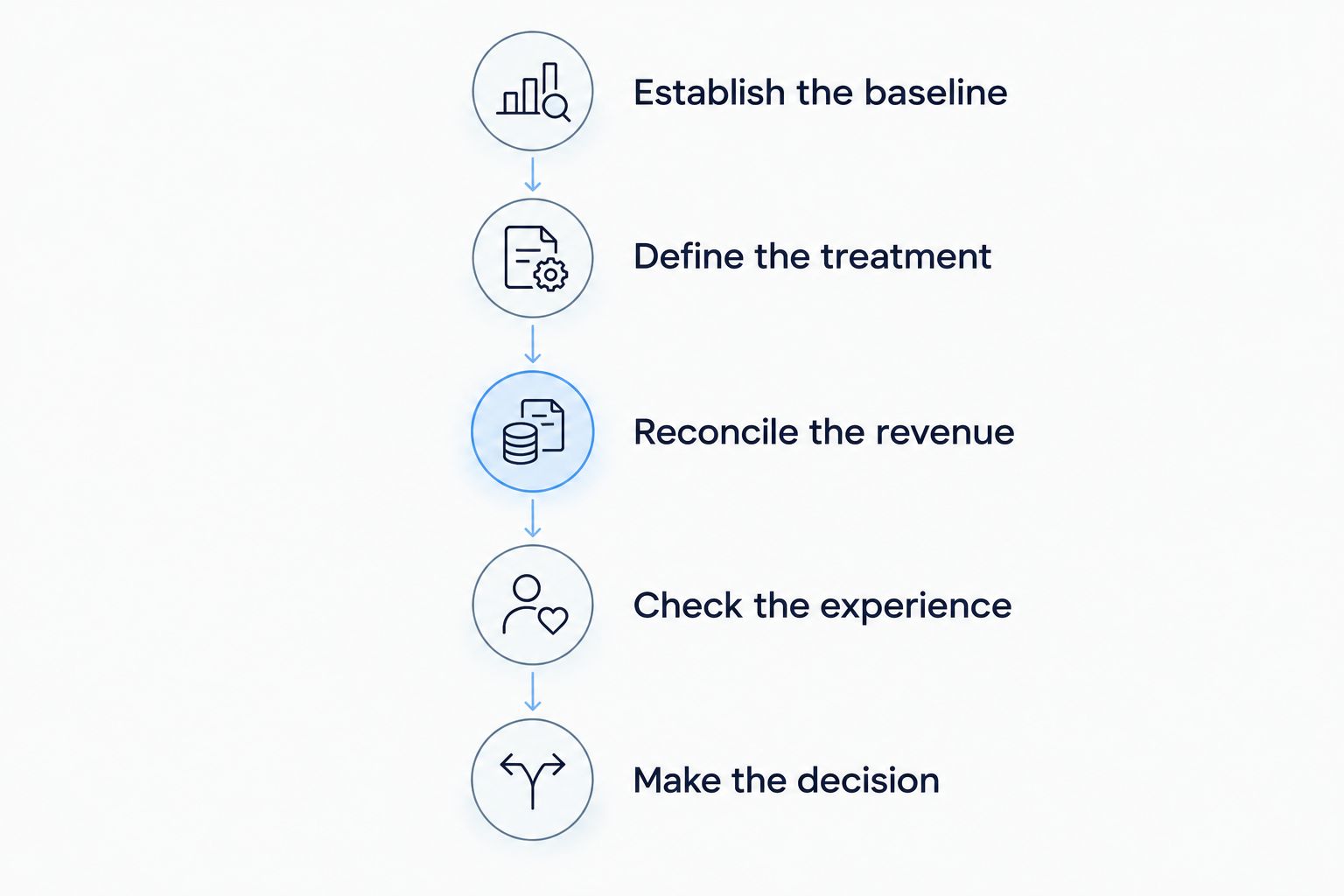
Agree on the comparison and acceptance conditions before interpreting the result.
For a 2026 performance check, Google's published Core Web Vitals good-experience thresholds provide established reference points: Largest Contentful Paint at 2.5 seconds or less, Interaction to Next Paint at 200 milliseconds or less, and Cumulative Layout Shift at 0.1 or less. Google assesses these at the 75th percentile of page visits, segmented across mobile and desktop.
These measure loading, responsiveness and visual stability respectively. They are page-experience thresholds, not header bidding revenue benchmarks or prescribed auction timeouts.
Compare your baseline and test implementation using equivalent measurements. Passing these thresholds does not prove that advertising has no effect, and a failed metric does not identify header bidding as the cause without further investigation.
Do not choose an auction timeout by copying a Core Web Vitals threshold. Measure auction behaviour and reader experience separately, then assess them together.
Keep the commercial models separate. Header bidding sells advertising opportunities through competing demand sources; sponsored content involves an agreement around content, distribution or other specified deliverables.
Use sponsored content pricing benchmarks to frame the deliverables you compare, not as a proxy for what open-auction impressions should earn. A sponsorship package and an auction impression are different units of sale.
Your comparison should account for the work involved in producing and delivering each arrangement. Editorial production, approvals, reporting and account management belong in the sponsorship assessment; technical operations and revenue reconciliation belong in the header bidding assessment.
Neither route automatically replaces the other. Protect any agreed direct-advertising commitments and verify how the proposed setup handles their delivery. Avoid evaluating auction revenue in isolation if the implementation also changes inventory used for direct business.
For your 2026 commercial plan, assign each revenue stream its own reporting basis. That makes the decision clearer than combining unlike activity into a single advertising-income headline.
Cake.Shop fits brands and independent agencies assessing a modular programmatic advertising stack. Its stated scope covers media buying and reporting, rich media and digital out-of-home creative, data clean rooms and publisher supply—not only a standalone buying tool.
For an agency evaluating Cake.Shop, the relevant discussion connects those parts: what inventory you want to buy, what creative you need to serve, how data supports the activity and how results will be reported. Digital out-of-home means advertising delivered through digital screens in physical locations.
For a small publisher, that wider scope does not establish a header bidding business case by itself. Ask Cake.Shop to confirm the relevant publisher-supply offering, eligibility, integration responsibilities and reporting arrangements before assessing suitability.
The benefit of considering a modular stack is evaluating related requirements together. The trade-off is that broader scope creates more questions to resolve; it is not evidence of a particular publisher outcome.
There is no universal traffic threshold that proves header bidding is worthwhile. Providers set their own eligibility criteria, while your economics depend on demand, implementation, commercial terms and operating effort.
Ask for the actual entry requirements before investing engineering time. Then establish whether your traffic can support a meaningful comparison across the audience segments that matter to your business.
More bidders do not guarantee more retained revenue. Additional demand can introduce competition, but each integration also needs assessment for its contribution, behaviour and maintenance requirements.
Review partner-level performance where reporting permits it. Remove the assumption that a longer partner list is automatically a better advertising setup.
Header bidding is not a replacement for every direct advertising relationship. Direct arrangements can include delivery commitments, sponsorship rights or creative requirements that an open auction does not reproduce.
Evaluate the two routes against their own objectives. Confirm that auction configuration respects your direct commitments rather than treating all inventory as interchangeable.
Is header bidding worth it for a small news website?
Header bidding is worth testing when a small news website can measure retained revenue, page performance and operational workload. Audience size alone does not establish the business case.
Should I choose managed header bidding or run it myself?
Choose managed header bidding when you need clearly defined implementation and operational support. Run a publisher-controlled setup only when engineering and ad operations responsibilities have named owners.
Does Prebid.js guarantee higher advertising revenue?
Prebid.js does not guarantee higher advertising revenue. It is an open-source header bidding framework; your result depends on demand, configuration, commercial terms and ongoing operation.
Will header bidding slow down my website?
Header bidding adds auction activity that needs performance testing. Compare equivalent page-experience measurements before and during the test rather than assuming either no impact or an unavoidable slowdown.
What should I measure before keeping header bidding?
Measure publisher-retained revenue, page performance, rendering behaviour and operational workload. Use a consistent traffic denominator and reconcile reporting differences before making the decision.
Can I keep direct advertising campaigns alongside header bidding?
Direct advertising campaigns can coexist with header bidding when the ad-server configuration supports the intended allocation. Verify delivery priorities and existing commitments before changing the setup.
Is Cake.Shop only a media buying tool?
Cake.Shop is a modular programmatic advertising platform covering media buying, rich media creative, data clean rooms and publisher supply. Small publishers should confirm the relevant supply offering and operating responsibilities directly.
Ask how to remove the integration before you approve it. A credible test includes a way back to the previous setup, not just instructions for launching the new one.
Document account ownership, configuration changes, reporting exports and the person responsible for rollback. Keep the original baseline intact so the next decision does not depend on memory.
For a 2026 header bidding decision, reversibility belongs beside revenue in the acceptance criteria. You are choosing an operating arrangement, not merely adding a script.
Can programmatic advertising work without third party cookies? Yes. Compare contextual targeting, first-party data and measurement trade-offs.
Read more →How long does it take to implement cookieless targeting? Scope decides. Compare contextual, first-party and clean-room paths, with launch readiness checks.
Read more →Is header bidding worth it for small publishers? Test net revenue, page speed and workload before committing. Compare managed and self-run setups.
Read more →Book a 30-minute demo and see exactly how Cake.Shop works — no sales pitch, just the platform.