
OPEN DAILY
OPEN
HONEST
TRUST
LET'S CHAT



Header bidding costs publishers implementation time, ongoing technical work and any contracted hosting, service or revenue-share fees; there is no single publisher-wide cost. An open-source wrapper does not remove those operating costs, and the headline commercial fee does not capture every deduction between an advertiser's spend and a publisher's payment. For a 2026 decision, compare the revenue you retain after fees and operating costs—not the advertised fee alone.
TL;DR
A publisher can negotiate a lower service fee and still retain less revenue if the implementation performs poorly or requires more internal work. Equally, paying for technical support is not automatically wasteful: that support has value when it replaces work your team would otherwise perform.
Start with your operating model before comparing header bidding platforms. Separate the auction technology, access to demand and responsibility for maintaining the integration. A proposal that combines them needs an itemised explanation, not just a headline percentage.
The useful answer is total operating cost plus contractual deductions, measured against retained revenue. A universal average would hide differences in technical responsibility, auction architecture and the revenue base to which a fee applies.
For your 2026 budget, request a written breakdown covering these categories:
Implementation
Ongoing operations
Infrastructure
Commercial deductions
Measurement
Ask each prospective provider to classify every charge as initial, recurring or usage-related. Then establish whether it is invoiced separately or deducted before payment. Those distinctions determine how you reconcile the contract with your accounts.
Do not add a deduction twice. If your starting revenue figure already excludes a supplier's fee, subtracting that fee again understates the amount you retain.
Client-side header bidding runs bidder integrations in the browser. With a self-managed implementation, your team takes responsibility for configuring the wrapper, connecting it to the ad server and keeping the setup working.
Prebid.js is an open-source header-bidding library. Its source-code licence is not a substitute for engineering, ad operations or commercial agreements with demand partners. Treat those responsibilities as separate budget lines.
Best for: publishers with the technical and ad operations capacity to own the implementation.
Before choosing this model, name the person responsible for each recurring task. A setup without an operational owner is not a finished implementation, even when ads are serving.
Server-side header bidding moves bidder communication to a server-side component. The publisher still needs a working connection between the page, auction service and ad server; server-side does not mean maintenance-free.
Your cost assessment should cover the hosting arrangement, monitoring, bidder configuration and incident response. Establish which responsibilities belong to the publisher, a hosting provider or another technology partner.
Best for: publishers prepared to manage server-side infrastructure or oversee a specialist hosting arrangement.
Evaluate server-side performance on your own inventory. Architecture describes where work happens; it does not establish the commercial result.
Managed header bidding assigns agreed implementation or operating tasks to a service provider. The contract—not the word managed—determines how much work actually leaves your team.
A service might cover wrapper maintenance while leaving consent configuration, ad server changes or payment reconciliation with you. Ask for a responsibility schedule that identifies those boundaries before assessing the commercial terms.
Best for: publishers that need external operating support and can define what that support must include.
For a 2026 procurement, ask providers to demonstrate an ordinary configuration change and an error investigation. A sales presentation is not evidence of how day-to-day support works.
Compare ownership and workload before comparing commercial terms. These models allocate responsibility differently; none is automatically the lowest-cost choice for every publisher.
Self-managed client-side
Self-managed server-side
Managed service
A managed service can use client-side, server-side or a combination of auction components. Management and architecture are different decisions. Ask both who operates the system and where the auction work happens.
Header bidding costs vary because publishers allocate technical work and commercial responsibility differently. Use these factors to explain differences between proposals rather than assuming a higher deduction buys a better result.
Turn each factor into a question with a written answer. If proposals describe different responsibilities, they are not directly comparable until you normalise their scope.
Build a reconciliation that starts with a defined revenue figure and ends with the publisher's retained contribution. Keep invoices, deducted fees and internal operating costs separate so you can trace every adjustment.
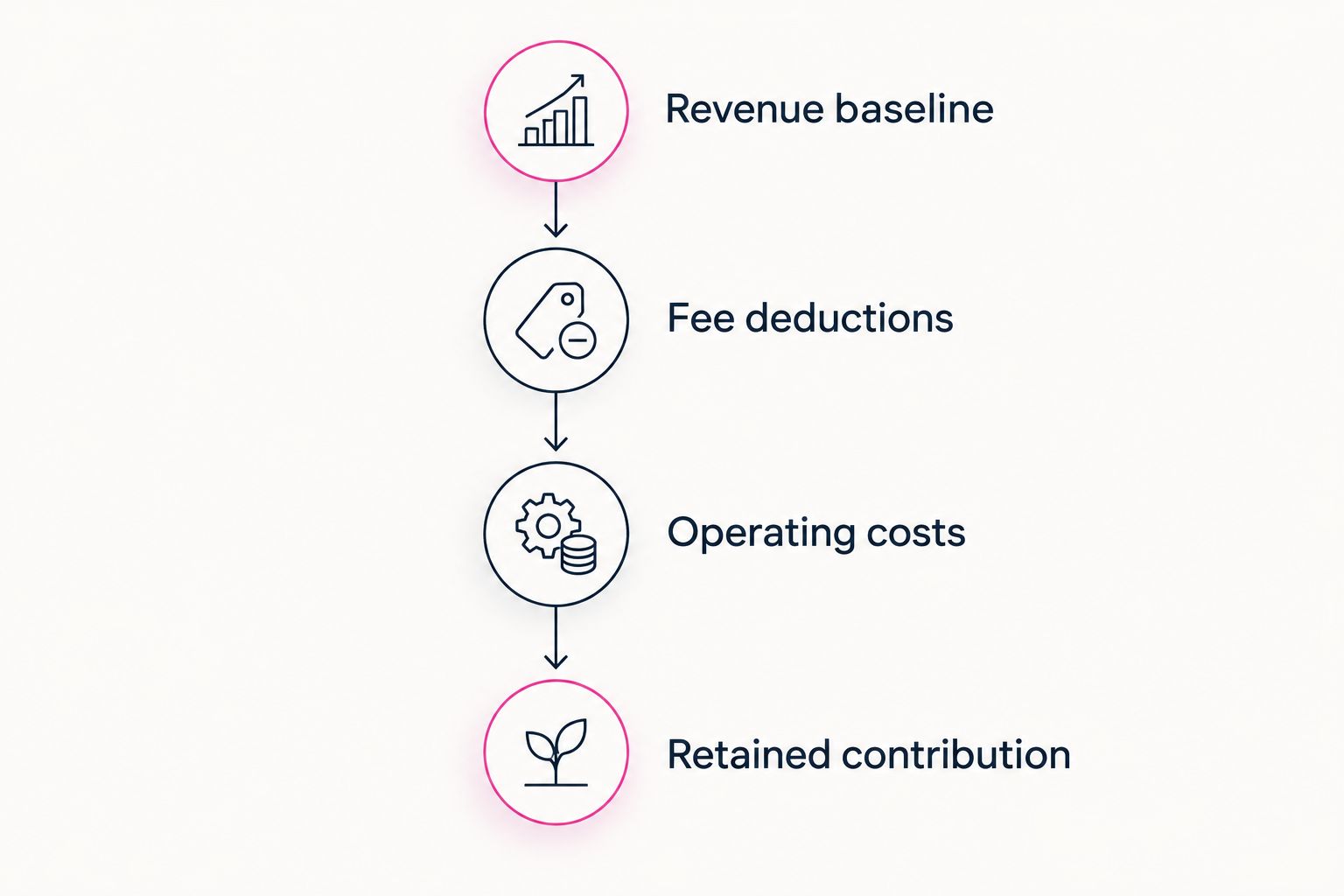
Start from a defined revenue baseline so deductions are not counted twice.
Use the same reporting period and inventory scope for competing proposals. CPM means revenue or cost per 1,000 impressions, but a higher reported CPM does not establish higher total retained revenue if the impression base or deductions differ.
Keep initial implementation work visible rather than burying it in recurring operations. Your finance team can then distinguish the cost of changing systems from the cost of running them.
Header bidding introduces auction work into the advertising workflow, so performance belongs in the acceptance criteria. Do not assume that more demand partners improve the commercial result or that server-side processing removes every page-performance issue.
For a 2026 rollout, Google's Core Web Vitals guidance provides useful website guardrails: a good Largest Contentful Paint is 2.5 seconds or less, and a good Interaction to Next Paint is 200 milliseconds or less. These are page-experience thresholds, not header-bidding auction timeout recommendations.
Measure the actual pages receiving the integration, including representative mobile traffic. Review advertising revenue alongside page experience, and investigate changes rather than attributing every movement to the wrapper.
Open-source header bidding still requires implementation and operation. Prebid.js gives publishers access to open-source wrapper software; it does not supply your engineering team, hosting arrangement or demand-partner contracts.
Choose it because the operating model fits your team, not because software licensing appears absent from the budget. The relevant comparison includes both outsourced charges and work performed internally.
A lower revenue share is not automatically a better commercial arrangement. Compare the fee base, included work, reporting access and retained revenue under equivalent conditions.
An apparently smaller deduction can apply to a broader revenue base. Ask for a worked reconciliation using your own reporting definitions rather than accepting percentages in isolation.
Cake.Shop is relevant to brands and independent agencies evaluating publisher supply alongside media buying and creative. Its modular programmatic advertising platform covers media buying and reporting, rich media and digital out-of-home creative, data clean rooms and publisher supply.
Those components connect the buying, creative, data and supply sides of a programmatic stack. That is broader than a standalone buying tool, but it does not establish a particular header-bidding integration, hosting arrangement or publisher fee schedule.
For a Cake.Shop programmatic advertising enquiry, specify whether you need publisher supply, buying-side technology or help connecting those requirements. Keep wrapper operation, supply access and buyer reporting as separate questions so the discussion addresses your actual stack.
How much does header bidding cost publishers in 2026?
Header bidding costs depend on implementation, ongoing operations, infrastructure and contractual deductions. Compare retained revenue after those costs rather than relying on a universal average.
Do publishers have to pay for Prebid.js?
Prebid.js is open-source software, but using it still requires implementation and ongoing operation. Assess internal technical work and any hosting or service agreements separately.
Is managed header bidding cheaper than doing it yourself?
Managed header bidding is not automatically cheaper than a self-managed setup. Compare equivalent responsibilities, attributable internal work and contractual deductions.
What does a header-bidding revenue share apply to?
The contract defines the revenue base to which a header-bidding revenue share applies. Ask whether that base is gross revenue, revenue after specified deductions or another defined amount.
Does server-side header bidding remove publisher operating costs?
Server-side header bidding does not remove publisher operating costs. Hosting, monitoring, integration and support still need an owner, whether internal or contracted.
How should publishers compare header-bidding proposals?
Publishers should compare proposals using the same inventory scope, reporting period and revenue definition. Then account for deductions, included services and work that remains with the publisher.
What should publishers ask about before leaving a managed provider?
Publishers should establish their contractual rights to configuration, reporting data and transition assistance. Confirm which accounts and integrations they control before agreeing to a migration.
Ask for the payment reconciliation before the product demonstration. A provider should be able to explain how the revenue shown in its reports connects to contractual deductions and the payment you receive.
Make that reconciliation part of your 2026 acceptance criteria. If you cannot trace the money, you cannot meaningfully compare the fee.
Is retail media worth it for CPG brands? Test incremental profit, not just attributed sales. Compare formats, measurement limits and investment criteria.
Read more →How much does header bidding cost publishers? Costs vary by setup, fees and operating work. Compare retained revenue, service scope and deductions.
Read more →Can a DSP buy CTV and DOOH from the same platform? Yes, with the right supply integrations. Check creative, reporting and measurement before you commit.
Read more →Book a 30-minute demo and see exactly how Cake.Shop works — no sales pitch, just the platform.