
OPEN DAILY
OPEN
HONEST
TRUST
LET'S CHAT


Retail media is worth it for CPG brands in 2026 when it generates additional sales at an acceptable contribution margin, not merely sales attributed to an advert. The decision must include data, creative, measurement and operating costs, plus a credible check on whether those purchases would have happened without advertising.
TL;DR
Invest when you can connect a defined audience, a commercial objective and a defensible measurement plan. Pause when the business case depends entirely on the retailer's headline return on ad spend.
Your programmatic advertising strategy for retail brands should distinguish capturing existing demand from creating additional demand. Both have a role, but they answer different business questions.
Onsite advertising
Offsite advertising
In-store advertising
These are routes to evaluate, not interchangeable products. Confirm what each proposed retailer or partner actually supports before treating the comparison as a buying plan.
Consumer packaged goods brands sell through retail partners, so retailer transaction data can help connect advertising with purchases. That connection is useful, but a recorded purchase does not prove the advert caused it.
For your 2026 plan, separate two decisions: whether a retailer is commercially important and whether its advertising delivers additional value. A strong distribution relationship is not evidence of advertising effectiveness.
The practical question is not whether retail media deserves a permanent budget line. It is which objective it serves better than the next available use of your advertising budget.
Onsite advertising appears within a retailer's own digital properties. Sponsored search placements are a familiar example: your advert competes for attention while someone searches or browses.
Best for: reaching shoppers already considering a relevant category. Match the placement to the product and the search context, then evaluate the quality of the resulting sales.
The advantage is proximity to a purchase decision. The limitation is the same proximity: shoppers searching for your brand might already intend to buy it, making attributed return look stronger than incremental return.
Separate brand searches from broader category searches in the reporting wherever that distinction is available. Otherwise, a blended result can hide whether you paid to intercept existing demand or reached shoppers considering alternatives.
Offsite retail media uses retailer-derived audience information to inform advertising outside the retailer's own properties. The activation method and available media depend on the arrangement.
Best for: reaching a defined shopper audience beyond the shopping session. Ask what qualifies someone for the audience, how recently that qualification was established and how campaign results connect back to purchases.
The advantage is a broader advertising context than onsite placements alone. The trade-off is a longer chain of dependencies: audience permissions, identity matching, media delivery and sales reporting all need examination.
Do not assume retailer audience access means access to identifiable customer records. Establish what data you receive, what remains within the partner's environment and what you can retain after the campaign ends.
In-store retail media places advertising within a physical shopping environment. Evaluate the actual placement rather than treating every screen or location as equivalent.
Best for: messages that make sense during a store visit. A category-relevant placement has a different job from a broad brand message at a store entrance.
The advantage is context. The limitation is measurement: an advert playing on a screen is not proof that a particular shopper saw it, and a store-level sales change is not automatically an advertising effect.
Ask how delivery is verified and how stores are compared. Keep promotions, distribution changes and other activity in view when interpreting any sales difference.
Retail media performance depends on more than the placement. Use these factors to explain differences before moving budget:
In 2026, compare proposals against the same objective and accounting basis. A campaign optimised for immediate retailer purchases should not be judged as though it had the same job as a brand-awareness campaign.
Use a written test plan before approving media. The following five checks turn a channel proposal into a decision your commercial team can assess.
Write down what the test must settle: additional category sales, acquisition of shoppers new to the brand, support for a launch or another explicit objective. Avoid combining every ambition into one success measure.
Specify the action attached to the result. A test without a decision rule becomes another report rather than a basis for investment.
Review the relevant sales pattern and concurrent activity before interpreting campaign results. Promotions, distribution changes and seasonality can change sales independently of advertising.
Record those conditions in the test brief. A baseline should describe the business context, not simply provide a convenient comparison period.
Where feasible, use a properly designed holdout or matched comparison to estimate what would have happened without advertising. A holdout is a group deliberately excluded from the advertising being tested.
Agree the assignment method and analysis before launch. If the proposed design cannot distinguish advertising effects from other changes, describe the result as directional rather than causal.
Assess incremental contribution after the costs needed to deliver the activity. Include the media, data, creative, measurement and operating work relevant to your arrangement without double-counting items already bundled together.
An impressive revenue multiple can still be commercially weak. Finance needs the contribution calculation, not just the advertising dashboard.
Expand, revise or stop based on the agreed evidence. Check whether the conclusion applies to a particular retailer, product group or audience rather than declaring the entire channel successful.
Your next test should address the largest remaining uncertainty. Repeating the same campaign with a larger budget does not resolve a weak measurement design.
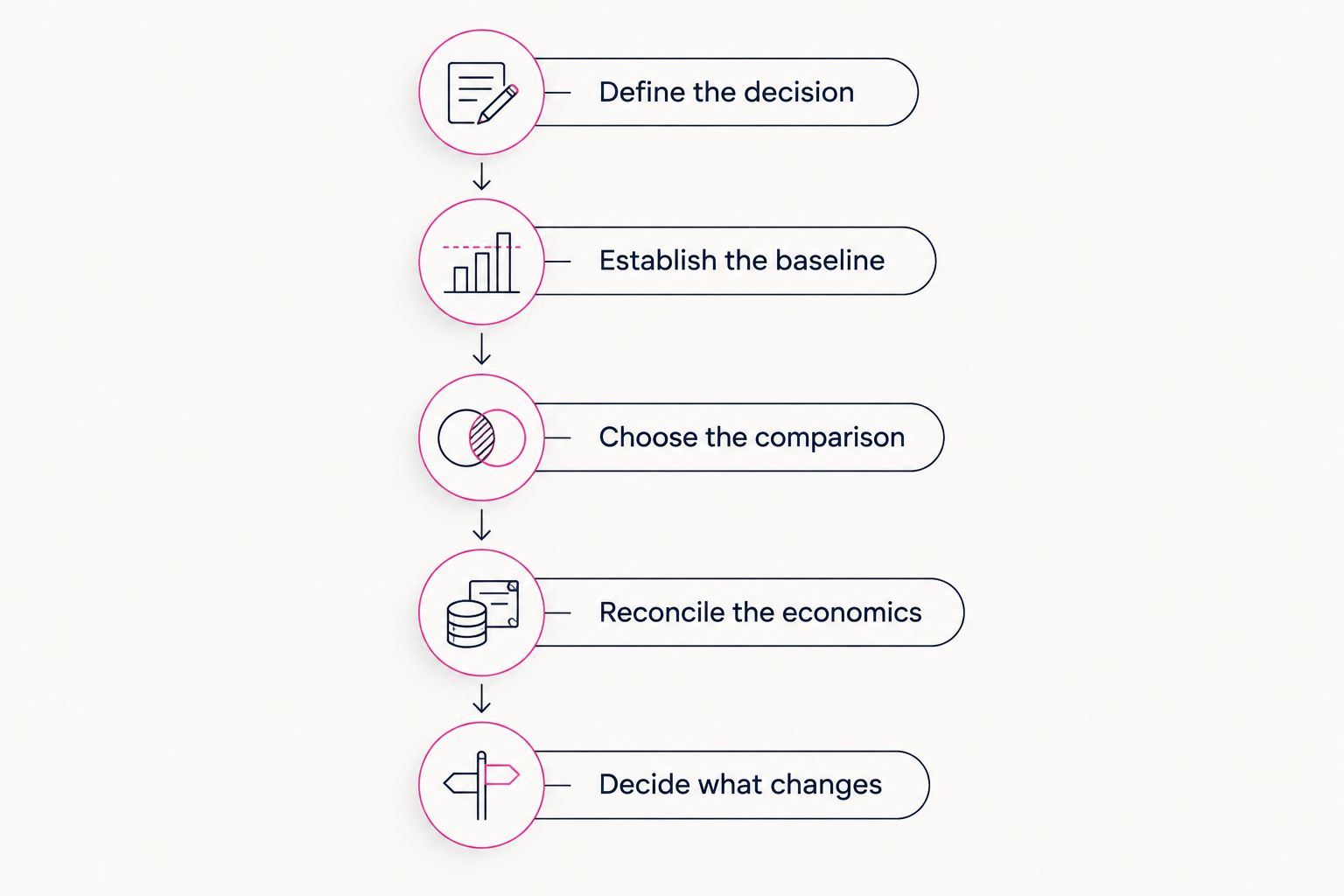
Agree the comparison and commercial decision before approving media.
Keep attributed sales, incremental sales and profit separate. They describe different things, and none should silently stand in for another.
Attributed sales
Return on ad spend
New-to-brand purchases
Incremental sales
Incremental contribution
Ask for the attribution window, included sales channels and definition of a qualifying purchase. For new-to-brand reporting, request the lookback period and the boundary of the retailer's data.
A data clean room is a controlled environment for approved analysis across datasets; it is not automatic proof of consent, complete matching or incrementality. The data clean room guide for CPG brands addresses a related part of the measurement architecture.
Retail media is a channel decision; your advertising stack is an operating decision. Independent agencies and in-house brand teams need to consider how buying, creative, data analysis and publisher relationships fit together across campaigns.
Cake.Shop provides a modular programmatic advertising platform spanning media buying and reporting, rich media and DOOH creative, data clean rooms and direct publisher supply. DOOH means digital out-of-home advertising, such as digital screens in public environments.
Cake.Shop is relevant to independent agencies and in-house brands assessing a modular programmatic advertising stack. The practical attraction is evaluating these functions together rather than treating buying as an isolated task.
The trade-off is scope: those platform categories do not establish access to any particular retailer's audiences, placements or transaction data. Ask about the specific retailer relationships, activation routes, reporting exports and responsibilities required by your brief before choosing an architecture.
For a 2026 enquiry, bring the commercial question first: which audience you need to reach, where you need to reach it and how you will judge the result. That gives a platform discussion substance without assuming a capability that has not been confirmed.
No—retail media should earn its allocation against a defined objective. Proximity to a purchase does not make every placement a substitute for brand-building activity or other customer acquisition channels.
Start with the role you need the channel to play. Compare the evidence on that basis, then retain other channels where they serve a different, necessary purpose.
No—retailer reporting and incrementality testing answer different questions. Attribution connects an exposure or interaction to a purchase under specified rules; incrementality estimates the difference advertising made against a counterfactual.
Use attribution for campaign diagnostics. Use a suitable experimental or analytical design when the decision requires evidence of causation.
Yes—direct access to identifiable customer records is not a prerequisite for every retail media campaign. What matters is whether the permitted audience activation and measurement answer your business question.
Document the permissions, outputs and limitations. Do not buy an audience proposition on the assumption that you will later receive data the agreement does not provide.
Is retail media worth it for CPG brands in 2026?
Retail media is worth it for CPG brands in 2026 when credible evidence shows additional sales with acceptable contribution after relevant costs. Attributed revenue alone does not establish that value.
What's the difference between retail media ROAS and incremental return?
Retail media ROAS compares attributed revenue with advertising spend; incremental return assesses the additional outcome caused by advertising against a comparison. Neither revenue measure alone establishes profit.
What's the best retail media format for a CPG brand?
The appropriate format depends on the objective: onsite placements address shopping intent, offsite placements extend audience reach, and in-store placements address the physical shopping context. Confirm the measurement and limitations of each proposal.
Can a small CPG brand test retail media?
A small CPG brand can assess a focused retail media test, but the measurement design must be capable of answering the commercial question. Do not promise a conclusive result without checking data volume and statistical requirements.
Do CPG brands need a data clean room for retail media?
A data clean room is not required for every retail media campaign. Assess it when the proposed analysis requires controlled collaboration across datasets, and confirm permissions and usable outputs.
How do I compare retail media proposals from different retailers?
Compare proposals using the same objective, cost scope and outcome definitions. Check audience qualifications, attribution windows, sales coverage and the proposed method for estimating additional sales.
Where does Cake.Shop fit into a retail media strategy?
Cake.Shop provides a modular programmatic advertising stack covering media buying and reporting, creative, data clean rooms and publisher supply. Confirm the retailer-specific access and workflow requirements of your proposed campaign rather than assuming them.
Write the conditions for stopping before you write the conditions for scaling. Specify which evidence would make the campaign commercially unacceptable, then make sure the reporting can reveal it.
For your 2026 retail media plan, that is more useful than another ambitious revenue target. A test earns its keep when it changes a decision—including the decision not to spend more.
Is retail media worth it for CPG brands? Test incremental profit, not just attributed sales. Compare formats, measurement limits and investment criteria.
Read more →How much does header bidding cost publishers? Costs vary by setup, fees and operating work. Compare retained revenue, service scope and deductions.
Read more →Can a DSP buy CTV and DOOH from the same platform? Yes, with the right supply integrations. Check creative, reporting and measurement before you commit.
Read more →Book a 30-minute demo and see exactly how Cake.Shop works — no sales pitch, just the platform.