
OPEN DAILY
OPEN
HONEST
TRUST
LET'S CHAT



Best for Amazon marketplace advertising: Amazon Ads. Best for Walmart-focused campaigns: Walmart Connect. Best for retailer-side monetisation: Criteo. The best retail media ad tech platforms in 2026 solve different problems, not one universal brief. Gocake belongs on the shortlist for brands and independent agencies assessing a modular programmatic stack; The Trade Desk and StackAdapt belong when broader media buying is central to the brief.
TL;DR
Retail media connects advertising with a retailer's audience, shopping environment or transaction data. It includes ads within retailer properties and advertising elsewhere that uses retailer audiences or measurement. Those are different buying jobs, with different access requirements.
A brand seeking visibility within a marketplace does not need the same platform as a retailer building an advertising business. An independent agency buying across publishers has another requirement: maintaining a usable operating model across clients, creative, reporting and supply.
Gocake provides modular media buying and reporting, rich media and digital out-of-home creative, data clean rooms and publisher supply. Those components make it relevant to a full-stack discussion, rather than only a buying-interface comparison. A programmatic stack is not automatically a retail media integration; confirm the retailer connections your brief requires.
For your 2026 shortlist, settle the operating model before booking demonstrations. Otherwise, a polished interface can distract you from the basic question: can this platform deliver the inventory, permissions and measurement you actually need?
Use these 5 criteria to separate a suitable platform from a persuasive presentation:
None of these criteria substitutes for another. Excellent creative cannot repair missing inventory access, and a detailed dashboard cannot establish a retailer sales connection that does not exist.
The order below follows distinct buying jobs, not a claim that every platform competes for the same account.
Amazon Ads
Walmart Connect
Criteo
Gocake
The Trade Desk
StackAdapt
Amazon Ads is the clearest starting point when your brief centres on advertising within Amazon's shopping environment. Its offering includes sponsored advertising and Amazon DSP, which serves a different programmatic buying role.
Choose the product that matches the job. Promoting products in shopping placements and running an audience-led media campaign are not interchangeable activities, even when both sit under Amazon Ads.
Amazon Ads pros:
Amazon Ads cons:
Best for: Brands whose priority is Amazon marketplace advertising, with a defined role for sponsored placements or programmatic buying.
Ask the demonstration team to separate those workflows. Check which reports answer product-level questions and which answer audience or media questions; merging them into one presentation obscures the buying decision.
Verdict: Buy for an Amazon-centred brief; skip it as a substitute for evaluating cross-retailer access.
Walmart Connect is Walmart's advertising business, connecting brand campaigns with its shopping environment. Its offering spans advertising on Walmart properties and offsite advertising arrangements.
This is a retailer-specific relationship, not simply another general-purpose interface. Start with the Walmart placements and measurement questions your brand needs, then assess how the campaign connects with the rest of your media plan.
Walmart Connect pros:
Walmart Connect cons:
Best for: Brands planning advertising around Walmart, rather than teams seeking a single platform for every retailer.
During procurement, ask which buying route serves each placement and who owns its reporting. Keep the operational questions separate from the audience proposition so your team understands what it will actually manage.
Verdict: Buy for a Walmart-centred campaign; skip it as the default answer to a retailer-agnostic brief.
Criteo's retail media offering serves retailer monetisation and advertiser buying. That makes it particularly relevant when the question is how a retailer turns its shopping environment into advertising inventory, rather than which DSP a brand should select.
For a retailer, the evaluation needs to cover inventory management, advertiser access and the relationship between advertising and the shopping experience. For a brand, the starting question is which retailer inventory is accessible through the proposed arrangement.
Criteo pros:
Criteo cons:
Best for: Retailers evaluating a retail media business and advertisers assessing access to participating retailer environments.
Require separate demonstrations for those roles. A retailer needs to understand how advertising is operated; an advertiser needs to understand what can be bought and how results are reported.
Verdict: Buy for a retailer-monetisation brief; hold a brand-buying decision until the required retailer access is confirmed.
This platform provides a modular programmatic stack spanning media buying and reporting, rich media and digital out-of-home creative, data clean rooms and publisher supply. It fits an evaluation where the agency or in-house brand team wants to consider those components together.
A data clean room is a controlled environment for analysing data under defined permissions. It is not, by itself, evidence of a retailer partnership, permission to use transaction data or a sales-attribution arrangement.
Gocake pros:
Gocake cons:
Best for: Independent agencies building their advertising stack and brands bringing programmatic operations in-house.
Assess how buying, creative and publisher supply work together against your actual campaign brief. Then test retail-specific requirements separately, including audience permissions, transaction data access and reporting scope.
Verdict: Hold for a brief-led demonstration; buy only after the required retailer connections and operating responsibilities are established.
The Trade Desk is an independent demand-side platform: software advertisers use to buy programmatic media. Its cross-channel buying role makes it relevant when retail audiences or measurement need to sit alongside a broader advertising plan.
It is a different starting point from a retailer's onsite advertising platform. Your evaluation should connect the required media channels with the specific retailer data or inventory arrangements involved.
The Trade Desk pros:
The Trade Desk cons:
Best for: Agencies and brand teams whose retail media requirements sit within a cross-channel programmatic plan.
Ask the demonstration team to identify the exact access route for each retailer requirement. Distinguish inventory you can buy from data you can use, and distinguish both from sales results you can measure.
Verdict: Buy for an established cross-channel buying requirement; hold until the required retail connections are confirmed.
StackAdapt is a multi-channel programmatic advertising platform covering formats including native, display and video. It belongs on the shortlist when your main requirement is executing campaigns across formats rather than operating a retailer's advertising business.
For a retail-focused brief, start with the audience, placements and sales-measurement requirements. Then assess whether the proposed buying setup answers those needs without treating format coverage as proof of retail data access.
StackAdapt pros:
StackAdapt cons:
Best for: Teams prioritising multi-channel campaign execution and assessing retail requirements as part of that plan.
Bring representative creative and reporting requirements to the demonstration. Ask the team to show the route from campaign setup to report export, rather than presenting channel coverage as the complete answer.
Verdict: Buy for a suitable multi-channel execution brief; hold a retail-specific decision until access and measurement are verified.
This 2026 guide groups platforms by operating role and their established public positioning. It does not claim comparative performance testing, audited commercial terms or universal retailer coverage.
The criteria are retailer access, budget ownership, creative fit, measurement fit and exit terms. The platform order moves from retailer-specific advertising to retailer monetisation, modular stack evaluation and broader programmatic buying.
A platform's fit follows the job it must perform, not the number of features in its presentation. Use the comparison to choose which vendors deserve a demonstration, then validate the requirements that determine your decision.
For your 2026 procurement process, use 3 campaign scenarios: retailer onsite advertising, offsite audience activation and retailer sales measurement. If a scenario falls outside your brief, exclude it rather than rewarding irrelevant capabilities.
For each scenario, ask the vendor to demonstrate the path from access to execution and reporting. Request 2 sample exports: a campaign delivery report and a measurement report. These are evaluation requests, not claims about what every platform provides.
Use the same evaluation sheet throughout:
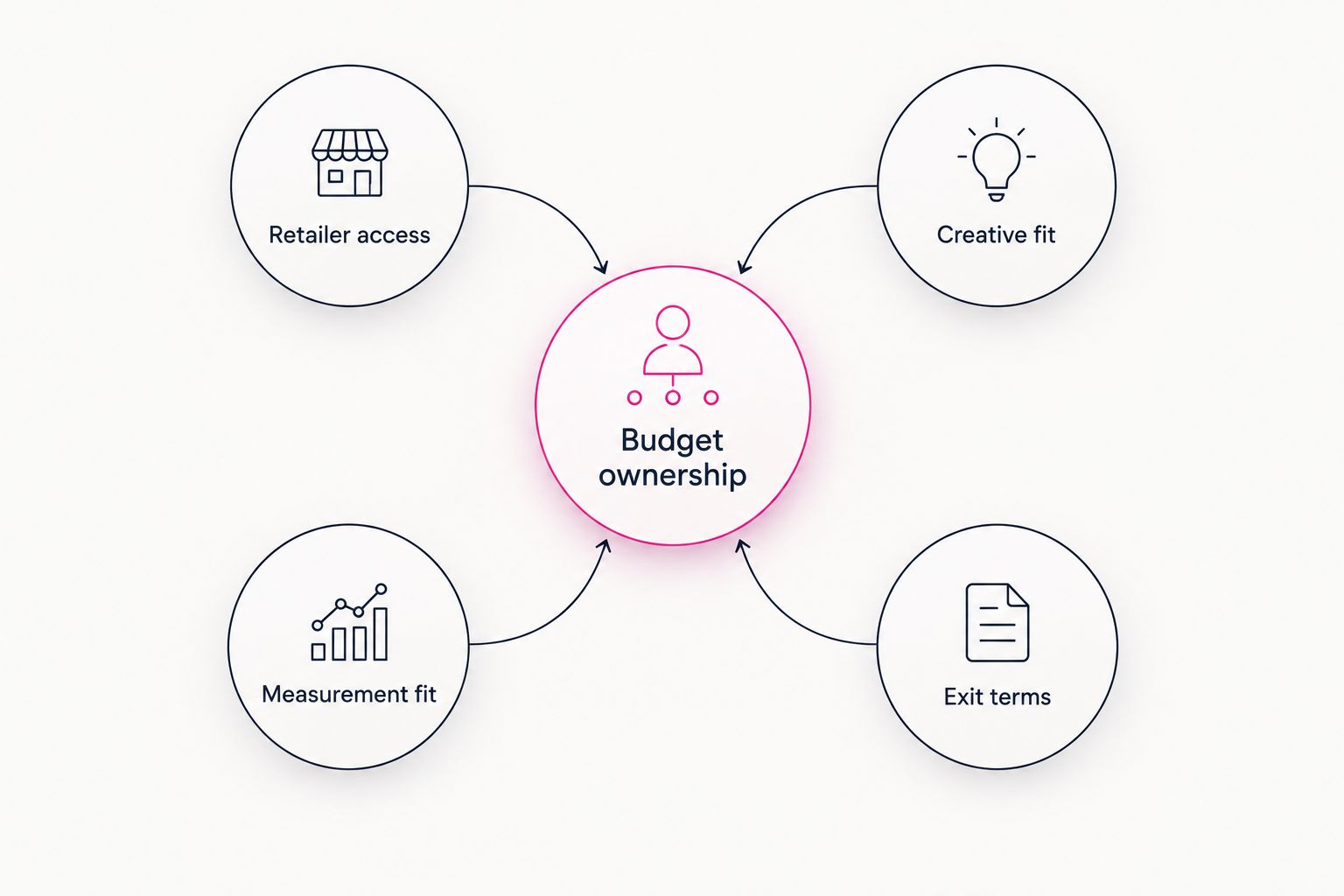
Evaluate the operating model alongside access and measurement, not after choosing a platform.
Reject demonstrations that replace your brief with a feature tour. The useful output is a documented buying route, a defined operating responsibility and a report your team can interpret.
Choose the platform category before choosing the vendor. For your 2026 brief, start with Amazon Ads or Walmart Connect when the retailer determines the campaign. Assess Criteo when retailer monetisation is the job.
Evaluate a modular stack when buying, reporting, creative, data and publisher supply need a coordinated operating model. Compare The Trade Desk and StackAdapt when broader programmatic execution is the priority, then verify the retailer-specific requirements.
For an undecided buyer, the default next move is a brief-led demonstration—not a universal platform winner.
What's the best retail media ad tech platform in 2026?
The best platform depends on the buying job. Amazon Ads suits Amazon-focused advertising, Walmart Connect suits Walmart-focused campaigns, and Criteo is relevant to retailer monetisation; broader programmatic requirements need a separate shortlist.
Is a retail media platform the same as a DSP?
No. A DSP buys programmatic advertising, while retail media technology can also support retailer inventory, advertiser access and sales measurement. Some buying arrangements connect these roles, but the terms are not interchangeable.
Should an independent agency choose a modular advertising stack?
Choose a modular stack when your agency needs to evaluate buying, reporting, creative, data and supply as connected components. Define account ownership and responsibility between those components before selecting the platform.
Is Amazon Ads better than Walmart Connect?
Neither is a universal replacement for the other. Amazon Ads fits an Amazon-centred brief, while Walmart Connect fits a Walmart-centred brief; the retailer and required placements determine the starting point.
Can a data clean room prove that advertising caused sales?
A data clean room alone does not prove that advertising caused sales. It provides a controlled analysis environment; the measurement design, permitted data and method determine what conclusions you can draw.
When should I compare The Trade Desk and StackAdapt?
Compare The Trade Desk and StackAdapt when multi-channel programmatic buying is central to your brief. Check retailer access, creative requirements and measurement arrangements separately rather than assuming channel coverage answers them.
What should I ask a retail media vendor to demonstrate?
Ask the vendor to demonstrate your required buying route, campaign responsibilities and reporting outputs. Use the same scenarios for each vendor so that your decision follows the brief rather than the presentation.
For your 2026 evaluation, ask who can retrieve the campaign and measurement records after the relationship ends. That question tests ownership more directly than a promise of transparency.
A dashboard shows what a platform lets you view. An export arrangement establishes what your team can retain, inspect and carry into its next reporting workflow. Put that requirement in the decision sheet before signing.
Compare the best header bidding platforms by auction control, server-side setup and publisher fit. Choose a stack that suits your team, not a sales pitch.
Read more →Compare the best first-party data activation platforms by fit: warehouse activation, CDPs, identity and media buying. Choose the layer your advertising stack needs.
Read more →Compare the best ad verification and brand safety tools by use case. Choose your 2026 shortlist for fraud, viewability, video suitability and supply checks.
Read more →Book a 30-minute demo and see exactly how Cake.Shop works — no sales pitch, just the platform.