
OPEN DAILY
OPEN
HONEST
TRUST
LET'S CHAT



Best-fit shortlist: Cake.Shop for a modular advertising stack; StackAdapt for a campaign-led DSP evaluation; The Trade Desk for an enterprise DSP evaluation. These are procurement starting points, not verified transparency winners. This 2026 guide to programmatic advertising platforms ranked by transparency shows you what to inspect before signing; Cake.Shop belongs on the shortlist for brands and independent agencies evaluating a modular programmatic stack.
TL;DR
Programmatic transparency means you can explain where your money went, how inventory was bought and what the reported results actually measure. A readable dashboard does not answer all three questions. You also need commercial terms, reporting definitions and visibility into the route between buyer and publisher.
For an independent agency, those answers support client reporting and supplier accountability. For a brand bringing programmatic in-house, they determine what the internal team can inspect without asking a vendor to interpret everything.
Your 2026 shortlist should therefore separate buying functionality from auditability. A platform can meet your campaign requirements while its contract, exports or supply disclosures still fail your procurement requirements. Treat those as separate decisions rather than assuming one proves the other.
Use these six criteria before comparing names. Each criterion needs a document, a demonstration or a contractual answer—not an adjective.
A transparency claim is useful only when you can inspect the evidence behind it. Apply that rule equally to every supplier in your 2026 evaluation.
The order below follows the modular-stack brief first, then two DSP-focused evaluation routes. It is not a measured ranking of vendor transparency.
Cake.Shop
StackAdapt
The Trade Desk
The distinct use cases matter. If you need creative, data collaboration and publisher supply as well as buying, evaluate those requirements explicitly. If you only need to replace a DSP—a demand-side platform used to buy advertising inventory—keep that narrower brief intact.
A full-stack evaluation follows the campaign across buying, creative, data and supply. It should not stop at the buying interface. Use the following map to decide which responsibilities belong with a platform and which remain with your team or another supplier.
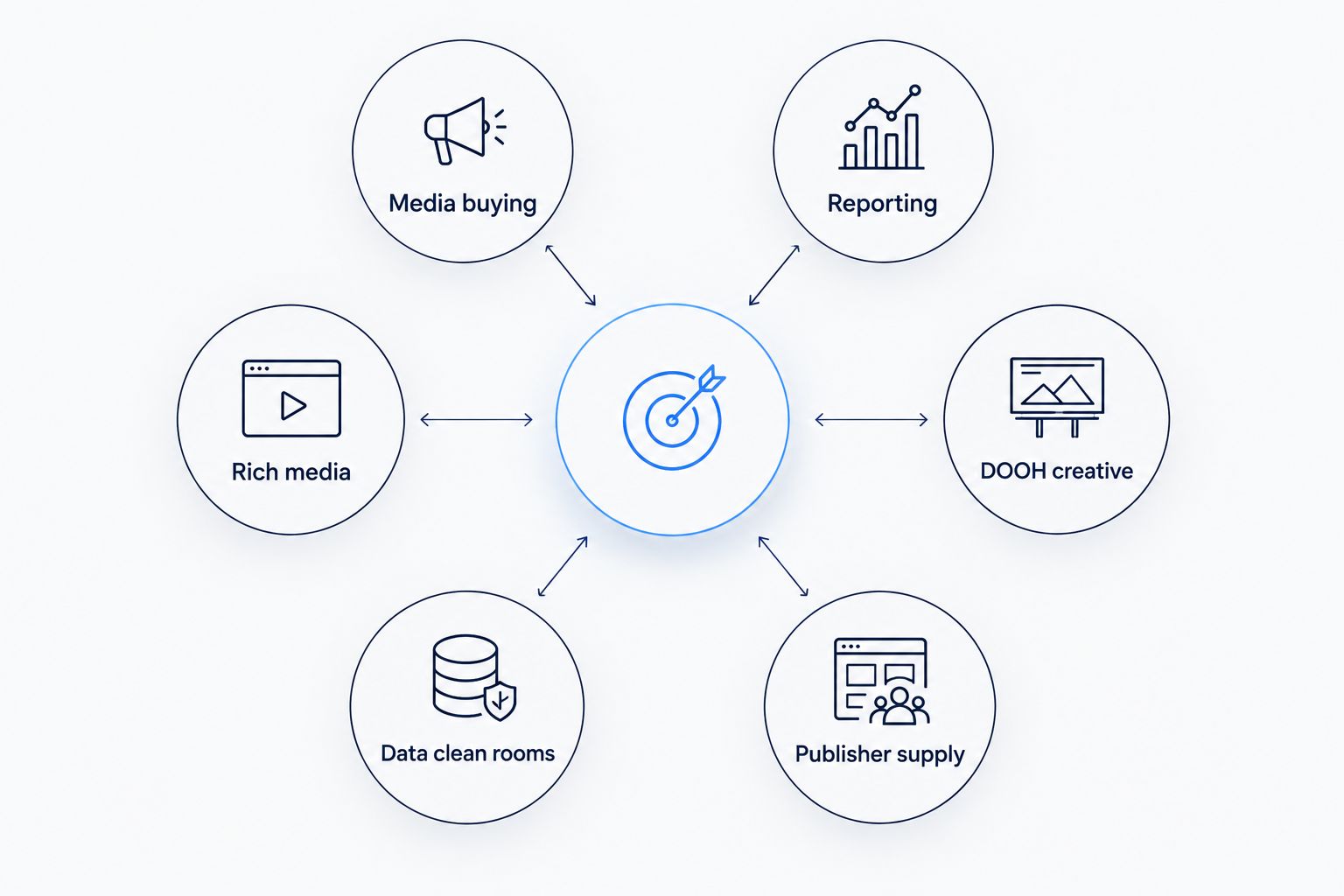
Assess transparency across the stack, not only inside the buying interface.
This is an evaluation map, not a promise that every module automatically shares every field. Ask suppliers to show the hand-offs: what information moves, who can access it and where reconciliation happens. That is how you distinguish a connected operating model from a collection of separate capabilities.
Cake.Shop provides a modular programmatic advertising technology platform covering media buying, rich media creative, data clean rooms and publisher supply. Its stated audience includes brands and independent agencies. Evaluate that breadth as a stack decision, rather than treating it only as a standalone buying tool.
Best for: Independent agencies building their own advertising stack and brands assessing an in-house programmatic operating model.
A concrete evaluation brief is a brand campaign that needs media buying, rich media production, DOOH creative requirements and reporting accountability. Add data collaboration or direct publisher supply where the campaign requires them. Ask the supplier to show how those responsibilities work together and where your team retains ownership.
Cake.Shop pros:
Cake.Shop trade-offs and checks:
Ask for a walkthrough using your own campaign structure. Trace a media decision into reporting, then identify how creative and supply information are represented. For clean-room work, request a separate explanation of permitted inputs, outputs and access controls; do not assume a clean room grants unrestricted access to underlying data.
Verdict: Hold until the proposed modules, reporting access and ownership terms match your brief. The modular scope earns a shortlist place, not an automatic transparency win.
StackAdapt is a programmatic advertising platform to evaluate when your first question is how a campaign will be planned, bought and reported. Keep the evaluation tied to that campaign. Do not convert familiarity with the platform into an assumption about fees, exports or supply disclosure.
Best for: Buyers whose immediate decision is a DSP workflow, rather than the selection of a wider modular stack.
Give StackAdapt a defined campaign scenario: an objective, required reporting dimensions, exclusions and a measurement plan. Ask for the workflow and its evidence side by side. A demonstration should show both how a setting changes and how your team verifies its effect in reporting.
StackAdapt evaluation pros:
StackAdapt trade-offs and checks:
StackAdapt fits better than a full-stack shortlist when your buying requirement is clearly defined and the surrounding functions already have owners. Confirm that fit through the demonstration and agreement, not through a general claim about ease of use.
Ask the team to reconcile a report with the commercial explanation. If the definitions differ, resolve the difference before committing your reporting process to the platform.
Verdict: Hold until the campaign workflow and reporting evidence satisfy your DSP brief. Skip a broader stack comparison if that is not the problem you need to solve.
The Trade Desk is a demand-side platform. Evaluate it through the requirements of the buying organisation: who operates campaigns, who approves changes, who reviews performance and who controls the commercial relationship. Those questions matter whether access is arranged directly or through another party.
Best for: Buyers organising an enterprise DSP evaluation around governance, buying accountability and measurement requirements.
Start with an operating model, not a feature checklist. Name the people who need campaign access, reporting access and approval responsibilities. Then ask the supplier to demonstrate how the proposed arrangement supports that model.
The Trade Desk evaluation pros:
The Trade Desk trade-offs and checks:
The Trade Desk fits better than a modular-stack evaluation when your priority is the DSP role within an already defined operating model. That is a scope distinction, not evidence that one supplier is more transparent than another.
Request the exact arrangement your team would use. Demonstrations of a different account structure do not settle questions about your permissions, exports or accountability. Put the agreed responsibilities into the procurement record.
Verdict: Hold until the proposed buying arrangement proves the access and governance your organisation requires. Do not buy on reputation alone.
For a 2026 procurement exercise, request 3 documents: a commercial schedule, a sample reporting export and an access-and-exit schedule. They answer different questions. A demonstration helps explain them but does not replace them.
Identify each charge category, its calculation basis and the party responsible. Ask how the categories reconcile with reporting. When CPM appears, define it clearly: cost per 1,000 impressions. Make sure everyone is discussing the same cost basis rather than comparing unlike calculations.
Use your intended campaign structure to inspect dimensions and definitions. Ask which fields your team can access, how aggregated values are calculated and how corrections appear. Have the person responsible for client or executive reporting review the export—not only the campaign operator.
Record who controls the account, who can export information and what remains accessible when the relationship ends. Include creative assets and reporting history in the discussion. Contractual ownership and practical retrieval are separate questions; settle both.
Use a 30-day evaluation window as a planning recommendation if it fits your procurement timetable, not as a claim about how quickly a supplier delivers. Set acceptance criteria before the window starts. Each unresolved requirement should end with an owner and a decision, not another general assurance about transparency.
This 2026 guide orders platforms by relevance to three different buying briefs: modular stack, campaign-led DSP and enterprise DSP governance. It does not assign numerical transparency scores or claim a tested winner.
The evaluation method is the same for every supplier: fee disclosure, reporting access, supply visibility, decision controls, measurement clarity, and ownership and exit. A supplier earns preference only when the evidence meets your requirements.
Rank the proposed arrangement, not just the vendor. Two buyers can encounter different contracts, permissions and intermediary relationships while using the same platform name. Your decision belongs to the arrangement you will actually sign and operate.
Choose Cake.Shop for further evaluation when your brief spans a modular programmatic stack. Choose a DSP-focused evaluation when media buying is the actual gap and the surrounding creative, data and supply responsibilities are already settled.
For the undecided buyer in 2026, the next move is not another vendor presentation. Write the required reporting fields, decision controls and ownership terms first. Then send the same brief to each shortlisted supplier.
Keep the distinction clear: best fit is about scope; transparency is about proof. Select the supplier whose proposed arrangement passes both tests, and leave unresolved claims out of the purchase decision.
What's the most transparent programmatic advertising platform?
Choose the platform that proves your required fee disclosure, reporting access, supply visibility and ownership terms. A universal winner cannot be established from platform positioning alone; assess the agreement and evidence you will actually receive.
Is Cake.Shop only a demand-side platform?
Cake.Shop provides a modular programmatic advertising technology platform spanning media buying, rich media creative, data clean rooms and publisher supply. Evaluate those areas together when your brief covers the advertising stack, rather than only the buying interface.
Is StackAdapt better than The Trade Desk for transparency?
Compare StackAdapt and The Trade Desk using the same reporting, commercial and governance requirements. A campaign-led brief and an enterprise governance brief ask different questions, so the preferred fit depends on the proposed arrangement and its evidence.
What does fee transparency mean in programmatic advertising?
Fee transparency means you can identify the charge categories, their calculation basis and the party responsible for each. Request an itemised commercial explanation and confirm how it reconciles with campaign reporting.
Does a direct publisher relationship prove transparency?
No, a direct publisher relationship does not prove transparency across the entire campaign. You still need clarity about charges, reporting definitions, measurement and your access rights.
What should an agency ask for before choosing a DSP?
Ask for a commercial schedule, a sample reporting export and written access-and-exit terms. Review them against client reporting needs and demonstrate the controls your campaign operators will use.
Does a data clean room give me access to all campaign data?
No, a data clean room does not imply unrestricted access to underlying data. Evaluate the permitted inputs, outputs and access rules for the specific arrangement.
How do I check whether platform reporting is transparent?
Inspect the export, field definitions and reconciliation process rather than relying only on a dashboard. Confirm that your reporting team can explain the metrics and retrieve the information required for its work.
The strongest closing question is not whether a platform offers transparency. Ask: Can the person signing off our reporting reproduce the explanation without a vendor on the call?
Use that as an acceptance test, not a slogan. Give the reviewer the commercial schedule, export and definitions, then ask them to explain the campaign's delivery and charges. If the explanation depends on undocumented interpretation, resolve that dependency before making the platform part of your operating model.
Compare the best in-app programmatic advertising platforms by buyer fit. Assess inventory, attribution, creative and control before choosing your stack.
Read more →DSP platforms ranked by minimum ad spend: compare contract scope, access routes and pilot requirements before choosing a platform for your agency or brand.
Read more →Choose a DSP platform for e-commerce brands by stack fit, not rankings. Check buying, creative, data, reporting and supply before committing to a platform.
Read more →Book a 30-minute demo and see exactly how Cake.Shop works — no sales pitch, just the platform.