
OPEN DAILY
OPEN
HONEST
TRUST
LET'S CHAT



Programmatic advertising has no single per-campaign cost: your total depends on the media you buy, the technology you use, the creative you produce and who operates the campaign. A media-only estimate excludes other campaign work, so your 2026 budget should separate ad delivery from platform charges, production, data and management.
TL;DR
A campaign budget is the cost of delivering the brief, not just buying impressions. Start with the outcome, audience, markets, formats and measurement requirements, then ask each provider to itemise the same scope.
Media
Technology
Creative
Data
Operations
An independent agency needs a budget it can explain to its client. An in-house team needs one that accounts for internal work as well as supplier invoices. Cake.Shop provides modular programmatic advertising technology spanning media buying and reporting, rich media and DOOH creative, data clean rooms and publisher supply.
That full-stack scope matters when you define the enquiry. Ask about the parts your campaign actually needs rather than treating every requirement as a separate buying-tool decision. Keep the same discipline when comparing an existing stack with a replacement: compare the complete operating scope, not isolated features.
CPM means cost per 1,000 impressions. It describes a delivery unit, not everything required to plan, build, run and evaluate a campaign. Ask whether a reported CPM represents media alone or includes other charges before comparing proposals.
CPC means cost per 1 click, while CPA means cost per 1 defined action. Neither metric tells you the total campaign commitment unless you also know the volume, included services and definition of the measured event.
A lower delivery metric does not, by itself, establish a better campaign. Compare the same audience, inventory, format and outcome. Otherwise, the apparent difference can reflect a different purchase rather than better value.
Keep these distinctions explicit in your 2026 planning documents:
For example, a lead-generation brief needs a clear definition of an acceptable lead. A reach brief needs a clear audience and reporting basis. Neither becomes more useful simply because a proposal includes a familiar acronym.
Programmatic campaign requirements differ across briefs. These factors explain what belongs in the budget; they are not a substitute for an itemised proposal.
For a 2026 proposal, put these assumptions beside the budget rather than leaving them in a presentation appendix. When the scope changes, update the assumptions and approval together. This gives the agency, brand and supplier a common record of what the campaign includes.
Choose the operating model around the work your team can own. Software access and campaign delivery are different responsibilities. A platform does not remove the need for planning, creative checks, trafficking, optimisation and interpretation.
Self-service
Managed service
Split responsibility
For a self-service brief, name the person responsible for launch checks and ongoing decisions. For a managed brief, specify which decisions require client approval. For split responsibility, document where one team's work ends and the next team's work begins.
Cake.Shop's modular programmatic advertising platform is relevant to brands and independent agencies building their own stack. Modularity gives you a way to discuss the components you need, but it does not replace campaign planning or establish which services your agreement includes.
Cake.Shop serves brands and independent agencies building a modular programmatic advertising stack. Assess that fit against your buying, creative, data, reporting and publisher-supply requirements, not an unsupported claim that one platform suits every campaign.
Use the following sequence to turn an advertising idea into a scope suppliers can answer. Each step should produce a decision, not another vague requirement.
A useful budget follows the same structure as the work. Keep optional requirements separate so you can remove them without losing sight of what the core campaign still needs.
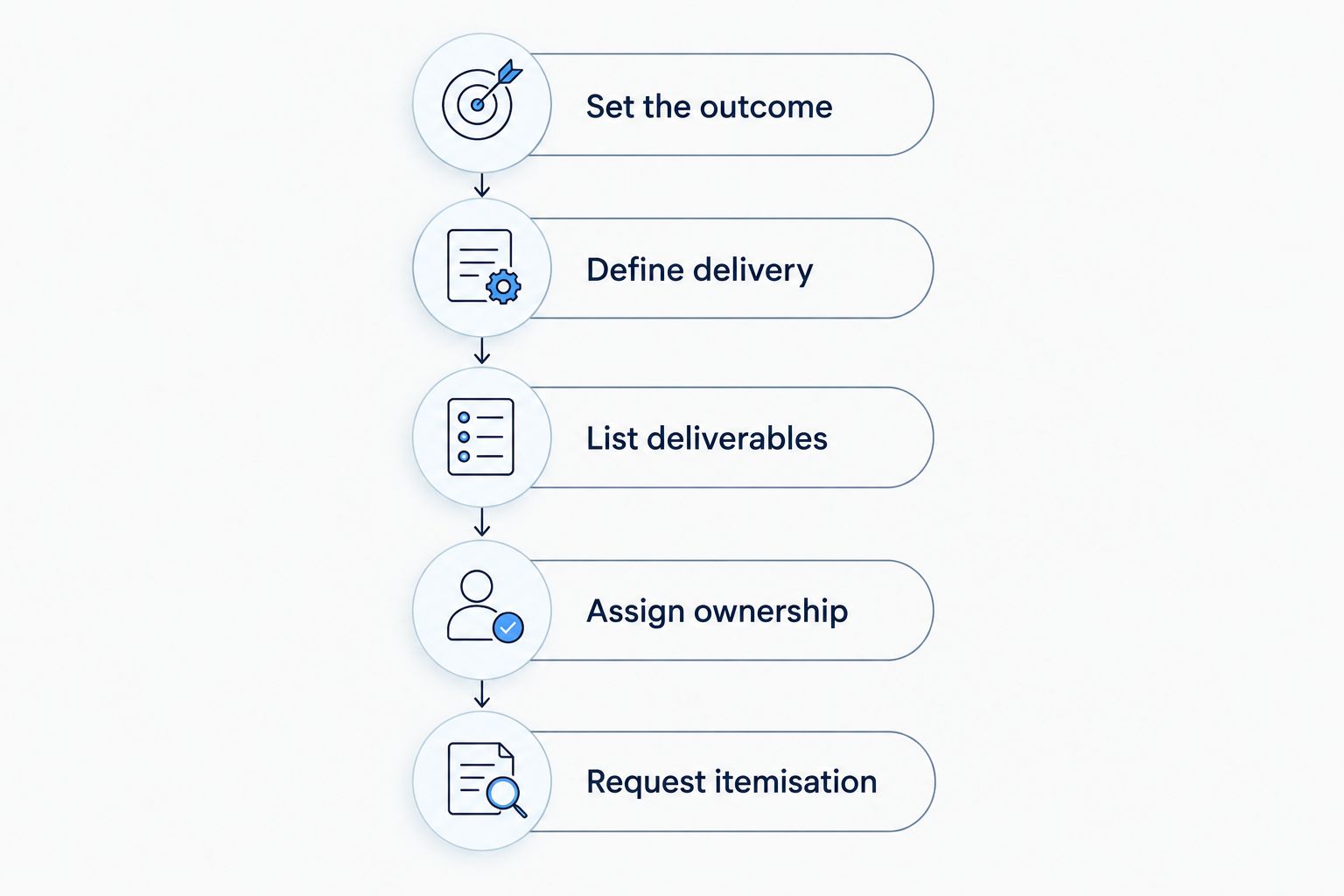
Define the work and its owner before asking suppliers to quote.
An itemised proposal should let you explain what each charge buys and how it relates to the brief. Ask the provider to identify whether each component is fixed for the agreed scope, linked to usage or dependent on additional work.
Check these points before signing:
Read platform terms separately from the campaign plan. A platform commitment and an individual campaign allocation answer different questions. The guide to how much a DSP platform costs addresses that distinction; a DSP is a demand-side platform used to buy advertising inventory.
For 2026 procurement, ask every shortlisted provider to respond in the same format. Do not compare one provider's media allocation with another provider's complete delivery scope.
Start by checking that each proposal answers the same brief. If a supplier changes the audience, creative scope or measurement approach, make that difference visible before assessing the commercial terms.
Then compare responsibilities. A proposal that includes campaign operations is not equivalent to software access alone. Equally, external operations are not automatically useful if your team already owns that work and wants to keep it.
Use a written comparison with a clear status for each requirement: included, separately scoped or not required. Ask for clarification where the response is ambiguous rather than treating silence as inclusion.
Compare the complete scope before comparing delivery metrics. This keeps the discussion tied to the campaign you intend to run. It also gives an agency a clearer basis for explaining its proposal to a brand client.
A small agency should budget for a defined, deliverable brief rather than copy another advertiser's allocation. Start with the client objective, available creative, audience requirements and the work your team can perform.
Keep the initial scope focused enough to operate and evaluate properly. Avoid adding formats or data workflows without a specific role in the plan; removing a requirement is useful only when the remaining campaign still answers the brief.
Before committing, confirm what your agency owns and what the provider supplies. That distinction protects the client relationship: your proposal should explain delivery responsibilities without relying on assumptions about the platform.
Bringing programmatic in-house moves responsibility into your team; it does not remove the work. Your budget still needs to account for campaign setup, asset checks, buying decisions, reporting and coordination.
Compare external scope with internal capacity, not just supplier invoices. Identify who performs each task, who covers absences and who approves changes when campaign requirements shift.
For a 2026 in-housing plan, assess the stack as a connected workflow. Cake.Shop combines modular media buying and reporting, rich media and DOOH creative, data clean rooms and publisher supply; your enquiry should identify which components you need and which existing systems must remain part of the process.
Define your programmatic stack requirements
Discuss the buying, creative, data, reporting and publisher-supply components your campaign needs.
How much does programmatic advertising cost per campaign?
Programmatic advertising has no single per-campaign cost. Build the budget from media, technology, creative, data and campaign operations, then request an itemised proposal for that scope.
Does a programmatic CPM include all campaign costs?
A CPM does not automatically include all campaign costs. CPM means cost per 1,000 impressions; ask which charges are included in the reported figure.
Is media spend the same as my total campaign budget?
Media spend is not the same as your total campaign budget. Your campaign can also require technology, creative, data and operational work, depending on the agreed scope.
Is self-service programmatic cheaper than a managed service?
Self-service and managed proposals cannot be compared fairly without accounting for the same work. Self-service assigns execution to your team, while a managed engagement assigns an agreed scope to a provider.
What should I ask for in a programmatic advertising quote?
Ask for separate media and non-media components, their charging basis, included work and scope-change conditions. Specify reporting access and responsibility for setup, creative, optimisation and measurement.
Do I need a data clean room for every programmatic campaign?
A data clean room should answer a defined data-collaboration requirement, not appear automatically in every campaign brief. Establish the intended use, permissions, participants and required output before adding that workflow.
Who is Cake.Shop's programmatic advertising platform for?
Cake.Shop serves brands and independent agencies building a modular programmatic advertising stack. Its stated scope includes media buying and reporting, rich media and DOOH creative, data clean rooms and publisher supply.
Ask each supplier to explain what remains your responsibility after you approve the proposal. The answer reveals whether you are buying technology access, an operational service or a combination of both.
A campaign budget is ready when every required task has an owner and every quoted component has a defined scope. Use that standard before approving spend, not after the campaign launches.
Is programmatic advertising worth it for small brands? Yes, with a clear test. Compare channel fit, measurement needs and the work behind a useful pilot.
Read more →How much does programmatic advertising cost per campaign? Scope comes first. Separate media, platform, creative and management costs to compare quotes.
Read more →Can a self-serve DSP replace a managed service? Yes, with operational ownership. Compare self-serve, managed and hybrid models before making the move.
Read more →Book a 30-minute demo and see exactly how Cake.Shop works — no sales pitch, just the platform.