
OPEN DAILY
OPEN
HONEST
TRUST
LET'S CHAT



Yes, a self-serve DSP can replace a managed service when your team can own campaign setup, optimisation, measurement and troubleshooting—not just approve media plans. The platform replaces buying access; it does not replace the people, judgement or operating processes behind a managed service.
TL;DR
Bringing programmatic in-house changes who does the work. Someone still needs to check delivery, diagnose tracking problems, review placements and explain results to the person signing off the budget. A login is not an operating model.
For your 2026 stack review, separate the technology decision from the staffing decision. Cake.Shop provides modular programmatic technology; whether you replace external campaign management depends on your own operational readiness.
Choose self-serve because you can take responsibility for execution, not because the interface looks straightforward. That distinction matters for independent agencies protecting client relationships and brands taking direct responsibility for media performance.
A self-serve demand-side platform, or DSP, gives your team direct access to programmatic media buying. A managed service adds people who carry out agreed campaign work. Replacing the service therefore means transferring responsibilities, not simply moving campaigns between accounts.
Use the following sequence to decide whether that transfer is practical.
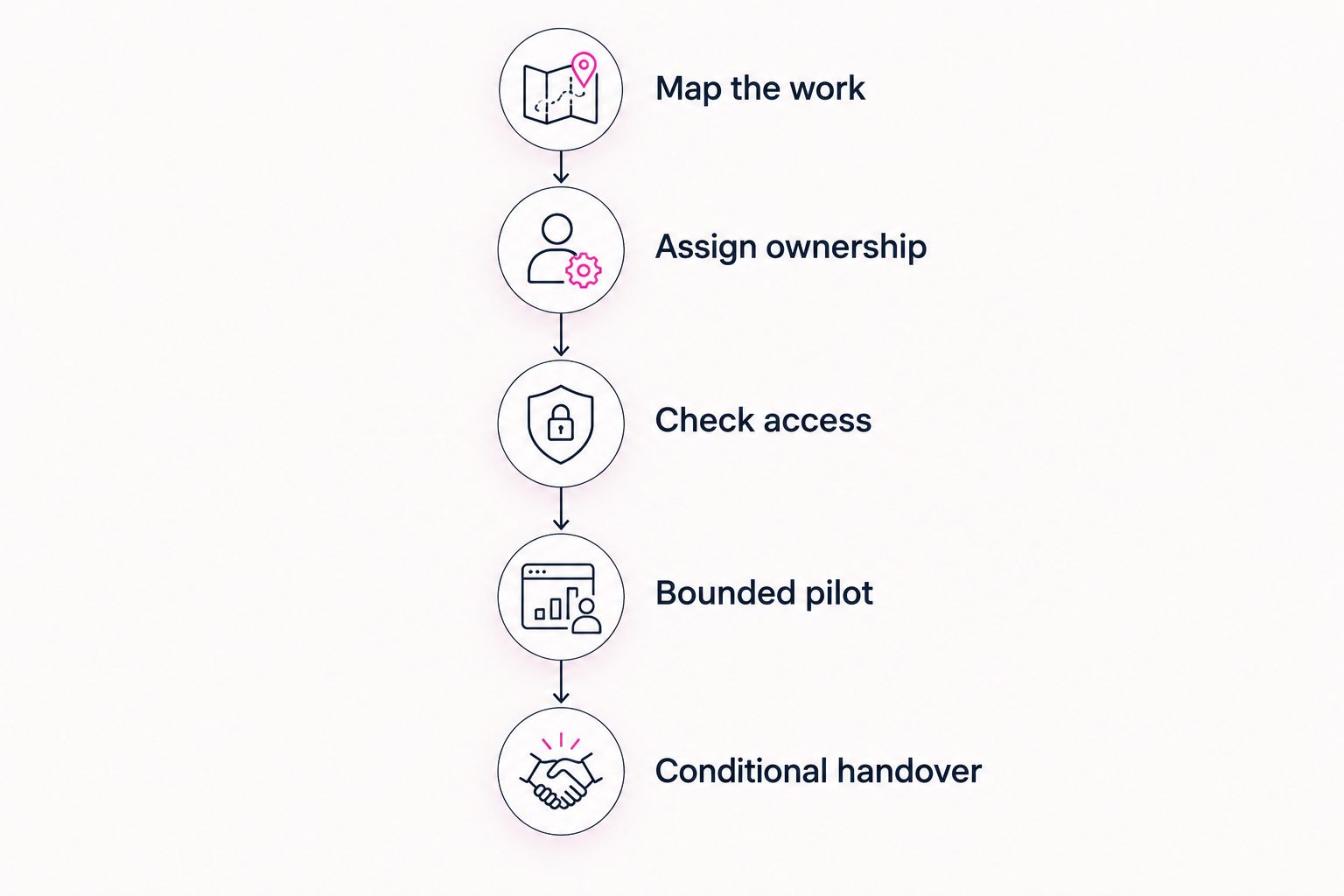
Transfer campaign responsibilities only after checking ownership, access and operational readiness.
The pilot should test ordinary work and exceptions. Ask the operator to explain an underdelivering campaign, investigate a tracking discrepancy and show how an incorrect setting would be corrected. Knowing where a control sits is different from knowing when to use it.
For a 2026 procurement review, compare who performs the work and who remains accountable. Platform features alone do not answer those questions.
Self-serve
Managed service
Hybrid
There is no automatic performance winner among these models. A comparison needs equivalent campaign objectives, measurement definitions and an explicit account of who did what. A different operating model is not evidence of better results.
Self-serve makes sense when you want direct control and have someone accountable for using it. For an independent agency, that means campaign operations must fit alongside client communication, planning and reporting—not sit in the gaps between them.
The practical advantage is decision ownership. Your operator can inspect settings, implement approved changes and build an internal record of what happened. That creates useful continuity when the organisation controls the relevant accounts and documentation.
The limitation is workload. Access to targeting controls does not resolve an unclear brief, repair a broken measurement setup or decide whether a creative message fits the audience. Those remain operating responsibilities.
Before reviewing self-serve DSP platforms, write down the decisions your team needs to make directly. Separate essential controls from features that look useful in a demonstration but have no owner in your workflow.
For example, an agency might bring routine campaign changes in-house while retaining external help for unfamiliar formats. That is a narrower, more testable decision than promising to replace every part of the service at once.
Keep a managed service when you need an external team to carry out defined campaign work. That is a capacity decision, not an admission that your organisation lacks strategic control.
A brand can retain responsibility for objectives, creative approval and business measurement while a provider handles campaign operations. The arrangement works only if both sides understand which decisions require approval and which sit within the operator's remit.
The trade-off is dependency. If campaign changes, reporting requests or investigations must pass through another team, your working agreement needs clear escalation routes and access expectations. Do not assume every managed service includes the same tasks or visibility.
For your 2026 review, ask the provider to demonstrate the service boundary using a real workflow. Who investigates a missing conversion signal? Who approves an audience change? Who explains the difference between delivery and business results?
Keep management where it fills a defined capability gap. Retaining an entire service because nobody has documented its responsibilities leaves the underlying dependency unresolved.
A hybrid model divides work between your team and an external operator. It suits an agency or brand that wants more direct ownership without taking every operational responsibility in-house immediately.
A useful split follows capability. Your team might own planning and reporting interpretation while an external specialist handles agreed campaign execution. Alternatively, your operator might manage familiar campaigns and seek specialist help for a new channel.
The disadvantage is coordination. If both parties can change settings but neither maintains the decision record, investigations become difficult. If each assumes the other checked tracking, a basic responsibility has no owner.
Define the handover points in writing. Specify who launches, who can change budgets, who reviews delivery, who investigates discrepancies and who communicates with stakeholders. Describe the work rather than relying on broad labels such as support or strategy.
A hybrid arrangement should have a purpose. Decide whether it is your long-term operating model or a transition with explicit readiness criteria; otherwise, temporary overlaps become permanent confusion.
The right model depends on the work your campaigns require and the people available to do it. Assess these factors against your actual account structure rather than a generic maturity label.
These factors also explain why spending alone is an incomplete decision rule. A campaign's budget does not tell you whether your team can operate its measurement, creative and approval workflows.
A full-stack decision connects media buying with reporting, creative, data and publisher supply. Assessing the DSP in isolation leaves important handovers outside the procurement discussion.
Cake.Shop is for brands and independent agencies evaluating a modular programmatic advertising stack. Its stated scope includes media buying and reporting, rich media and DOOH creative, data clean rooms, and direct publisher supply. That makes the relevant question broader than whether your team can place a bid.
Map how those areas fit your campaign process. Who approves creative? Who authorises data use? Who evaluates the supply route? Who turns reporting into a decision the client or brand team understands?
The limitation is equally clear: a modular stack does not establish that your organisation has operators, measurement ownership or an effective approval process. Verify the capabilities and working arrangements your use case requires rather than assuming the technology supplies the team.
For a 2026 buying decision, ask for a demonstration built around your workflow. Bring a campaign brief, a reporting requirement and a realistic exception scenario. Request a clear distinction between what the platform handles, what your team handles and what requires another service.
Review your programmatic stack
Explore modular media buying, creative, data clean rooms and publisher supply.
You can bring ownership in-house without assigning every execution task to an employee. A hybrid arrangement can retain external operations while your team controls objectives, approvals and measurement requirements.
If an existing employee will operate campaigns, assess their capability and available workload explicitly. Renaming the responsibility does not create the time or expertise to fulfil it.
Self-serve gives you direct access to the controls and information included in your account permissions. It does not, by itself, establish complete visibility into fees, supply relationships or measurement methods.
Ask for those details separately. Transparency is a set of verifiable access rights, disclosures and reporting definitions—not a label attached to an operating model.
Keep external campaign management when your team cannot yet take responsibility for essential operational tasks. Retain the specific work you need, with clear ownership and escalation arrangements.
Reassess after the internal team demonstrates readiness. The decision should follow evidence from your workflow, not a deadline chosen before the work was mapped.
Can a self-serve DSP completely replace a managed service?
A self-serve DSP can replace a managed service when your team takes responsibility for all the operational work the service performed. Check planning, setup, optimisation, creative coordination, measurement and troubleshooting before making the transfer.
Is self-serve programmatic better for an independent agency?
Self-serve suits an independent agency with capable operators and a clear reason to own campaign execution. Managed service or hybrid arrangements fit agencies that still need external capacity or specialist execution.
Will switching to a self-serve DSP reduce our costs?
A switch does not establish a saving on its own. Compare the full operating requirements, including internal labour, technology, data, creative work, measurement and any retained external services.
Does platform support replace a managed service?
Platform support is not a substitute for campaign management unless the agreed scope explicitly includes that work. Confirm who handles setup, optimisation, reporting investigations and urgent campaign changes.
Can a brand keep its agency while using a self-serve DSP?
A brand can retain its agency while taking selected programmatic responsibilities in-house. Document account access, approval authority, operational ownership and reporting responsibilities so the arrangement has no unassigned tasks.
Where does Cake.Shop fit in an in-house programmatic stack?
Cake.Shop provides modular programmatic technology spanning media buying and reporting, rich media and DOOH creative, data clean rooms, and publisher supply. Evaluate those areas against your operating requirements rather than treating the platform as only a buying interface.
What should a DSP migration pilot prove?
A DSP migration pilot should prove that the intended operator can launch, monitor, explain and correct the agreed campaign scope. Use consistent objectives and measurement definitions, and record any work that still depends on external support.
Before signing off a 2026 migration, ask your intended campaign owner to walk through what happens when delivery stops unexpectedly. They should identify what to inspect, who has the necessary access and when to escalate.
If that workflow has no owner, keep the relevant management support until it does. A handover is complete when responsibility works under pressure—not when the new account opens.
Is programmatic advertising worth it for small brands? Yes, with a clear test. Compare channel fit, measurement needs and the work behind a useful pilot.
Read more →How much does programmatic advertising cost per campaign? Scope comes first. Separate media, platform, creative and management costs to compare quotes.
Read more →Can a self-serve DSP replace a managed service? Yes, with operational ownership. Compare self-serve, managed and hybrid models before making the move.
Read more →Book a 30-minute demo and see exactly how Cake.Shop works — no sales pitch, just the platform.