
OPEN DAILY
OPEN
HONEST
TRUST
LET'S CHAT



Programmatic advertising is worth it for small brands when it solves a defined reach, audience or publisher-access problem and you can measure the result. In 2026, the deciding factor is not business size: it is whether the campaign justifies the creative, measurement and management work beyond buying impressions.
TL;DR
A small brand does not need another advertising dashboard. You need a reason to move money and attention away from work that already supports sales or qualified enquiries. Programmatic deserves consideration when your current channels leave a specific gap, not simply because automated buying sounds efficient.
For brands bringing advertising in-house, Cake.Shop provides a modular platform spanning media buying, rich media creative, data clean rooms and publisher supply. That scope makes the question bigger than which buying interface to choose. Decide which parts of the advertising stack you need to operate, and who will own the work.
Yes, if you can name the job it will do, explain why your existing channels cannot do that job adequately, and judge the result against a business outcome. Otherwise, keep your current channel mix and fix the missing foundations first.
Use this comparison to separate different advertising jobs. These are channel-selection criteria, not promises of performance.
Paid search
Paid social
Programmatic advertising
The practical distinction is intent versus access. Someone searching for your service has expressed a need; someone reading relevant editorial content has not necessarily done so. Your programmatic message must work without assuming the reader already wants to buy.
For a small brand, that changes the test. Do not judge an audience-building campaign solely by the same immediate response expected from a high-intent search campaign. Equally, do not use awareness as an excuse to avoid an accountable objective.
Proceed when you have a specific audience, a credible message and a useful way to assess the outcome. A defined geographic market, a relevant publishing context or an identifiable customer-data use case gives the campaign a clearer purpose than simply seeking more exposure.
A useful brief sounds like this: reach people in the service area who are not already arriving through branded search, then assess whether the campaign adds qualified enquiries. That is a testable question. “Get the brand everywhere” is not.
Wait when the offer is unclear, the landing page does not support the advertised action, or nobody owns campaign decisions. Programmatic distribution does not repair those problems. It adds another place where they affect results.
Also wait if the only proposed benefit is cheaper impressions. An impression is an ad delivery event, not evidence of attention, a qualified visit or a sale. Delivery efficiency and commercial effectiveness are different questions.
Business size alone does not establish channel fit. These factors determine whether your 2026 programme has a useful job and an accountable owner:
These factors interact. A clearly defined audience cannot compensate for broken measurement, and detailed reporting cannot rescue an irrelevant message. Treat the campaign as an operating system of connected decisions, not an isolated media purchase.
Build a pilot around a decision you need to make. The goal is not to demonstrate every available capability; it is to establish whether a defined use case deserves continued investment.
Write down the commercial question before speaking to a platform or agency. Specify the audience, the intended action and the reason your existing channels leave a gap. Include the decision the result will inform: continue, change the approach or stop.
Keep that question stable during the pilot. If the campaign begins as an enquiry-generation test and becomes an awareness exercise after weak results, the original decision remains unanswered.
Choose the business outcome and supporting delivery measures separately. Qualified enquiries or completed purchases answer a different question from impressions, clicks or visits. Use supporting measures to diagnose delivery, not to replace the objective.
Document attribution rules before launch. Attribution assigns credit under a chosen method; incrementality asks whether the outcome happened because of the advertising. Use a suitable comparison or holdout design where practical, and describe its limitations honestly.
Specify the publishing environments, geography and exclusions that make sense for the brand. Ask what placement information will be available and how unsuitable delivery will be handled. Do not accept a large inventory description as a substitute for campaign relevance.
Keep the buying plan narrow enough to interpret. Launching across unrelated environments at once makes it harder to identify which part of the plan deserves another test.
Give unfamiliar audiences enough context to understand the offer. Match the message and landing page so that a person responding to the ad reaches the promised information. Rich media adds interaction, but interaction alone is not a business outcome.
Choose formats because they serve the brief. A more elaborate asset adds production and review work; use that complexity only when the message benefits from it.
Review delivery quality alongside the business result. Check whether the intended audience and environments were reached, whether tracking worked, and whether the outcome supports the original hypothesis.
Separate a failed proposition from a failed implementation. Unsuitable placements, incorrect geography or broken tracking do not answer whether the channel works for your brand. Correct those faults before drawing a broader conclusion.
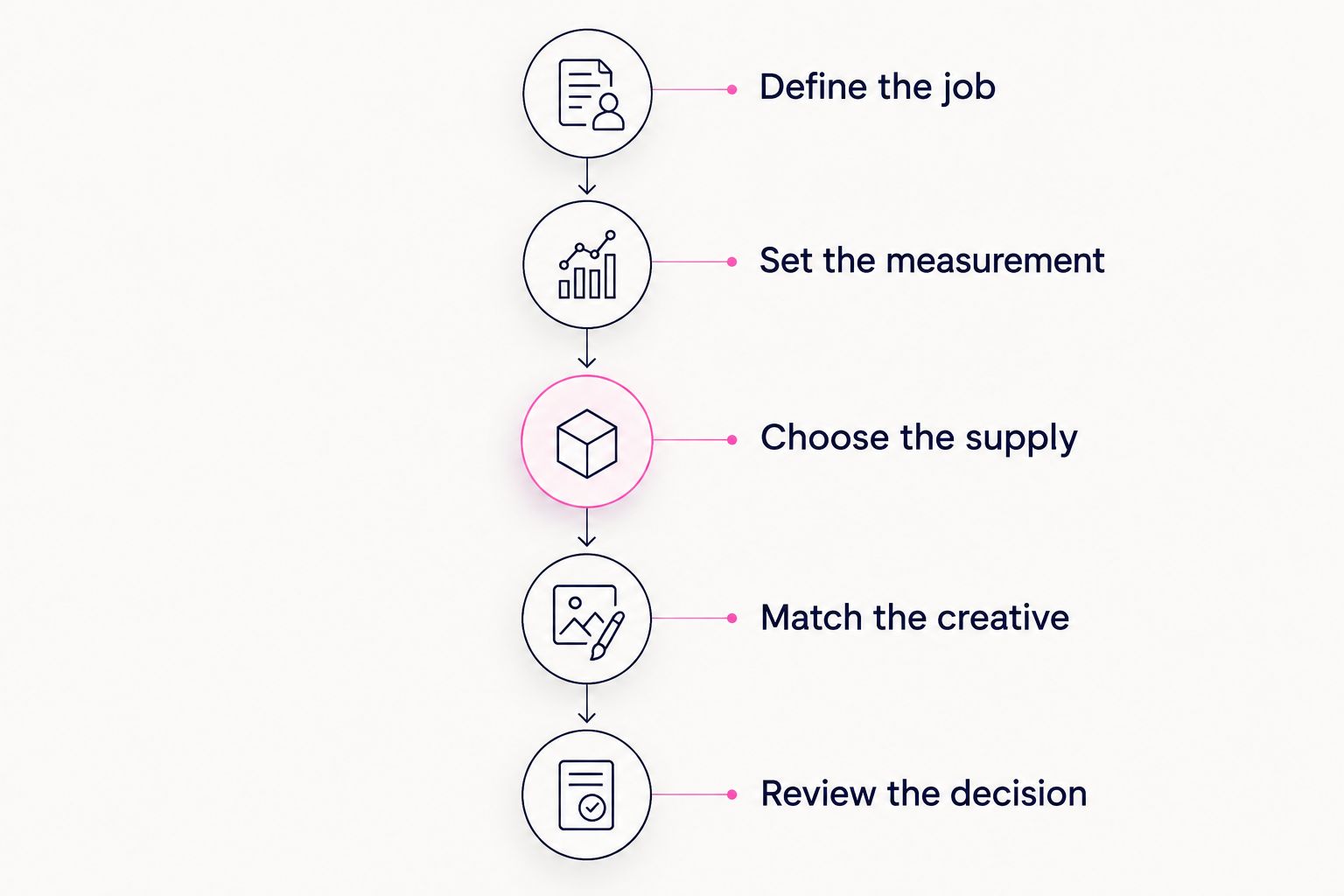
Agree the decision and measurement before choosing supply or creative.
A buying platform is part of the answer, not the entire operating model. For a small brand's 2026 plan, map the required work across buying, reporting, creative, data and publisher access before deciding what to bring in-house.
Cake.Shop is a modular programmatic advertising platform for brands bringing buying in-house and independent agencies building their own stack. Its stated scope includes media buying and reporting, rich media and digital out-of-home creative, data clean rooms, and direct publisher supply.
That breadth is relevant when you want to assess connected parts of the stack rather than a standalone buying tool. The trade-off is decision-making responsibility: a modular approach still requires you to specify the components, responsibilities and reporting your campaign needs. A product category is not proof that a particular integration or workflow is included.
Buying handles media execution; reporting helps you inspect delivery and results. Ask for a demonstration using your intended campaign structure and business outcome. Check what you can inspect, what you can export and which decisions require support.
Do not confuse access to a dashboard with operational readiness. Someone still needs to interpret the result and act on it.
Rich media and digital out-of-home, or DOOH, serve different placement contexts. Interactive advertising and advertising on physical digital screens do not offer identical response paths. Match the format to the audience situation and measurement plan.
For a small pilot, choose the format required by the brief. Access to more formats is not a reason to use them all.
A data clean room supports controlled analysis or collaboration involving data. It is not a shortcut around consent, permissions or the need for a defined data use case. Do not make a clean room a prerequisite for a campaign that does not need one.
Publisher supply concerns the advertising inventory available to buy and the route through which it is accessed. Ask how direct publisher supply applies to your intended campaign rather than assuming every placement follows the same route.
Choose the operating model by responsibility, not by who has the login. In-house buying gives your team direct operating responsibility; an agency arrangement assigns agreed work to an external team. Neither arrangement removes the need for clear measurement and commercial oversight.
For a small brand assessing programmatic in 2026, list who owns creative approval, campaign changes, reporting interpretation and supplier questions. If those responsibilities are unassigned, the operating model is unfinished.
An independent agency should also separate platform selection from client strategy. Cake.Shop's modular programmatic advertising platform is relevant to that stack-building discussion, but the agency still needs to explain why the proposed campaign suits the client's objective. Access to technology is not the same as a justified media plan.
Is programmatic advertising worth it for a small brand in 2026?
Programmatic advertising is worth it for a small brand in 2026 when it addresses a defined audience or publisher-access gap and has accountable measurement. Wait if the offer, landing page or campaign ownership is not ready.
Is programmatic better than paid search for a small business?
Programmatic is not automatically better than paid search for a small business. Paid search addresses expressed search intent, while programmatic can address a distinct audience or publisher-access objective; choose according to the job.
Do I need a large customer database to try programmatic advertising?
A large customer database is not a universal prerequisite for programmatic advertising. A campaign can be planned around relevant publishing contexts or geography, subject to the platform and inventory; customer-data activation is a separate use case.
Can a small brand manage programmatic advertising in-house?
A small brand can manage programmatic advertising in-house if someone owns execution, creative, measurement and review. Platform access alone does not provide the time or expertise to perform those tasks.
Does a reported conversion prove programmatic advertising worked?
A reported conversion does not prove that programmatic advertising caused the outcome. Attribution assigns credit under a reporting method; evaluating incremental impact requires an appropriate comparison and attention to its limitations.
What should I ask Cake.Shop before choosing a platform?
Ask Cake.Shop which buying, reporting, creative, data and publisher-supply components match your campaign brief. Confirm the required workflows, responsibilities and commercial terms rather than assuming that every component is necessary or included.
Write the stop rule before launch. Specify what would make the campaign uninformative, what would justify another test and what would make you stop spending attention on the idea.
That document is more useful than a promise of cheap reach. For your 2026 plan, a worthwhile pilot produces a decision—not just a delivery report.
Is programmatic advertising worth it for small brands? Yes, with a clear test. Compare channel fit, measurement needs and the work behind a useful pilot.
Read more →How much does programmatic advertising cost per campaign? Scope comes first. Separate media, platform, creative and management costs to compare quotes.
Read more →Can a self-serve DSP replace a managed service? Yes, with operational ownership. Compare self-serve, managed and hybrid models before making the move.
Read more →Book a 30-minute demo and see exactly how Cake.Shop works — no sales pitch, just the platform.