
OPEN DAILY
OPEN
HONEST
TRUST
LET'S CHAT


DOOH advertising in Australia is quoted against the screens, locations, dates and delivery terms you choose; there is no single national cost that applies to every campaign in 2026. Your media quote is only part of the budget: creative production, buying technology, campaign management, measurement and GST also need a clear place in the scope. Compare the total campaign commitment, not an isolated media rate.
TL;DR
A low-looking media rate does not tell you whether a campaign reaches the right places or includes the work needed to launch. A quote for selected roadside screens is not interchangeable with a quote for a broader indoor network, even when both use the same billing unit.
Start with the buying requirements, then compare DOOH advertising platforms. For independent agencies and in-house brand teams, the decision also includes who controls buying, creative changes and reporting. Those responsibilities belong in the brief before supplier selection.
The useful answer is an itemised quote for a defined campaign, not an Australian-wide average. In 2026, request the same geography, screen environment, campaign dates and delivery requirements from each supplier. Otherwise, the totals describe different purchases.
Use this breakdown to establish what each quote actually includes. These are budget components to confirm, not charges that every supplier necessarily applies.
Media
Creative
Buying technology
Campaign management
Measurement
Tax
Do not add every row automatically. Ask the supplier to mark each component as included, separately scoped or not required. That distinction prevents you from counting a bundled service twice or overlooking work your team must perform.
Australia's standard GST rate is 10% on taxable supplies. Confirm the tax treatment on the actual quote rather than assuming every total is presented on the same basis.
CPM means cost per 1,000 impressions. In DOOH, an audience impression estimate is not the same thing as a recorded screen play, so the impression methodology matters alongside the rate.
Ask which audience measurement source supports the estimate, how it applies to the selected screens and whether the report distinguishes forecast delivery from delivered estimates. A mathematical comparison is only useful when the underlying units mean the same thing.
1 ad play does not equal 1 verified viewer. Playback records concern the screen; audience estimates concern the people expected to have an opportunity to see it.
Request both the delivery definition and the reporting fields before booking. If your approval process requires proof that an asset ran at particular locations, make that requirement explicit rather than assuming an audience summary will satisfy it.
A direct booking involves agreeing the campaign with a media owner or its representative. The agreement should identify the placement scope, schedule and delivery obligations; do not assume a direct relationship automatically means exclusive screen use.
Best for: a brief centred on named locations and an agreed placement schedule, provided the supplier accepts those requirements.
The advantage is a placement-led discussion with the party selling that inventory. The trade-off is that cross-owner coordination, creative handovers and reporting still need an assigned owner. Specify how schedule changes, substitutions and missed delivery are handled before approving the booking.
For an agency, the practical question is whether the team can manage those responsibilities within the agreed service scope. For an in-house brand, it is whether the booking process fits existing creative approvals and campaign reporting.
Programmatic DOOH uses software to transact advertising inventory. A demand-side platform, or DSP, is the buying system; it does not make every screen available or turn every campaign into an auction with identical conditions.
Best for: a brief that requires software-based buying and defined delivery controls across the inventory available through the chosen setup.
The advantage is the ability to organise buying through a software workflow. The trade-off is another layer of commercial and technical decisions: supply access, buying permissions, reporting definitions and platform terms all need checking.
Ask whether the proposed transaction is auction-based or governed by an agreed deal, and what delivery commitments apply. Do not infer guaranteed delivery from the word programmatic.
Direct booking
Programmatic buying
Neither route is automatically the cheaper or better choice. Choose the route that meets the brief, then compare its complete commercial scope.
For a 2026 brief, hold these factors constant when comparing proposals. If a supplier changes a factor, ask for the change to be identified rather than buried in the total.
A supplier should be able to explain how the proposal maps to these requirements. If the proposal substitutes a broader geography or a different screen environment, evaluate that as a changed plan, not simply a better deal.
Send suppliers one brief with explicit acceptance criteria. The aim is not to force identical buying models; it is to make differences visible before you commit.
A good brief also states who can approve changes. Without that authority, even a technically straightforward campaign can become a chain of unanswered handovers.
Before signing, ask for 2 documents: the itemised commercial proposal and the delivery specification. Read them together. A detailed rate explanation does not replace a clear statement of what will run and how delivery will be evidenced.
Treat the stack as connected responsibilities rather than a shopping list of tools. Media buying determines the delivery setup; Creative provides approved assets; Publisher supply defines the inventory relationship; and Reporting explains what happened.
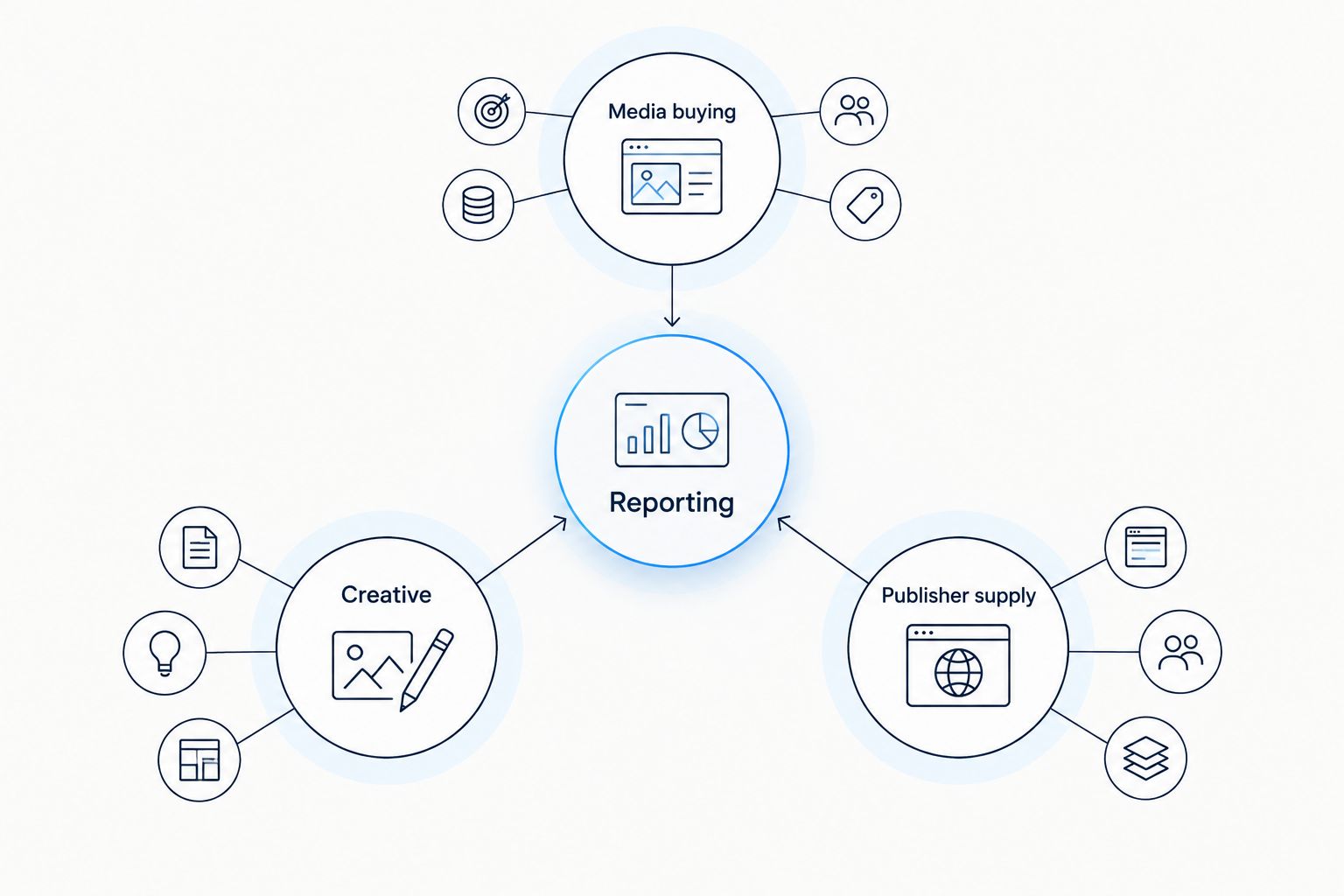
Define the handovers as carefully as the individual buying and creative tasks.
Cake.Shop provides a modular programmatic advertising stack covering media buying and reporting, rich media and DOOH creative, data clean rooms, and direct publisher supply. That makes the enquiry broader than access to a buying account: an agency or in-house team should explain which parts it needs and which it already operates.
The trade-off with a modular stack is that module selection does not remove responsibility for handovers. Confirm the proposed DOOH inventory, creative workflow, reporting outputs and commercial scope rather than assuming every platform component belongs in every campaign.
Cake.Shop serves brands and independent agencies building a modular programmatic advertising stack. For a 2026 enquiry, bring the campaign brief and identify the work your team intends to own. That gives the commercial discussion something concrete to assess.
Scope your advertising stack
Bring your DOOH brief and identify the buying, creative, supply and reporting responsibilities you need.
Programmatic DOOH is not automatically cheaper than direct booking. Compare equivalent inventory, schedules, delivery obligations and operating scope before drawing a conclusion.
A platform-based proposal and a media-owner proposal can allocate work differently. Identify that difference before treating either headline figure as a saving.
A DOOH media quote does not establish that creative production is included; the written scope does. Ask whether the proposal covers supplied assets, adaptations or original production, and who handles approval.
Also confirm the process for replacement files. A campaign that changes its message needs an agreed creative workflow, not just permission to buy media.
Check delivery against the agreed specification, using playback evidence and the stated audience methodology where applicable. Neither a booking confirmation nor a creative approval proves that the planned campaign ran.
For a 2026 campaign review, keep media delivery and business outcomes separate. Delivery reporting answers what ran; an outcome assessment needs its own method and scope.
How much does DOOH advertising cost in Australia in 2026?
DOOH advertising in Australia is quoted against the inventory, schedule and delivery terms of the campaign. Request an itemised scope covering media, creative, technology, management, measurement and GST treatment.
What does CPM mean for DOOH advertising?
CPM means cost per 1,000 impressions. Ask how DOOH audience impressions are estimated, because a screen play and an audience impression are different measures.
Does one DOOH ad play mean one person saw it?
No: 1 ad play does not equal 1 verified viewer. Playback evidence records screen delivery, while audience estimates use a separate measurement method.
Is programmatic DOOH better than buying directly?
Neither route is automatically better. Direct booking suits placement-specific discussions, while programmatic buying suits a software-based workflow; the right choice depends on inventory, controls and responsibilities.
Do I need a data clean room for a DOOH campaign?
Do not add a data clean room without a defined data collaboration or measurement requirement. Establish the purpose, permissions and expected output before including it in the campaign scope.
What should an agency ask Cake.Shop about DOOH?
Ask Cake.Shop how the proposed scope connects media buying, DOOH creative, publisher supply and reporting. Bring your inventory requirements and identify which responsibilities your agency will keep.
Should Australian DOOH quotes include GST?
Ask each supplier to state the GST treatment explicitly. Australia's standard GST rate is 10% on taxable supplies, so tax-inclusive and tax-exclusive totals need to be distinguished.
Check the sample report before approving the campaign. If the report cannot show the evidence your team needs, the problem belongs in the buying specification—not in a post-campaign argument.
Ask the supplier to walk through a report structure against your brief. Clarify the meanings of plays, estimated impressions, locations and reporting periods before those fields become the basis of an invoice reconciliation.
How long does it take to set up a data clean room? Readiness determines the timeline. Map permissions, data preparation and validation before launch.
Read more →How much does DOOH advertising cost in Australia? It depends on the brief. Compare media, creative, platform fees and delivery terms before you book.
Read more →Can a data clean room work without cookies? Yes. Learn what first-party matching needs, where activation fails, and what to check before choosing a provider.
Read more →Book a 30-minute demo and see exactly how Cake.Shop works — no sales pitch, just the platform.