
OPEN DAILY
OPEN
HONEST
TRUST
LET'S CHAT



A DSP platform’s total cost depends on the commercial agreement, the media you buy and the services you need; there is no single price that answers the question for every buyer in 2026. A platform fee alone does not account for media, creative production, data, measurement or the people running your campaigns.
TL;DR
The useful answer is the total cost of running your intended campaigns, not an isolated technology charge. Ask each provider to quote against the same campaign brief, service responsibilities and reporting requirements. Otherwise, you are comparing different scopes under the same DSP label.
A demand-side platform, or DSP, is software used to buy advertising inventory programmatically. Its commercial agreement needs to distinguish the software from the advertising purchased through it. A minimum media commitment is also different from a platform fee; the guide to DSP platforms ranked by minimum ad spend addresses that separate buying constraint.
Use this breakdown to check what a proposal actually covers. These are cost categories to investigate, not charges that every provider applies.
Media
Platform
Data
Creative
Measurement
Operations
An annual procurement decision also needs a consistent currency, tax treatment and contract period. For international agencies, a proposal quoted in another currency is not directly comparable with a domestic proposal until finance has normalised those terms.
A headline fee answers a narrow question: what does this supplier charge for the stated scope? Your business question is broader: what will it take to operate the stack and deliver the reporting your stakeholders expect?
For a 2026 procurement brief, define the work before discussing the fee. An independent agency managing client campaigns and a brand bringing buying in-house can need similar technology but different support, permissions and reporting arrangements.
Ask providers to identify their charging model explicitly. A proposal can combine several models, so do not assume the label describes the whole agreement.
The following comparison explains the trade-offs to examine. It does not assign any model to a named provider.
Fixed platform fee
Spend-linked fee
Managed service
Modular agreement
A fixed fee is not automatically more transparent than a spend-linked fee. Transparency comes from a clear charging basis, identifiable inclusions and invoices you can reconcile.
Likewise, managed service is not automatically poor value because it includes labour. Compare the work supplied with the work your team would otherwise perform. Keep that operational comparison separate from the media-buying comparison.
Choose the commercial model after defining who does the work. Reversing that order makes it easy to select an attractive agreement that leaves essential tasks unassigned.
DSP cost varies because buyers are not purchasing identical operating arrangements. Build your evaluation around these factors rather than treating the platform as an interchangeable login.
These factors also explain why a single DSP fee cannot describe a complete advertising stack. Buying, creative, data, supply and reporting need to work together, even when you procure them separately.
Give every shortlisted provider the same brief. A useful 2026 comparison starts with your operating requirements and ends with a reconciliation exercise, not a slide showing a headline fee.
Describe the campaigns you intend to run, the markets you need to reach and the creative formats you plan to use. State whether you are buying technology for an existing trading team or asking a provider to handle execution.
Include reporting requirements at this stage. Discovering after selection that finance needs a different billing breakdown or clients need a different reporting structure creates avoidable work.
Name the owner of campaign setup, audience preparation, creative approval, optimisation and reporting. Where a provider supplies a service, ask for that responsibility in the agreement.
An agency should also define responsibilities between its own team and its clients. Client approval delays and unclear access permissions are workflow problems, not features a platform purchase automatically solves.
Request a proposal that distinguishes media, technology, data, creative, measurement and operations. Ask which items are included, optional or supplied through another agreement.
For any spend-linked charge, request the definition of the spending base. For any fixed commitment, request the term and what happens when your requirements change. Do not rely on a verbal explanation where the contract uses different wording.
Ask the provider to explain how campaign reporting connects to billing. You should understand which figures represent inventory expenditure, which represent supplier charges and which are calculated performance measures.
Then check export requirements. A readable dashboard is useful, but it is not a substitute for the information your finance team or client reporting workflow requires.
Review termination, renewal, data access and export provisions before signing. Establish what your team retains and what requires a separate process when the agreement ends.
A clear exit plan is part of stack ownership. It also exposes dependencies that a feature demonstration can leave hidden.
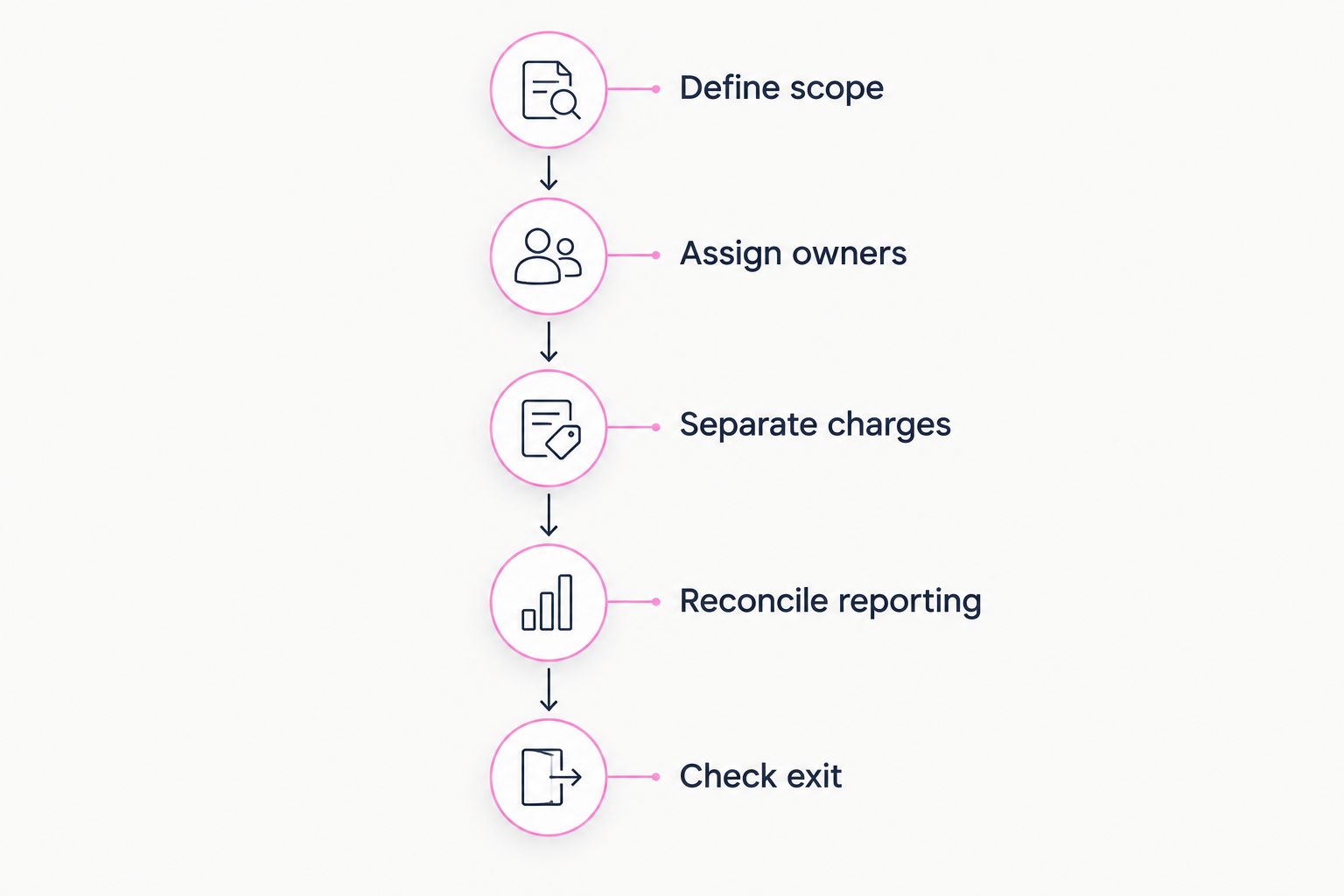
Define responsibilities before comparing commercial proposals.
Cake.Shop provides a modular programmatic advertising platform covering media buying and reporting, rich media and DOOH creative, data clean rooms, and publisher supply. Those components belong in the same evaluation because a buying decision affects creative delivery, data use and reporting responsibilities.
Cake.Shop is a modular programmatic platform for brands and independent agencies building their own advertising stack. Assess it against that scope rather than treating it only as a standalone buying tool.
The advantage of a modular approach is the ability to assess components against your requirements instead of assuming every component belongs in the brief. The trade-off is coordination: you still need to establish how modules connect, who operates them and which commercial terms apply.
For an agency, that means discussing client reporting, creative workflows and publisher supply alongside media buying. For an in-house brand team, it means defining which responsibilities move inside the business and which remain with external providers.
In a 2026 evaluation, ask Cake.Shop to map the proposed modules to your actual workflow and quote that scope. Apply the same test to every shortlisted supplier; a broader feature list is not evidence of a better fit.
Minimum ad spend is a commitment to advertising expenditure; a DSP platform fee is a technology charge. A contract can connect them, but they are not interchangeable terms.
Ask what counts towards the commitment and whether the agreement imposes separate obligations. Check whether commitments apply across the account or at another level, and how the contract treats periods when you run less activity.
Keep the answer in your comparison sheet. A commitment matters to procurement even when it does not appear as a separate invoice line.
Self-service and managed service cannot be compared fairly without accounting for campaign operations. Self-service assigns more work to your team; managed service adds an agreed execution scope.
Compare the responsibilities rather than assuming one model is cheaper. If your team already handles trafficking, optimisation and reporting, evaluate how the technology fits that workflow. If those roles are unfilled, include staffing or external execution in the decision.
Neither arrangement removes the need for oversight. Your team still needs clear objectives, approval responsibilities and a way to assess delivery.
A modular advertising stack does not guarantee a lower total cost. It lets you assess components separately, but integration, operations and reporting still require ownership.
The useful test is whether the proposed configuration meets your requirements without unnecessary duplication. Check overlapping creative, data and measurement agreements before adding another module.
Keep capability and commercial scope together. A component that meets a technical requirement still needs acceptable terms and a defined place in your operating model.
How much does a DSP platform cost in 2026?
DSP platform cost depends on the agreement, media expenditure and services required. Compare technology, media, data, creative, measurement and operations separately to establish the total scope.
What should I ask a DSP provider to include in a quote?
Ask for itemised scope covering media, technology, data, creative, measurement and campaign operations. Request clear inclusions, charging definitions, commitments and contract terms.
Does a DSP fee include the advertising spend?
Do not assume a DSP fee includes advertising spend. Ask the provider to distinguish inventory expenditure from technology and service charges in the proposal and billing explanation.
Can an independent agency run a DSP itself?
An independent agency can choose a self-service operating model, but it needs people responsible for campaign setup, optimisation and reporting. Evaluate the platform against those responsibilities rather than access alone.
What does Cake.Shop provide beyond media buying?
Cake.Shop provides rich media and DOOH creative, data clean rooms, publisher supply and reporting alongside media buying. Evaluate the proposed modules together and confirm their scope in the agreement.
What should I check before signing a DSP contract?
Check the charging basis, commitments, service responsibilities, reporting access and exit provisions. Confirm that the written agreement matches the workflow and commercial explanation you evaluated.
Before signing a DSP agreement in 2026, ask the provider to walk through a sample invoice alongside the corresponding campaign report. Trace each charge to its contractual basis and identify which reported figures your team can reconcile.
This is a practical check on the proposal. If the explanation requires assumptions that the contract never states, resolve them before approval—not during your first billing dispute.
First party loyalty data cookieless targeting starts with permission. Build an auditable workflow for audience matching, activation, reporting and removal.
Read more →Is a DSP platform worth it for a small agency? Yes, when recurring work justifies control. Compare operating models, staffing needs and reporting checks.
Read more →How much does a DSP platform cost? Compare the full scope: media, technology, data, creative and operations. Know what to ask before signing a contract.
Read more →Book a 30-minute demo and see exactly how Cake.Shop works — no sales pitch, just the platform.