
OPEN DAILY
OPEN
HONEST
TRUST
LET'S CHAT


A DSP platform is worth it for a small agency in 2026 when you have recurring programmatic work, an accountable campaign operator and a clear need for buying control. It is not worth taking on self-service software if campaign management, creative production and reporting will consume the capacity you need to serve clients.
TL;DR
A DSP decision changes what your agency takes responsibility for. Buying access is only part of the job; someone must also own campaign setup, quality checks, optimisation and explanations when reported results differ.
Cake.Shop provides a modular programmatic platform spanning media buying and reporting, rich media and digital out-of-home creative, data clean rooms, and publisher supply. That makes the relevant buying question broader than which bidding interface to use: which parts of the advertising stack should your agency operate?
For your 2026 planning, start with the work clients need you to deliver. Choose the operating model before choosing the platform. Otherwise, you risk adding a system without removing a problem.
Yes, if direct campaign control supports a repeatable client service and you can staff the responsibility. No, if the purchase rests on occasional briefs, unused features or the assumption that software replaces media expertise.
Compare these operating models against the same campaign requirements. None is automatically the right answer for a small team.
Self-service DSP
Managed programmatic execution
Existing media workflow
Use a real client requirement to decide. If a client needs access to a specific advertising environment, establish whether the proposed setup supports it. If the problem is inconsistent reporting, test reporting rather than treating more buying access as the answer.
Self-service makes sense when campaign operation is part of the service you intend to sell. You need someone who can translate a brief into targeting, creative requirements, measurement choices and buying decisions.
The benefit is control. The trade-off is responsibility: the platform does not take accountability for your campaign plan or client explanation.
Before choosing self-service, ask your operator to describe how they would identify underdelivery, investigate unexpected results and document changes. If the answer depends entirely on vendor intervention, clarify what support is included before committing.
Choose self-service when your team can own the workflow, not merely access the interface. Use the self-serve DSP platform guide to structure a shortlist, then verify each candidate against your actual brief.
Managed execution is worth assessing when clients need programmatic delivery but your agency is not ready to operate campaigns directly. It lets you evaluate a service relationship rather than assuming your team must immediately become a trading desk.
The trade-off is dependency. Campaign changes, troubleshooting and access to underlying records depend on the agreement with the delivery partner.
Ask who approves changes, who communicates with the client and what happens when performance needs investigation. Require a clear distinction between strategic advice, campaign execution and reporting responsibilities.
Choose managed execution when support closes a defined operational gap. Do not use it to avoid understanding what your clients are buying.
Keeping your current workflow is a valid decision when it meets the client's requirements. A new platform needs a purpose beyond making your service list look broader.
The advantage is focus. Your team avoids another set of permissions, processes and reporting dependencies.
The limitation appears when a brief requires buying access, creative delivery or data handling that your current setup cannot provide. At that point, document the missing requirement rather than replacing the whole stack by default.
Keep the existing workflow until you can name the gap a DSP must close. That gives vendors a concrete problem to demonstrate against.
Small agency size alone does not settle the decision. The value depends on the work you need to deliver and how that work fits your team.
For a 2026 buying brief, turn each relevant factor into a written acceptance criterion. A feature earns its place only when someone can explain its role in the campaign.
A useful evaluation connects the campaign brief to the work required across the stack. Separate the following responsibilities before deciding whether to consolidate them with a provider or manage them across several systems.
Media buying
Creative
Data permissions
Publisher supply
Reporting
Cake.Shop's modular programmatic platform covers media buying and reporting, rich media and DOOH creative, data clean rooms, and publisher supply. It is relevant to independent agencies assembling those parts into their own stack. That scope is not proof that every module belongs in your first deployment; confirm the required connections, responsibilities and terms for your brief.
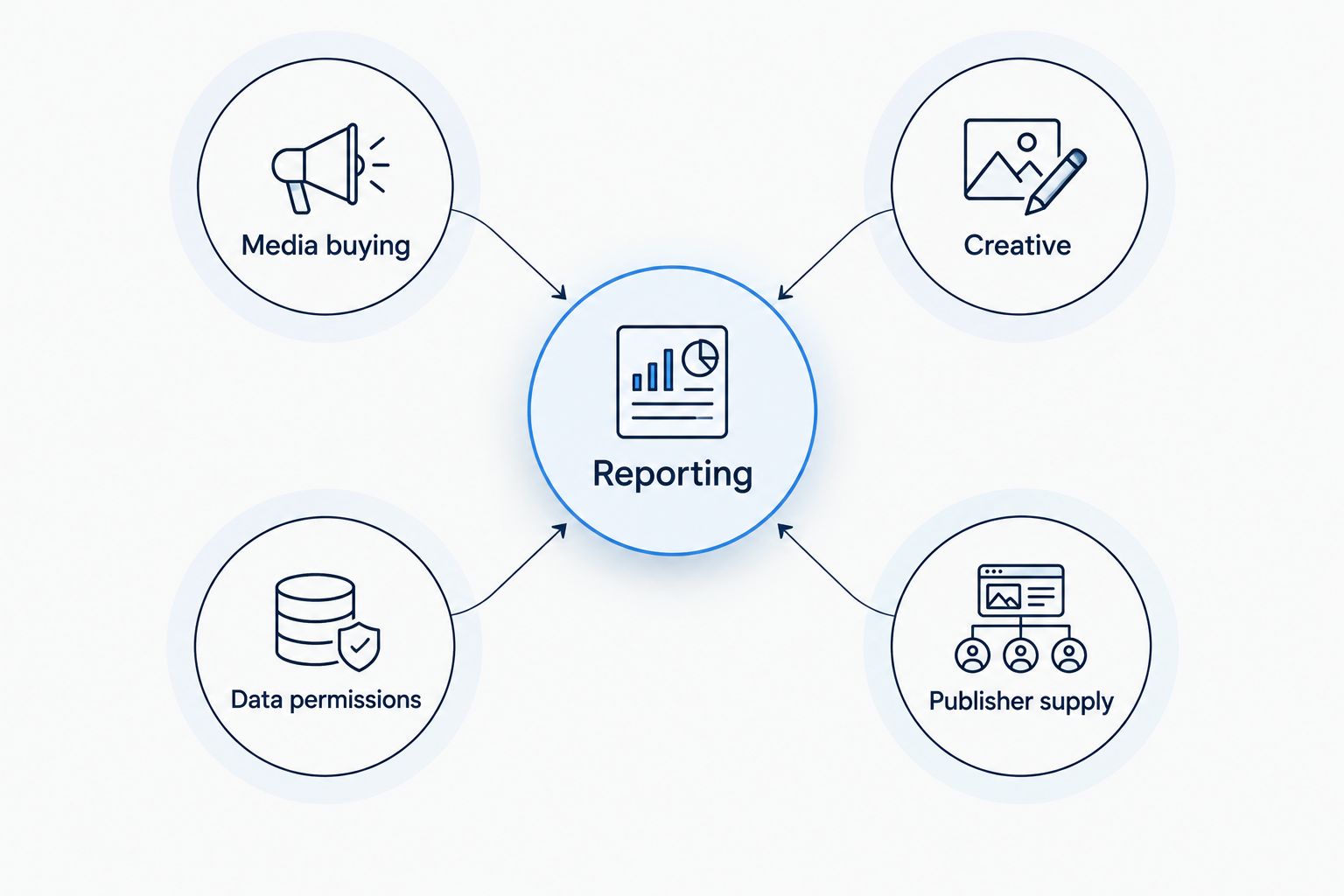
Evaluate the responsibilities around buying, not only the buying interface.
A modular approach gives you a way to separate required components from optional ones. The trade-off is that you still need to establish how the chosen components work together and who resolves problems between them.
Use the same client brief for every vendor discussion. A polished demonstration is not a substitute for showing how your agency's work gets done.
Apply this process consistently to your 2026 shortlist. If StackAdapt or The Trade Desk demonstrates a closer fit to your documented workflow, support needs and reporting requirements, choose on that evidence—not on an unsupported platform ranking.
Ask for written answers to operational questions while you still have a choice. The person presenting the software should not be the only person who understands the proposed arrangement.
Treat transparency as something you can inspect. A clear answer names the record, permission or contract term that supports it.
Do not accept a dashboard tour as evidence of operational ownership. Ask your future campaign operator to walk through the workflow and identify anything they cannot inspect, change or explain.
A small agency can use a DSP without a dedicated trader, but campaign responsibility still needs a named owner. A job title is less important than the ability to set up, monitor, investigate and report on campaigns.
If nobody has that capacity, assess managed execution or keep the existing workflow until you can staff the requirement. Client-facing strategy and hands-on campaign operation are separate responsibilities, even when the same person performs both.
No. A data clean room belongs in the evaluation when the brief requires controlled analysis or collaboration involving data from different parties; it is not a prerequisite for every programmatic campaign.
Define the data question and permissions first. A clean room does not remove the need to establish lawful use, appropriate access and clear responsibilities for the proposed workflow.
Is a DSP platform worth it for a small agency in 2026?
A DSP platform is worth it when recurring client work justifies campaign ownership and your team can operate it. Keep the existing workflow or assess managed execution when those conditions are not met.
What's the difference between self-service and managed programmatic?
Self-service puts campaign operation with your team; managed programmatic assigns execution work to a delivery partner under an agreed scope. Compare control, support and reporting responsibilities before choosing.
What's the best DSP for a small independent agency?
The right DSP is the one that meets your documented campaign, operating and reporting requirements. Evaluate providers against the same brief rather than assuming a platform ranking proves suitability.
Is Cake.Shop only a media-buying tool?
Cake.Shop provides a modular programmatic platform covering media buying and reporting, rich media and DOOH creative, data clean rooms, and publisher supply. Confirm which components your agency needs and how the proposed workflow connects them.
Can I use a DSP without changing my whole advertising stack?
Evaluate the DSP against the specific gap in your existing stack rather than assuming everything must change. Verify the required connections and remaining manual work before making that decision.
How do I know whether my agency is ready for self-service buying?
Your agency is ready to assess self-service buying when a named operator can own setup, monitoring, investigation and client reporting. Test that readiness with a real campaign brief before signing.
Should I choose a DSP based on its feature list?
No—choose against the work your client brief requires. A feature list does not establish usable reporting, clear account ownership or a workable support arrangement.
Ask for the report before the product demonstration. Then ask your operator to explain what decision each field would support and what evidence would still be missing.
For your final 2026 decision, reject any setup your team cannot explain to a client. Buying control is useful only when you can connect the brief, the campaign decisions and the resulting evidence.
First party loyalty data cookieless targeting starts with permission. Build an auditable workflow for audience matching, activation, reporting and removal.
Read more →Is a DSP platform worth it for a small agency? Yes, when recurring work justifies control. Compare operating models, staffing needs and reporting checks.
Read more →How much does a DSP platform cost? Compare the full scope: media, technology, data, creative and operations. Know what to ask before signing a contract.
Read more →Book a 30-minute demo and see exactly how Cake.Shop works — no sales pitch, just the platform.