
OPEN DAILY
OPEN
HONEST
TRUST
LET'S CHAT



Cookieless targeting has no single implementation duration: the timeline depends on whether you are configuring contextual campaigns, activating first-party audiences or connecting a data clean room. A campaign going live is not the same as a validated measurement setup, so your implementation plan must cover both activation and reporting. For your 2026 plan, set the launch date against completed readiness checks, not an assumed industry average.
TL;DR
Your implementation brief determines what the launch date actually means. Switching on contextual targeting is a different project from moving customer records into an approved audience workflow, even when both sit under the same cookieless label.
Choose the targeting method before committing to a delivery date. If your immediate question is whether contextual advertising covers the use case, start with whether contextual advertising can replace cookie-based targeting. That decision sets the boundaries for the work that follows.
Implementation takes as long as the unfinished dependencies on your chosen path. The useful distinction is between work needed to launch a campaign and work needed to demonstrate that targeting, delivery and reporting behave as intended.
Use this comparison to scope your 2026 project. These are implementation paths, not guaranteed delivery schedules.
Contextual targeting
First-party audience activation
Data clean room workflow
Before assigning dates, name the person responsible for every unfinished dependency. A launch plan without owners is a list of assumptions.
Write separate acceptance criteria for technical readiness, campaign readiness and measurement readiness. Technical readiness means the required connections and permissions work; campaign readiness means targeting, supply and creative pass checks.
Measurement readiness means your team can explain the reported results and their limitations. Do not label the whole implementation complete because an audience appears in a buying interface.
Contextual targeting selects advertising opportunities using the surrounding content rather than a third-party cookie profile. It removes customer-list preparation from that targeting path, but it does not remove campaign setup.
For a contextual launch, agree on:
A travel advertiser, for example, can brief a campaign around destination content without first creating a customer-list audience. That is a targeting choice, not proof that every reader is planning a trip.
Best for: a content-led campaign that does not require customer-level audience selection. The trade-off is precision of intent: relevant content provides context, not confirmation of an individual's buying plans.
First-party activation uses data collected through your own customer relationships in an advertising workflow. Having a customer database is only the starting point; the activation route needs usable records and an approved purpose.
Start by documenting the intended audience. Existing customers, recent purchasers and inactive subscribers represent different briefs, with different inclusion and exclusion rules.
Then check the required fields, record formatting, duplicate handling and destination requirements. Confirm who approves the use of the data and who owns corrections when records fail validation.
The implementation also needs a process for updating or withdrawing audience membership. A successful initial transfer does not establish that the ongoing workflow is ready.
Best for: a campaign whose audience genuinely depends on an existing customer relationship. The limitation is that a database record does not automatically become an addressable advertising opportunity.
For your 2026 scope, separate the initial audience build from the recurring update process. Otherwise, the launch can succeed while the operating model remains unfinished.
A data clean room is a controlled environment for agreed analysis or collaboration between data holders. It is not automatically the targeting method, the media-buying destination or permission to use data for any purpose.
Define what the collaboration must produce before configuring it. An aggregate analysis, an approved audience output and campaign measurement are different deliverables.
Your brief should specify the participating organisations, permitted inputs, access controls, matching approach where relevant, and allowed outputs. It should also identify the next step after an output is approved.
Best for: a use case that requires controlled collaboration between data holders. The trade-off is coordination: data owners, governance teams and activation teams must agree on the same workflow.
Do not treat clean-room setup and media activation as interchangeable milestones. A completed analysis environment can still leave an unresolved hand-off to the buying platform.
The implementation date depends on the work your chosen route actually requires. Use these factors to explain the schedule rather than adding a generic contingency to every project.
An independent agency should also distinguish client approval from technical work. A configuration can be ready while the client has not approved the audience definition, exclusions or reporting approach.
For a brand bringing programmatic in-house, make ownership explicit across marketing, data and procurement. Your 2026 implementation plan should show those hand-offs, not hide them inside a single task called platform setup.
Use a sequence that makes unfinished work visible. Tasks can run in parallel, but each launch decision needs evidence that its dependencies are complete.
State the campaign objective, targeting method, audience or content definition, and intended measurement approach. Keep the initial scope narrow enough that everyone can describe what is included and excluded.
Record why the method fits the objective. If the objective requires identifying existing customers, a contextual brief alone does not answer it.
Confirm account access, data-use approvals and the responsibilities of each participating team. For customer-data workflows, establish who can approve the audience definition and authorised outputs.
Keep unresolved permissions separate from engineering tasks. They need different owners and different decisions.
Configure the targeting route, buying settings, supply choices and creative. Check that the intended audience or contextual rules are usable in the campaign's actual destination.
Record what is connected and what still requires a manual hand-off. Do not assume that an integration covers every field or workflow your brief requires.
Check inclusion rules, exclusions, creative delivery and reporting before expanding the scope. Where customer audiences are involved, confirm how updates and removals reach the activation destination.
Define pass conditions in advance. A check without an agreed pass condition creates another approval discussion rather than a launch decision.
Reconcile the campaign settings with the reports your team will use. Document what the reports measure, which identifiers or signals they depend on, and where their interpretation stops.
Declare the workflow ready only when someone can explain both the campaign result and its measurement limits. That is a stronger handover than a screenshot showing that delivery has started.
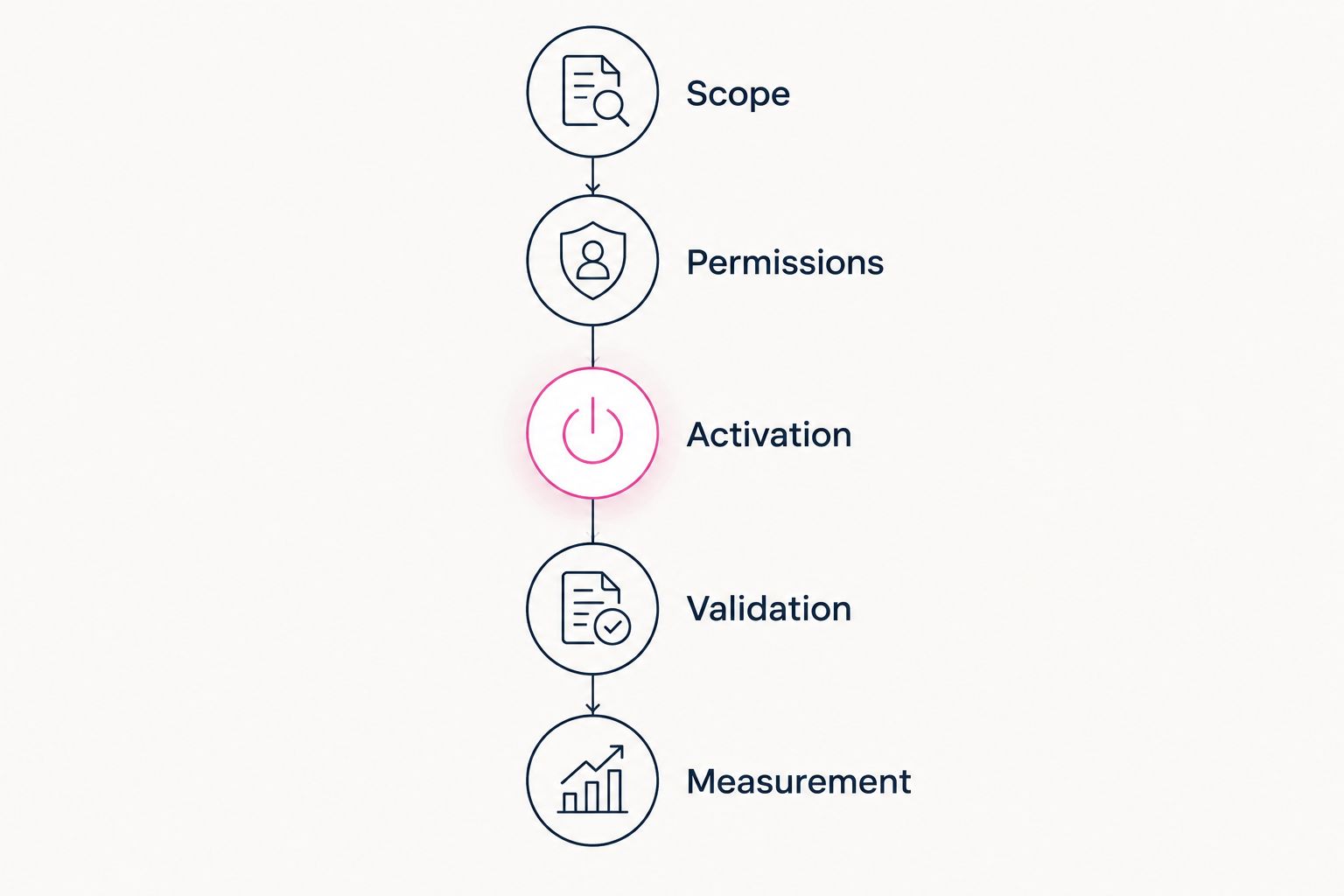
Launch readiness includes validation and measurement, not just campaign activation.
Cake.Shop is for brands and independent agencies building a modular programmatic advertising stack. Its stated scope covers media buying and reporting, rich media and DOOH creative, data clean rooms, and publisher supply—not just campaign buying.
That matters when your implementation crosses several workstreams. Your requirements should connect the buying decision to the creative, supply, data and reporting work needed to support it.
When discussing a Cake.Shop programmatic advertising implementation, bring a workflow brief rather than asking only for a launch date. Specify the targeting route, data sources, creative formats, intended supply and required reporting; ask which parts are covered and which require separate work.
The trade-off with a modular stack is that you still need clear decisions about module boundaries and ownership. Treat each connection as something to confirm, not as an assumed capability or an automatic reduction in implementation time.
Discuss your implementation scope
Bring your targeting method, data dependencies, creative requirements and reporting brief.
You can separate a contextual campaign from a customer-data activation project when the campaign objective supports that choice. Treat them as distinct scopes with distinct approval criteria.
Do not describe contextual reach as activation of your customer audience. The targeting basis is different, and the reporting needs to preserve that distinction.
No. Removing third-party cookies from a targeting method does not remove the need to assess data collection, permitted use and applicable privacy requirements.
For a 2026 implementation, review the actual data flow rather than relying on the cookieless label. Identify what enters each system, who can access it and what leaves it.
No. A live campaign proves that delivery has started, not that audience updates, exclusions, reporting and operational handovers have passed their checks.
Close the implementation against the acceptance criteria you agreed at the start. Keep performance evaluation separate from the technical launch decision.
How long does it take to implement cookieless targeting?
The timeline depends on the targeting route and its unfinished dependencies. Contextual configuration, first-party audience activation and data clean room collaboration require different work, so set dates against readiness checks rather than a universal average.
Is contextual targeting simpler to implement than first-party targeting?
Contextual targeting avoids customer-list onboarding, but it still requires campaign configuration, suitable creative, supply checks and measurement. First-party activation adds data preparation, permission checks and destination requirements.
Do I need a data clean room for cookieless targeting?
No, a data clean room is not a requirement for every cookieless targeting method. Use one when the brief requires controlled data collaboration or analysis, not simply because the campaign avoids third-party cookies.
Can I use my existing customer database for cookieless targeting?
Your existing customer database can support an activation brief only when the intended use and activation route are appropriate. Check permissions, required fields, record quality and destination requirements before promising an audience launch.
What should an agency ask a platform before agreeing to a launch date?
Ask which targeting methods, data connections, creative formats, supply routes and reporting requirements the proposed setup covers. Then assign owners and acceptance criteria to every remaining dependency.
How does Cake.Shop fit a cookieless implementation brief?
Cake.Shop provides a modular programmatic advertising platform covering media buying, creative, data clean rooms and publisher supply. Confirm the specific targeting workflow, connections and responsibilities required for your brief rather than assuming a standard implementation schedule.
Ask a different question before asking for a launch date: what evidence will prove that this workflow is ready? That forces the conversation beyond an activated campaign and into data permissions, exclusions, reporting and ownership.
Put the answer in the brief. A date becomes useful when everyone agrees on what must be true when it arrives.
Can programmatic advertising work without third party cookies? Yes. Compare contextual targeting, first-party data and measurement trade-offs.
Read more →How long does it take to implement cookieless targeting? Scope decides. Compare contextual, first-party and clean-room paths, with launch readiness checks.
Read more →Is header bidding worth it for small publishers? Test net revenue, page speed and workload before committing. Compare managed and self-run setups.
Read more →Book a 30-minute demo and see exactly how Cake.Shop works — no sales pitch, just the platform.