
OPEN DAILY
OPEN
HONEST
TRUST
LET'S CHAT



Setting up a data clean room takes as long as it takes to approve the data use, prepare compatible datasets, configure access and validate the intended output; there is no universal duration. Creating the technical environment is only part of the job. For your 2026 implementation plan, measure readiness against an approved, repeatable analysis or activation workflow—not an account creation date.
TL;DR
A useful setup estimate covers the path to a validated business output, not just technical access. Ask whoever owns the implementation to identify the dependencies behind the proposed completion date and the evidence needed to close each stage.
For independent agencies, the data clean room for media agencies guide provides context for defining that scope. Build your schedule around the following acceptance steps.
Write down the decision the clean room must support. Comparing advertising exposure with customer purchases is a different assignment from preparing an audience for campaign activation.
Specify the required output before discussing integrations. An aggregate measurement report, an audience definition and a recurring reporting feed each need their own acceptance criteria; treating them as interchangeable makes the completion date meaningless.
Done means: the business owner has approved the question, intended users and permitted output. Keep unrelated use cases outside the initial scope rather than carrying them as undefined requirements.
Identify who controls each dataset, who authorises its use and who approves the proposed collaboration. Establish the applicable contractual, privacy and security requirements before transferring or connecting data.
A clean room does not replace those decisions. Your implementation needs an agreed position on permitted purposes, access, retention and output controls, with named owners for unresolved questions.
Done means: the relevant owners have approved the intended processing and documented any restrictions that affect configuration or results.
Document the fields required for the business question, their formats and their meaning. Check identifiers, event dates, duplicate records and the relationship between customer, transaction and campaign records.
Matching requires a compatible basis for linking records. The presence of an email field in both datasets does not establish that the values have been prepared consistently or that using them is authorised.
Done means: the data owners can explain what each required field represents and demonstrate that the agreed preparation rules have been applied.
Set up the agreed data connections, user roles and analysis permissions. Distinguish people who administer the environment from people who submit queries or consume approved results.
Test restrictions as well as access. A successful login does not demonstrate that someone is prevented from viewing an unauthorised dataset or exporting an impermissible result.
Done means: authorised users can perform the agreed tasks, and prohibited actions are blocked under the approved design.
Run the agreed analysis against a controlled validation dataset. Check record handling, date boundaries, joins and output restrictions before interpreting the result as campaign evidence.
An empty result needs investigation, not an automatic conclusion that the audiences do not overlap. Examine data preparation, identifier compatibility, filtering and disclosure controls before accepting the finding.
Done means: the business and technical owners agree that the output answers the intended question and respects the agreed restrictions.
Assign responsibility for refreshes, failed jobs, access changes and questions about results. If campaign activation is in scope, validate the receiving workflow separately rather than assuming an approved analysis is automatically usable for buying media.
Done means: the team can repeat the process, recognise a failure and identify who fixes it. That is a stronger launch criterion than a completed demonstration.
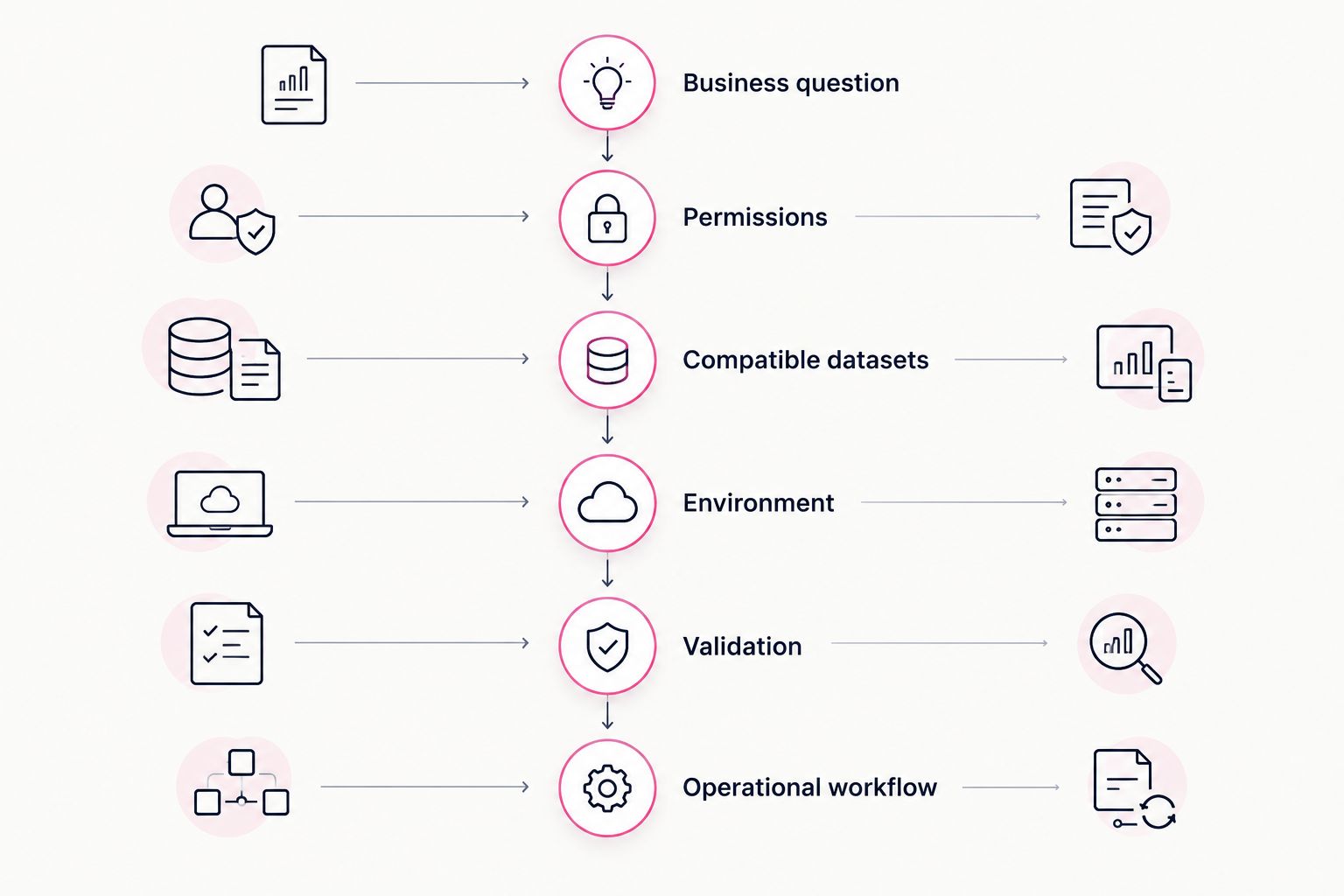
Technical configuration is a stage in setup, not the definition of completion.
A setup deadline is only useful if everyone agrees what will exist on that date. An agency expecting campaign-ready audiences and a technical team delivering an accessible environment are working towards different outcomes.
For a 2026 launch brief, distinguish technical configuration from business acceptance. This gives your privacy, engineering and media teams a shared basis for deciding whether the implementation is ready, rather than leaving the media team to discover unfinished dependencies at campaign launch.
The commercial question is straightforward: what decision or campaign action becomes possible when this work is complete? If the answer remains vague, narrow the brief before committing to a delivery date.
Measurement and activation are different deliverables. Agree which you need before asking a provider for a schedule, and request separate acceptance criteria when both are included.
Measurement
Audience activation
Measurement and activation
Do not label a measurement-only implementation incomplete because it cannot activate audiences outside its agreed scope. Equally, do not accept a measurement demonstration as proof that an activation project has finished.
For your 2026 acceptance document, name the destination and output format wherever activation is required. Use an actual test of the agreed hand-off, not a general statement that integration is possible.
The schedule follows the dependencies in your implementation. These factors deserve explicit questions in the brief rather than an unexplained allowance added to the end.
Request a schedule with dependencies, owners and acceptance evidence. A date without those details hides the work that determines whether the date is credible.
Use a brief that both the business owner and the technical owner can approve. Keep it specific enough that an external provider can identify assumptions rather than filling the gaps with its own interpretation.
For a 2026 procurement or implementation brief, include:
Ask the implementation team to identify what it can configure independently and what depends on your organisation or a collaboration partner. That distinction separates provider delivery work from decisions the provider cannot make for you.
Keep unresolved assumptions visible in the project plan. For example, an unconfirmed matching field is a dependency to resolve, not a detail to bury beneath a promised completion date.
Cake.Shop is a fit for brands and independent agencies evaluating data clean rooms within a modular programmatic advertising stack. Its stated scope includes media buying and reporting, rich media and DOOH creative, data clean rooms and publisher supply.
Assess those parts against a shared campaign brief. The clean room work should define the permitted data output; the buying, creative and supply work should define how the campaign will operate. DOOH means digital out-of-home advertising, such as advertising on digital screens outside the home.
Cake.Shop's modular scope is relevant when your enquiry spans these connected requirements. The trade-off is that evaluating the full stack requires more than accepting a clean room demonstration: request evidence for each required hand-off, ownership boundary and reporting requirement.
Do not assume that a common platform label proves a particular connector, export route or workflow exists. Ask for a demonstration of the exact workflow in your brief and document any work your team must still complete.
You can separate discovery and validation work from production acceptance. Documenting fields, approving the intended purpose and agreeing test cases do not require you to pretend that the entire production workflow is already ready.
Keep the boundary explicit. A controlled validation exercise is evidence about that exercise, not permission to transfer additional data or launch a campaign outside the approved scope.
Hashing customer data does not, by itself, finish privacy review. Hashing transforms a value into a derived representation; it does not establish a lawful purpose, settle contractual responsibilities or prove that the resulting data cannot be linked to a person.
Ask the relevant privacy owner to assess the actual processing and controls. Treat identifier preparation and permission to use the data as separate questions.
The setup completion date should be the date the agreed workflow passes acceptance. Record environment access, validated analysis and production acceptance separately so nobody mistakes an intermediate milestone for the final deliverable.
For your 2026 rollout, retain the acceptance evidence alongside the operating instructions. That gives the team a clear reference when datasets, permissions or campaign requirements change.
How long does it take to set up a data clean room?
The duration depends on the agreed use case, data readiness, permissions, configuration and validation. Ask for a dependency-based schedule ending with an accepted business output, rather than an account creation date.
Can we use a clean room as soon as the account is created?
Account creation does not establish production readiness. Confirm that access controls, data preparation, permitted analysis and the intended output have passed acceptance.
What should we prepare before asking for a setup estimate?
Prepare the business question, participating datasets, data owners, permitted purpose and expected output. These details give the implementation team a defined scope to estimate.
Is a measurement clean room ready for audience activation too?
Measurement readiness does not establish audience activation readiness. Activation requires its own approved output, receiving destination and hand-off validation.
Does a clean room remove the need for privacy review?
A clean room does not remove the need for privacy review. Your organisation still needs to assess the purpose, permissions, contractual responsibilities and controls for the proposed processing.
Can an independent agency assess a clean room alongside its buying platform?
An independent agency can assess both against a shared campaign workflow. Cake.Shop includes data clean rooms within its modular programmatic advertising platform; verify the specific connections and responsibilities your implementation requires.
What should we ask a provider to demonstrate before sign-off?
Ask the provider to demonstrate the agreed workflow using an approved validation approach. Check authorised access, prohibited actions, analysis correctness, output restrictions and operational ownership before signing off.
Include a prohibited action in your acceptance test. Ask the team to demonstrate that a user cannot access an unauthorised dataset or obtain an output outside the agreed rules.
A successful query shows that something works. A correctly blocked action provides evidence that a boundary works too; both belong in a clean room sign-off.
How long does it take to set up a data clean room? Readiness determines the timeline. Map permissions, data preparation and validation before launch.
Read more →How much does DOOH advertising cost in Australia? It depends on the brief. Compare media, creative, platform fees and delivery terms before you book.
Read more →Can a data clean room work without cookies? Yes. Learn what first-party matching needs, where activation fails, and what to check before choosing a provider.
Read more →Book a 30-minute demo and see exactly how Cake.Shop works — no sales pitch, just the platform.