
OPEN DAILY
OPEN
HONEST
TRUST
LET'S CHAT



Contextual advertising can replace cookie-based targeting for prospecting based on what someone is reading or watching, but it cannot replace every audience, retargeting or measurement function. Matching an advert to content does not identify previous site visitors, recognise customers across sites or establish that an impression caused a sale. For your 2026 media plan, replace specific targeting jobs—not the entire identity and measurement stack.
TL;DR
Yes, where your objective is to reach people in a relevant content environment rather than recognise a particular browser. A running-shoe advertiser can buy placements beside marathon-training articles without needing a record of each reader’s previous browsing. That is contextual prospecting, not a substitute for identifying an abandoned basket.
Before comparing contextual advertising platforms, separate the buying task from the technology used to perform it. A platform’s ability to select relevant pages does not establish its ability to suppress existing customers or measure cross-site exposure.
Contextual targeting
Cookie-based behavioural targeting
First-party audience targeting
These approaches are not mutually exclusive. Use contextual selection to find relevant environments, then apply other controls only where the identifiers, permissions and platform functions support them. Do not describe an entire campaign as identity-free simply because its prospecting audience is contextual.
The practical question in 2026 is not whether cookies have disappeared everywhere. It is whether each campaign depends on an identifier that is available, permitted and useful for its objective. A single replacement narrative hides those dependencies.
An independent agency needs to explain what changes when a client switches targeting methods. A brand bringing programmatic in-house needs the same clarity across buying, creative, publisher access and reporting. Neither buyer benefits from replacing a behavioural audience with a contextual segment while leaving incompatible measurement expectations untouched.
Contextual targeting changes the selection signal; it does not automatically replace the rest of your advertising operations. Keep that distinction visible in briefs, reporting definitions and supplier discussions.
Contextual prospecting fits campaigns seeking new customers through relevant content. Instead of selecting a browser because of its recorded history, you select an advertising opportunity because of the surrounding subject, meaning or environment.
Consider a travel brand advertising walking holidays. Content about hiking routes offers a defensible relevance hypothesis. It does not prove that the reader is ready to book, lives in a serviceable market or has the required budget.
Build the brief around a clear relationship between content and offer:
Use contextual prospecting when the surrounding content supplies a useful reason to show the advert. Reject segments whose relevance depends on a chain of assumptions you cannot explain to the client.
Retargeting starts with a different question: has this browser or person already taken a relevant action? A contextual placement does not answer that question by itself.
Someone reading about sofas is not necessarily the visitor who abandoned your sofa checkout. Likewise, an existing customer can read the same article as a new prospect. Without a usable recognition method, content selection alone cannot distinguish them.
That limitation matters when your campaign requires:
Keep contextual prospecting separate from visitor recognition. If you need both, document how recognition works, where it stops working and which permissions apply. Do not promise individual-level suppression through contextual targeting alone.
Contextual targeting does not prevent you from measuring business outcomes. It does change which exposure and identity connections you can assume are available.
A sale recorded on your site is different from proof that a particular advert caused that sale. Attribution assigns credit under a defined method; incrementality asks whether advertising produced an outcome that would not otherwise have happened. Neither question is answered merely by selecting relevant content.
For a 2026 contextual campaign, define the outcome and reporting method before launch. Record whether reporting depends on clicks, conversion events, matched identifiers or a separate experimental design. Check what is observed directly and what is modelled.
Keep these distinctions explicit:
A strong delivery report is not proof of business impact. Equally, losing a familiar cross-site report does not establish that contextual advertising failed. Judge the campaign using the evaluation method agreed before delivery.
Contextual targeting describes a selection principle, not a standardised level of performance. These factors determine whether your implementation matches the brief:
Treat these as supplier questions, not assumptions. A label such as cookieless says little about the quality of classification, the suitability of placements or the usefulness of reporting.
Use 3 campaign cells as a starting design: contextual prospecting, behavioural prospecting and a combined approach. This is a recommended structure, not a claim that every campaign needs the same experiment. Only include approaches your permissions and buying setup support.
Choose 1 primary outcome per test. Plan 2 comparisons: contextual against behavioural prospecting, and the combined approach against your existing prospecting approach. Keep retargeting separate so previous customer interest does not distort the prospecting comparison.
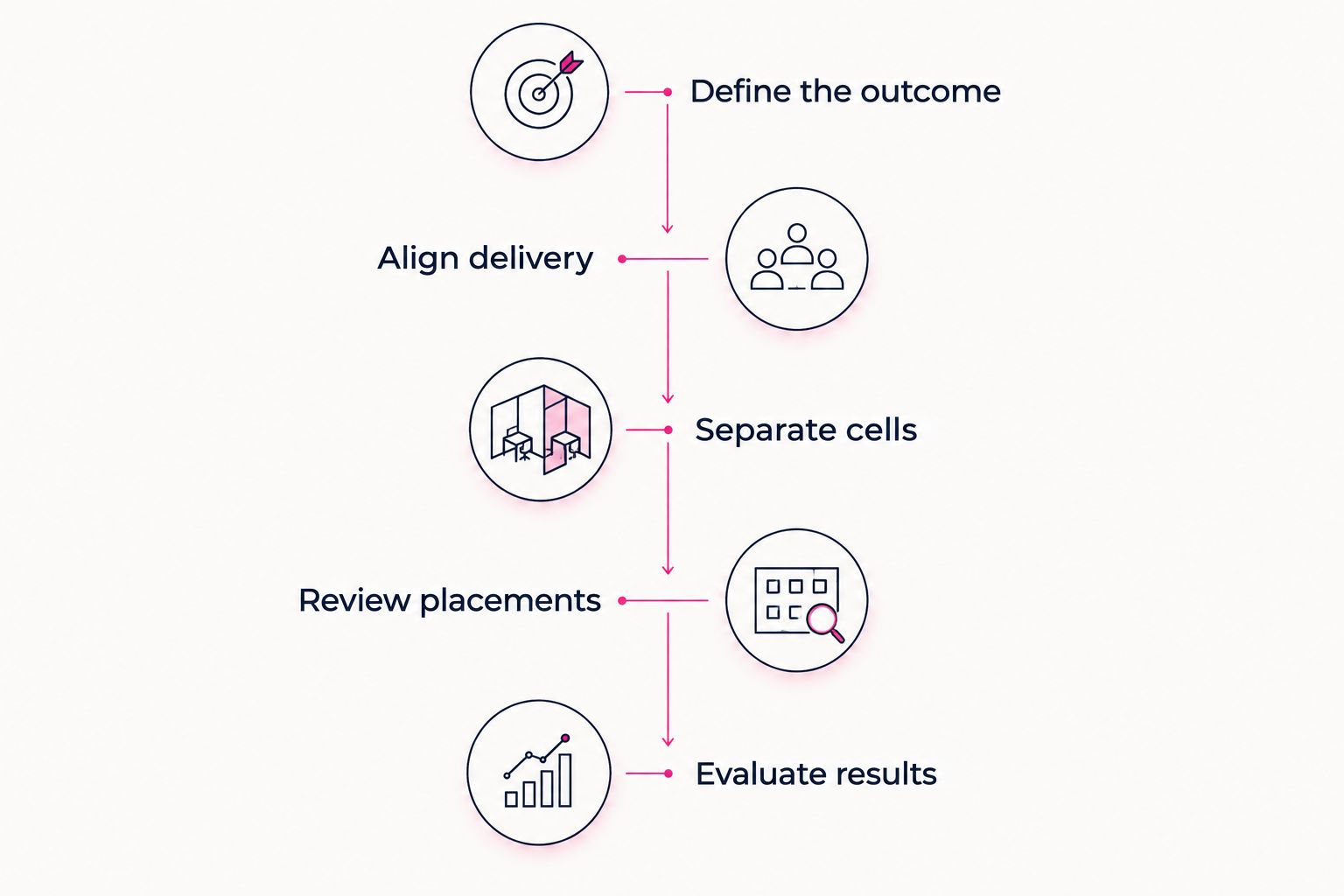
Define the outcome before comparing targeting approaches.
For your 2026 test brief, set the evaluation period using your conversion cycle and the evidence required for a decision. Do not declare a winner after an arbitrary number of days or a small cluster of conversions. If the design cannot isolate the targeting effect, describe the result as a campaign comparison rather than causal proof.
A contextual segment is only one buying input. You still need media buying and reporting, creative production, publisher access and an appropriate data strategy. Digital out-of-home, or DOOH, also needs its own treatment: a screen’s location or surroundings are not the same signal as a web page’s subject.
Cake.Shop is a modular programmatic advertising platform for independent agencies and brands bringing programmatic in-house. Its stated scope includes media buying and reporting, rich media and DOOH creative, data clean rooms, and direct publisher supply. That makes the enquiry a stack-design conversation, not simply a request for another buying interface.
For a contextual brief, ask how those components would work together in your proposed setup. Which component makes the selection decision? How does the creative match the placement? What publisher-level evidence reaches reporting? Which data uses require identity or permissions?
The trade-off with a modular stack is the need to define responsibility between components. Cake.Shop’s stated platform scope does not, by itself, verify a particular contextual classification method, integration or measurement outcome. Confirm those requirements before committing the brief.
No: contextual targeting can replace the audience-selection role of third-party cookies in relevant-content prospecting, but not every recognition function. Customer suppression, cross-site sequencing and identity-dependent attribution need their own supported methods.
For a 2026 replacement plan, list each cookie-dependent task separately. Keep the tasks your alternative setup can perform, redesign those it cannot and remove promises the evidence no longer supports.
Contextual selection can use page content rather than a person’s browsing history. That does not establish that every other part of the advertising transaction avoids personal data.
Review measurement, consent handling and any audience overlays separately. A contextual buying rule is not a blanket privacy or regulatory exemption.
No: choose contextual targeting for client objectives that benefit from content relevance, not as a universal replacement policy. A prospecting brief and a customer reactivation brief require different signals.
Standardise the questions your agency asks, rather than forcing every client into the same answer. Document the selection method, recognition requirements, reporting limits and responsibility for each component.
Can contextual advertising replace cookie based targeting for prospecting?
Yes, contextual advertising can replace cookie-based audience selection when prospecting depends on relevant content rather than recognising previous visitors. It does not automatically replace retargeting, customer exclusions or identity-dependent measurement.
Is contextual targeting the same as keyword targeting?
No, keyword targeting is one way to select content, while contextual targeting can also use categories and analysis of meaning. Ask the supplier what it analyses and how it handles unsuitable uses of the same words.
Can contextual advertising retarget people who abandoned a basket?
Contextual targeting alone cannot identify people who abandoned a basket. That task requires a supported way to recognise the relevant visitor or customer, with the necessary permissions.
Does cookieless advertising mean no consent is needed?
No, a cookieless label does not establish that consent is unnecessary. Requirements depend on the data, technology, purpose and applicable jurisdiction, including activities beyond initial ad selection.
How should an agency compare contextual and behavioural targeting?
Compare contextual and behavioural prospecting against the same defined business outcome, using comparable delivery conditions. Separate retargeting and record differences in inventory, creative, recognition and reporting.
Can a data clean room replace contextual targeting?
No, a data clean room and contextual targeting serve different purposes. A clean room supports controlled data collaboration under its configured rules; contextual targeting selects advertising environments using content or context.
Where does Cake.Shop fit in a contextual advertising plan?
Cake.Shop provides a modular programmatic advertising platform spanning media buying and reporting, rich media and DOOH creative, data clean rooms, and publisher supply. Confirm the contextual selection method, component connections and reporting requirements for your proposed setup.
An advert beside perfectly relevant content can still reach an existing customer. Contextual relevance and customer status are separate facts. Before moving an acquisition budget, ask who you need to exclude and how the buying setup will enforce that exclusion.
If the answer depends on an identifier, record that dependency plainly. Your targeting can be contextual without your entire campaign being identity-free.
Can contextual advertising replace cookie based targeting? Yes for prospecting, not every task. Compare retargeting limits and build a fair test.
Read more →How much does CTV advertising cost? Get a quote-based budgeting framework covering media, platform fees, creative, data and measurement before buying.
Read more →How much does identity resolution cost? Get a scoped quote covering data matching, integration, activation and governance before you commit to a platform.
Read more →Book a 30-minute demo and see exactly how Cake.Shop works — no sales pitch, just the platform.