
OPEN DAILY
OPEN
HONEST
TRUST
LET'S CHAT


CTV advertising has no single fixed cost in 2026: you need a quote tied to your audience, inventory, campaign length and buying arrangement. The media quote alone is not the full budget; confirm whether it includes platform access, audience data, creative production, verification, measurement and campaign management. Compare the total scope, not just the headline CPM.
TL;DR
A CTV proposal can describe the cost of delivering advertising without describing everything required to run the campaign. If you approve the media line before checking the rest, you have not approved a complete campaign budget.
For independent agencies, this affects client scope and delivery responsibilities. For in-house teams, it determines which work stays with employees and which work needs a supplier. The broader programmatic advertising cost per campaign framework helps separate campaign delivery from the technology and services around it.
The useful question is not simply whether one proposal has a lower CPM. It is whether both proposals buy the same advertising, include the same work and measure the same result.
Your CTV campaign budget is the total of media delivery and the additional services you actually need. Ask each supplier to show what is included, what is optional and what is billed separately.
CPM means cost per 1,000 impressions. An impression is an ad delivery event, not a unique person, household or completed sale. You cannot translate a CPM into business value without knowing what was delivered and how the outcome was measured.
Use this breakdown when requesting a proposal:
Media delivery
Platform and service
Audience data
Creative
Verification and measurement
This is a budgeting checklist, not a claim that every supplier charges every line separately. Some proposals bundle work together; others itemise it. Require the breakdown either way.
For your 2026 brief, specify the billing currency as well. An Australian advertiser comparing local and international proposals needs to distinguish the currency of the quote from the geography of the audience.
For CPM-based buying, the planning relationship is:
Media budget = planned impressions ÷ 1,000 × quoted CPM.
That calculation describes media delivery only when the quoted CPM excludes other charges. If the supplier presents an all-in CPM, ask exactly which components are included before adding separate budget lines. Otherwise, you risk counting the same item twice.
Do not treat the calculation as a delivery guarantee. Auction buying and negotiated commitments have different terms; the proposal must state what is estimated, what is committed and what happens if the agreed delivery is not achieved.
Different buying arrangements change who handles the work and how clearly you can see the underlying components. They do not remove the need for creative, campaign decisions or reporting.
Use the following comparison to assign responsibilities, rather than assuming a buying model is automatically cheaper.
Self-serve platform
Managed service
Direct publisher agreement
Choose the operating model you can manage, not the one with the shortest proposal. A self-serve agreement still needs an operator. A managed agreement still needs a client brief and approval process. A direct agreement still needs a measurement plan.
Keep the evaluation consistent: give each supplier the same audience definition, creative requirements, campaign dates and reporting questions. Differences in scope should be visible before you compare commercial terms.
The following factors belong in your brief because they change what you are asking suppliers to deliver. Their effect on the quote must be established with the supplier, not assumed from a generic benchmark.
These factors also interact. A narrowly defined audience on restricted supply can create a different delivery problem from a broad audience across more publishers. Ask the supplier to explain the consequences for the proposed campaign rather than promising an outcome from the targeting description alone.
A useful 2026 budget shows the campaign's purpose, the work required and the conditions attached to delivery. Follow this sequence before authorising spend.
Choose the business question the campaign should answer. For example, are you trying to build awareness among a defined audience or examine whether exposure is associated with subsequent customer activity?
Then identify the reporting needed to answer that question. A completed video view is a delivery signal; it does not, by itself, establish a sale caused by advertising.
Document geography, audience, inventory requirements, dates and exclusions. Include any publisher or content restrictions that matter to the brand.
Send the same brief to every supplier. If a supplier changes the brief to make delivery practical, record the change alongside the proposal so it does not disappear during comparison.
Ask whether your proposed placements accept assets of 15 seconds or 30 seconds, and request the actual technical specifications. These are common television advertising lengths, not a promise that every placement accepts both.
Assign ownership for editing, sound, captions where required, file delivery and approval. If the campaign needs different versions, list those versions in the production scope rather than treating them as an informal extra.
Separate media, platform, data, creative and measurement. Mark each component as included, separately billed or unnecessary for this campaign.
Request the billing basis for each line and identify any minimum commitment or cancellation condition. Do not mistake a minimum commitment for a forecast of the amount needed to achieve your objective.
Specify the delivery fields, reporting frequency, access rights and measurement definitions. If the plan includes outcome attribution, document the method and its limitations before launch.
A report should explain what the campaign delivered and what the measurement method can establish. It should not convert an observed association into a causal claim without supporting evidence.
The process is sequential: agree the objective before selecting metrics, and agree the scope before approving the budget.
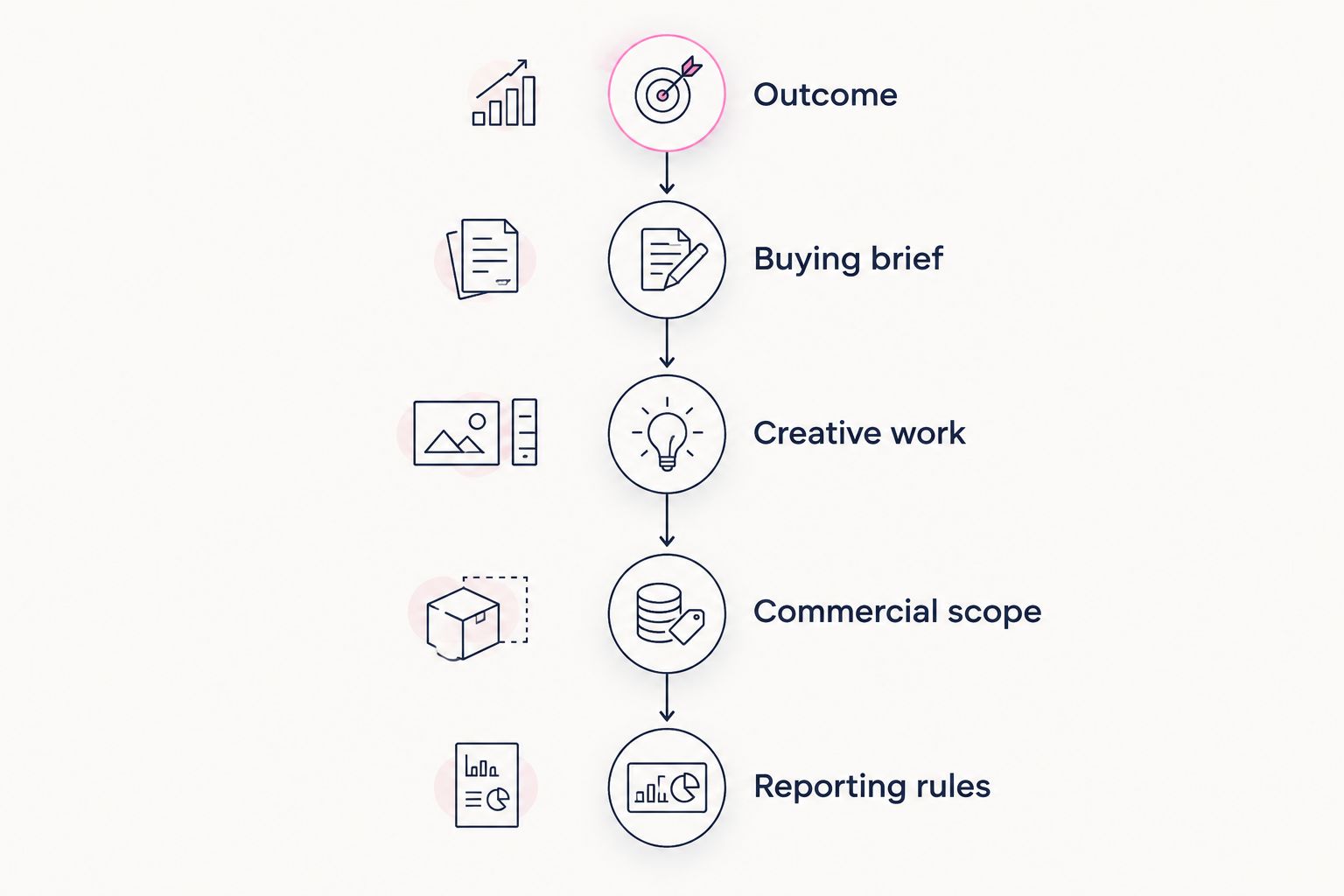
Set the objective and scope before approving the campaign budget.
Cake.Shop is for brands and independent agencies building a modular programmatic advertising stack. Its stated scope includes media buying and reporting, rich media and DOOH creative, data clean rooms, and direct publisher supply.
That makes Cake.Shop relevant when the enquiry concerns the wider advertising operation rather than a standalone buying interface. Your brief can cover buying responsibilities, reporting requirements, creative workflows, data collaboration and publisher relationships together.
The trade-off is specification work: a modular approach requires you to decide which components you need and how responsibilities connect. Do not assume that a broad platform description confirms particular CTV publishers, inventory access, supported video specifications or measurement integrations. Request those details against your campaign brief.
For an agency enquiry, explain who operates campaigns and who owns the client reporting relationship. For an in-house enquiry, identify the functions your team will retain and the external support you require.
A lower CPM is not enough to establish a better buy. You need comparable inventory, audience definitions, delivery conditions and measurement before drawing that conclusion.
Check frequency as well as impressions. Repeated delivery to the same household is not the same as reaching additional households, and impression totals alone do not distinguish between them.
Ask how reach and frequency are calculated across the proposed inventory. Do not assume separate publisher reports can be added together without accounting for overlapping audiences.
An existing video advert needs a placement-specific technical and editorial check before use on CTV. Obtain the publisher or platform specifications, then confirm the file, duration, audio and approval requirements.
Check the message too. A video that depends on an immediate click needs a different response plan from one designed for a television viewing environment. Agree how viewers should respond and how that response will be measured.
A CTV proposal should identify the inventory, audience, delivery terms, complete commercial scope and reporting method. It should also state who handles creative approval, campaign changes and delivery problems.
For a 2026 supplier review, ask for an example report with its metric definitions. You are checking whether the proposed reporting answers your business question, not whether the dashboard contains many charts.
How much does CTV advertising cost in 2026?
CTV advertising requires a campaign-specific quote covering media and any additional technology, data, creative, measurement or management work. Compare itemised proposals against the same audience, inventory and campaign brief.
What does CPM mean in CTV advertising?
CPM means cost per 1,000 impressions. It describes an impression-based buying unit, not unique reach or the complete campaign commitment.
Does a CTV media quote include video production?
A CTV media quote does not establish whether video production is included. Request a separate statement covering production, adaptations, technical checks and approvals.
Is self-serve CTV buying better than a managed service?
Self-serve buying suits teams that can operate campaigns; managed service suits teams assigning that work externally. Compare responsibilities, reporting access and the complete scope before choosing.
Can I measure sales from a CTV campaign?
Sales measurement depends on the available data, permissions and measurement method. Ask how exposures are connected to outcomes and whether the analysis establishes attribution, association or incremental impact.
What should an agency ask Cake.Shop about CTV?
Ask Cake.Shop to confirm the CTV inventory, creative requirements, reporting and operating arrangements relevant to your brief. Its stated modular platform scope does not replace campaign-specific confirmation.
Should I choose the proposal with the lowest CPM?
Do not choose on CPM alone. First establish whether the proposals include comparable inventory, audience definitions, services and measurement.
Ask each supplier to explain what happens when the campaign cannot deliver as planned. The answer belongs in the agreement: who flags the problem, who approves changes, and how undelivered commitments are handled.
That question tests whether your budget is an executable plan rather than a headline media estimate. Get the answer before launch, while you can still change the scope.
Can contextual advertising replace cookie based targeting? Yes for prospecting, not every task. Compare retargeting limits and build a fair test.
Read more →How much does CTV advertising cost? Get a quote-based budgeting framework covering media, platform fees, creative, data and measurement before buying.
Read more →How much does identity resolution cost? Get a scoped quote covering data matching, integration, activation and governance before you commit to a platform.
Read more →Book a 30-minute demo and see exactly how Cake.Shop works — no sales pitch, just the platform.