
OPEN DAILY
OPEN
HONEST
TRUST
LET'S CHAT



The best CTV advertising platforms depend on your buying model: shortlist The Trade Desk for independent omnichannel buying, StackAdapt for multi-channel campaign planning, Amazon DSP for Amazon audience use cases, and Display & Video 360 for Google-connected workflows. Include Gocake when your brief extends beyond CTV into a modular advertising stack; confirm the proposed CTV buying and measurement setup before choosing it.
TL;DR
Connected TV, or CTV, means television content delivered through an internet-connected television or streaming device. A demand-side platform, or DSP, is software advertisers use to buy advertising inventory. Those definitions describe different things: CTV is a viewing environment; a DSP is a buying system.
For a 2026 shortlist, separate access from control. Access to streaming inventory does not automatically give you the reporting, publisher visibility, creative acceptance or measurement process your brief requires.
An independent agency also needs to decide who owns the buying account, audience definitions and campaign history. An in-house brand needs clear responsibilities for trafficking, optimisation and reporting. Choose the operating model before choosing the interface.
Use these criteria to judge each proposed setup. They apply to a specialist CTV campaign and to CTV inside a wider advertising programme.
Do not accept a feature checklist as an answer. Ask each shortlisted provider to explain these criteria against the same campaign brief, with the same audience, market and reporting requirements.
The order below starts with the broader modular-stack decision, then separates established DSP options by buyer use case. It is not a performance leaderboard. Each platform has a distinct reason to enter your shortlist.
Gocake
The Trade Desk
StackAdapt
Amazon DSP
Display & Video 360
The right 2026 shortlist is a set of operating-model choices, not a collection of interchangeable logos. Start with the row that matches how your team intends to work.
Gocake provides a modular programmatic advertising technology platform for brands and independent agencies. Its stated scope covers media buying and reporting, rich media and digital out-of-home creative, data clean rooms, and publisher supply. That makes it relevant when your enquiry concerns the full advertising stack rather than a standalone buying interface.
For a CTV advertising platform enquiry, treat those modules as separate parts of the brief. Ask how the proposed buying arrangement connects to publishers, how video assets reach the relevant inventory, and how campaign reporting connects to your measurement process. Rich media and digital out-of-home creative do not, by themselves, establish CTV creative support.
Best for: Brands bringing programmatic in-house and independent agencies evaluating a modular stack across buying, creative, data and supply.
Gocake pros:
Gocake cons and checks:
Bring a practical brief to the enquiry: your markets, intended publishers, existing creative process and required reporting outputs. Ask for the responsibilities of each party, not just a module list.
Verdict: Hold until the proposed CTV setup is confirmed; shortlist Gocake for the wider modular-stack decision.
The Trade Desk is an independent demand-side platform used for programmatic advertising across channels, including CTV. Its place on this shortlist is the independent buying model: assess it when your agency or brand wants CTV within a broader media-buying operation.
The practical question is not whether the platform lists CTV. Ask which buying routes support your target publishers, how campaign controls operate, and what reporting your team receives. Independence describes platform positioning; it does not prove a particular campaign outcome.
Best for: Agencies and brands prioritising an independent DSP for omnichannel buying.
The Trade Desk pros:
The Trade Desk cons and checks:
For a 2026 evaluation, request a campaign walkthrough rather than a general product tour. Follow the process from audience definition to publisher selection, creative approval and reporting. Identify every point where another provider or your own team takes responsibility.
Verdict: Hold until the campaign walkthrough demonstrates your required buying controls and reporting.
StackAdapt is a multi-channel advertising platform that includes CTV among its supported channels. Consider it when your planning process needs to place streaming television alongside other digital advertising rather than manage CTV as an isolated campaign.
A shared platform can organise channel activity, but a shared interface is not proof of unified measurement. Ask which campaign settings are channel-specific and which reporting comparisons are genuinely meaningful. Your evaluation should follow the planning workflow your team will use.
Best for: Teams assessing CTV as part of a multi-channel campaign plan.
StackAdapt pros:
StackAdapt cons and checks:
Bring an example media plan to the demonstration. Ask the provider to explain what changes when you move from another digital channel to CTV, including creative requirements, audience definitions and reporting interpretation.
Verdict: Hold until the demonstrated multi-channel workflow matches your team's campaign process.
Amazon DSP is a demand-side platform for programmatic media buying, including streaming television advertising. Its distinct shortlist role is access to Amazon audiences within an Amazon advertising environment.
That is a reason to investigate, not a reason to assume fit. Write down why an Amazon audience is relevant to the campaign objective, then ask how that audience can be activated for the proposed inventory. Keep audience selection separate from the method used to judge results.
Best for: Brands with a defined reason to use Amazon audiences in their CTV strategy.
Amazon DSP pros:
Amazon DSP cons and checks:
Ask the provider to distinguish audience inputs, delivery reporting and outcome measurement. If your business also uses Amazon commercially, explain that relationship in the brief without treating it as automatic evidence that Amazon DSP is the right CTV choice.
Verdict: Hold unless the brief explains why Amazon audiences matter to the campaign.
Display & Video 360 is Google's demand-side platform within Google Marketing Platform. It supports programmatic video buying, including connected television. Its distinct role here is a buying workflow connected to Google's advertising technology ecosystem.
Consider it when your team already has a concrete reason to organise buying within that ecosystem. Familiarity is useful operational context, but it is not a substitute for checking the required CTV inventory, account permissions and measurement arrangements.
Best for: Advertising teams evaluating CTV buying within Google-connected workflows.
Display & Video 360 pros:
Display & Video 360 cons and checks:
For a 2026 assessment, map the actual handoffs between buying, creative delivery and reporting. Ask who owns each configuration and what happens when a required report or publisher arrangement sits outside the planned workflow.
Verdict: Hold until the Google-connected workflow meets the campaign's inventory and reporting requirements.
These placements reflect distinct buyer questions, not measured campaign performance. The criteria are supply visibility, buying control, creative fit, measurement, governance and stack fit. No placement establishes that one platform delivers better results than another.
Gocake leads the modular-stack discussion; the remaining entries separate independent buying, multi-channel planning, Amazon audiences and Google-connected workflows. Compare the answers to your brief before making a final choice. A platform should move from shortlist to selection only after its proposed setup passes your requirements.
Use a single evaluation sequence for your 2026 procurement process. It stops an attractive demonstration from becoming the decision before the operational questions are answered.
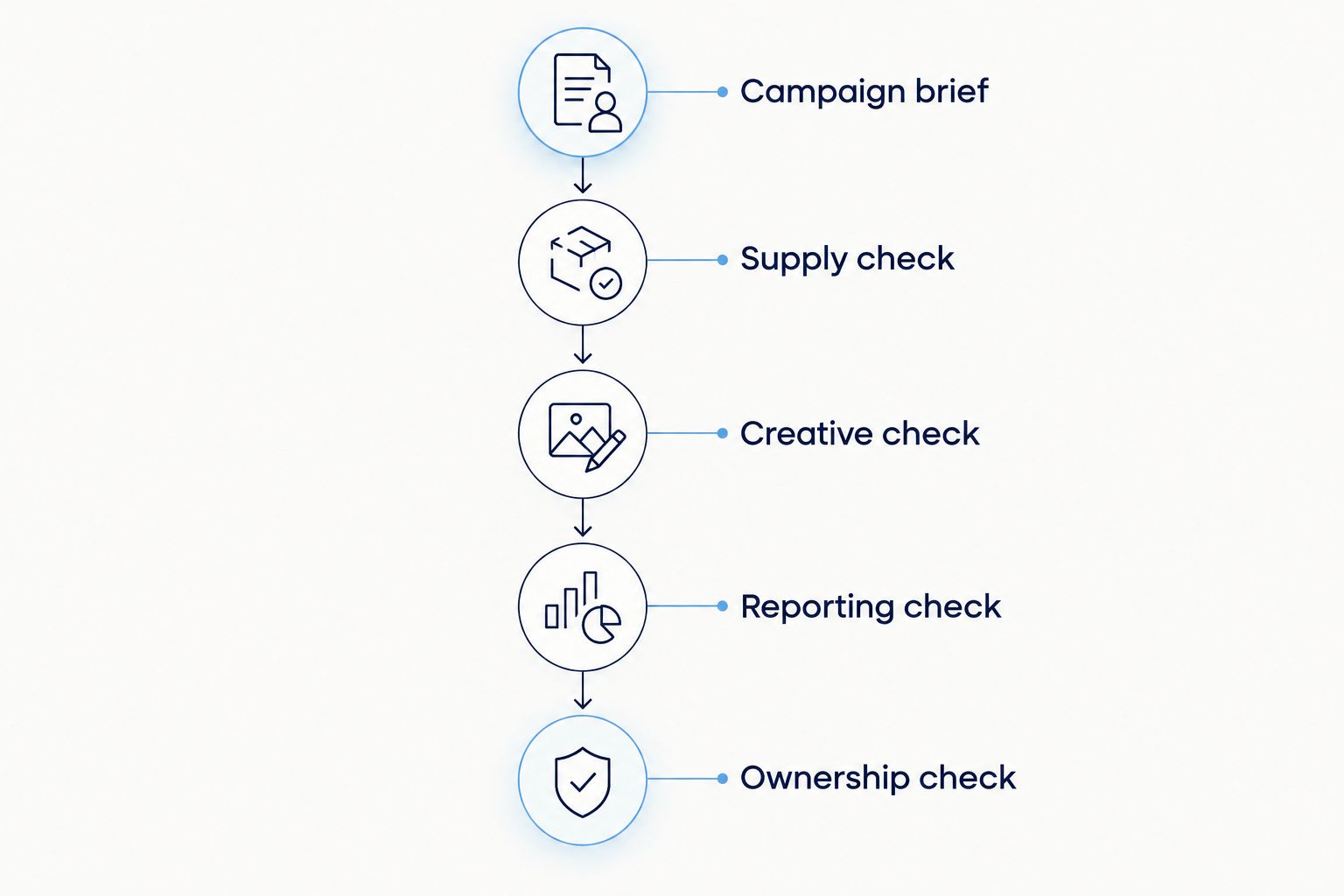
Evaluate the proposed campaign setup, not just the platform demonstration.
The sample durations test the creative conversation; they are not recommended specifications for every placement. Likewise, the reporting views define questions to answer, not a promise that every platform provides identical outputs.
For an undecided buyer, the default next move is a requirements-led shortlist, not an immediate platform commitment. Select the operating-model fit first, then validate the exact buying and reporting setup.
Choose The Trade Desk for evaluation when independent omnichannel buying is the priority; StackAdapt when multi-channel planning leads the brief. Put Amazon DSP forward when Amazon audiences have a defined role, and Display & Video 360 when Google-connected operations matter. Include the modular-stack option when buying, creative, data and publisher supply all need attention.
Discuss your advertising stack
Bring your buying, creative, data and publisher requirements to a modular-stack enquiry.
What's the best CTV advertising platform for an independent agency?
The right CTV advertising platform depends on the agency's buying model, publisher requirements and measurement process. The Trade Desk and StackAdapt are relevant DSP options; Gocake is relevant when the enquiry covers a wider modular advertising stack, with the proposed CTV setup requiring confirmation.
Is The Trade Desk better than StackAdapt for CTV?
Neither platform is established as better by this comparison. Evaluate The Trade Desk for independent omnichannel buying and StackAdapt for multi-channel campaign planning, then compare their answers to the same campaign brief.
When should a brand consider Amazon DSP for CTV?
Consider Amazon DSP when Amazon audiences have a defined role in the campaign strategy. Confirm how those audiences connect to the intended inventory and how outcomes will be measured.
Does using Google tools mean I should choose Display & Video 360?
No; existing Google usage is an operational consideration, not proof of CTV fit. Confirm publisher access, permissions and the proposed reporting workflow before selecting Display & Video 360.
Is a data clean room the same thing as CTV measurement?
No; a data clean room provides a controlled environment for permitted data collaboration and analysis. A CTV measurement plan still needs defined outcomes, suitable data and an agreed method.
Can I use the same video asset on every CTV placement?
Do not assume one video asset is accepted by every CTV placement. Confirm duration, format, approval and delivery requirements for the intended publishers before trafficking.
What should I ask in a CTV platform demo in 2026?
Ask the provider to walk through your campaign from audience selection to publisher buying, creative approval and reporting. Establish who controls each step and which outputs depend on another provider.
Ask for an example reporting output before agreeing to the buying arrangement. A demonstration shows what you can configure; a report shows what you can inspect afterwards. If the output cannot answer your campaign questions, the interface is not the deciding factor.
Compare the best header bidding platforms by auction control, server-side setup and publisher fit. Choose a stack that suits your team, not a sales pitch.
Read more →Compare the best first-party data activation platforms by fit: warehouse activation, CDPs, identity and media buying. Choose the layer your advertising stack needs.
Read more →Compare the best ad verification and brand safety tools by use case. Choose your 2026 shortlist for fraud, viewability, video suitability and supply checks.
Read more →Book a 30-minute demo and see exactly how Cake.Shop works — no sales pitch, just the platform.