
OPEN DAILY
OPEN
HONEST
TRUST
LET'S CHAT



Identity resolution has no single standard cost: the scope depends on the records you resolve, the matching method, the systems you connect and where you use the resulting audiences. A useful quote separates identity processing from implementation, data access, activation and ongoing operations. For a 2026 buying decision, compare the cost of a usable audience workflow—not just the matching service.
TL;DR
Matching customer records is not the same as making those customers addressable in an advertising campaign. A resolved profile can still lack the permissions, destination compatibility or usable identifiers required for activation.
That distinction changes the buying brief. If your workflow includes collaboration between organisations, understand whether a data clean room can work without cookies before treating a clean room and an identity service as interchangeable purchases.
Buy the workflow your team needs, not a match-rate claim in isolation. A quote only becomes comparable when its inputs, outputs and operating responsibilities are explicit.
Identity resolution requires a scoped quote rather than a universal benchmark. Start by asking suppliers to itemise the following components, mark exclusions and define exactly what triggers a charge. Not every contract separates these items; the purpose is to expose the boundaries.
Identity processing
Data access
Implementation
Activation
Operations
Governance
Ask each supplier to complete the same scope document. A bundled proposal and an itemised proposal are not directly comparable until you can identify what each includes.
For your 2026 budget, distinguish initial implementation from recurring operations. Then document the events that change the bill: additional datasets, new destinations, more frequent processing or expanded support. Treat these as contract questions, not assumed features or charges.
A record, a customer and a resolved identity are not necessarily equivalent units. One customer can appear in several source systems, while duplicate records can inflate the input count without adding audience reach.
Ask the supplier to define the unit used in its proposal. Clarify whether repeated processing counts again, whether unmatched records are included and how merged or deleted identities are handled. A billing unit without a counting rule is not a usable comparison.
Choose the matching approach before requesting a final proposal. Deterministic matching links records through explicit shared identifiers; probabilistic matching infers relationships from signals. A hybrid approach combines methods, but that label alone does not explain how decisions are made.
These are technical approaches, not standard commercial tiers. Do not assume one carries a particular fee or produces better results without testing it against your actual task.
Deterministic matching
Probabilistic matching
Hybrid matching
An exact identifier match is only as useful as the identifier itself. Shared email addresses, recycled identifiers and inconsistent formatting need attention when you define matching rules.
Choose deterministic matching for traceable links, then test the exceptions. Ask for documented normalisation rules, conflict handling and a clear explanation of what happens when identifiers disagree.
A probabilistic link is an inference, not proof that records belong to the same person. Establish how confidence is represented and which uses permit inferred relationships.
Evaluate probabilistic matching against the consequence of a wrong link. Campaign audience construction and customer record updates can require different acceptance criteria; do not treat them as the same task.
Combining methods does not remove the need to explain individual links. Your team needs to distinguish an explicit identifier match from an inferred association when reviewing quality or investigating a problem.
Request separate reporting for confirmed and inferred links. Otherwise, an aggregate match rate can hide differences that matter to activation, measurement and governance.
The scope changes when the job changes. Use these factors to explain differences between proposals rather than assuming a larger feature list represents better value.
For a 2026 renewal or new contract, describe these factors in the statement of work. Keep optional future requirements separate from what the team will actually use at launch.
Use a defined sequence: state the business action, describe the data, specify the output, test the workflow and assign ongoing ownership. Each stage should produce something a supplier can respond to without guessing.
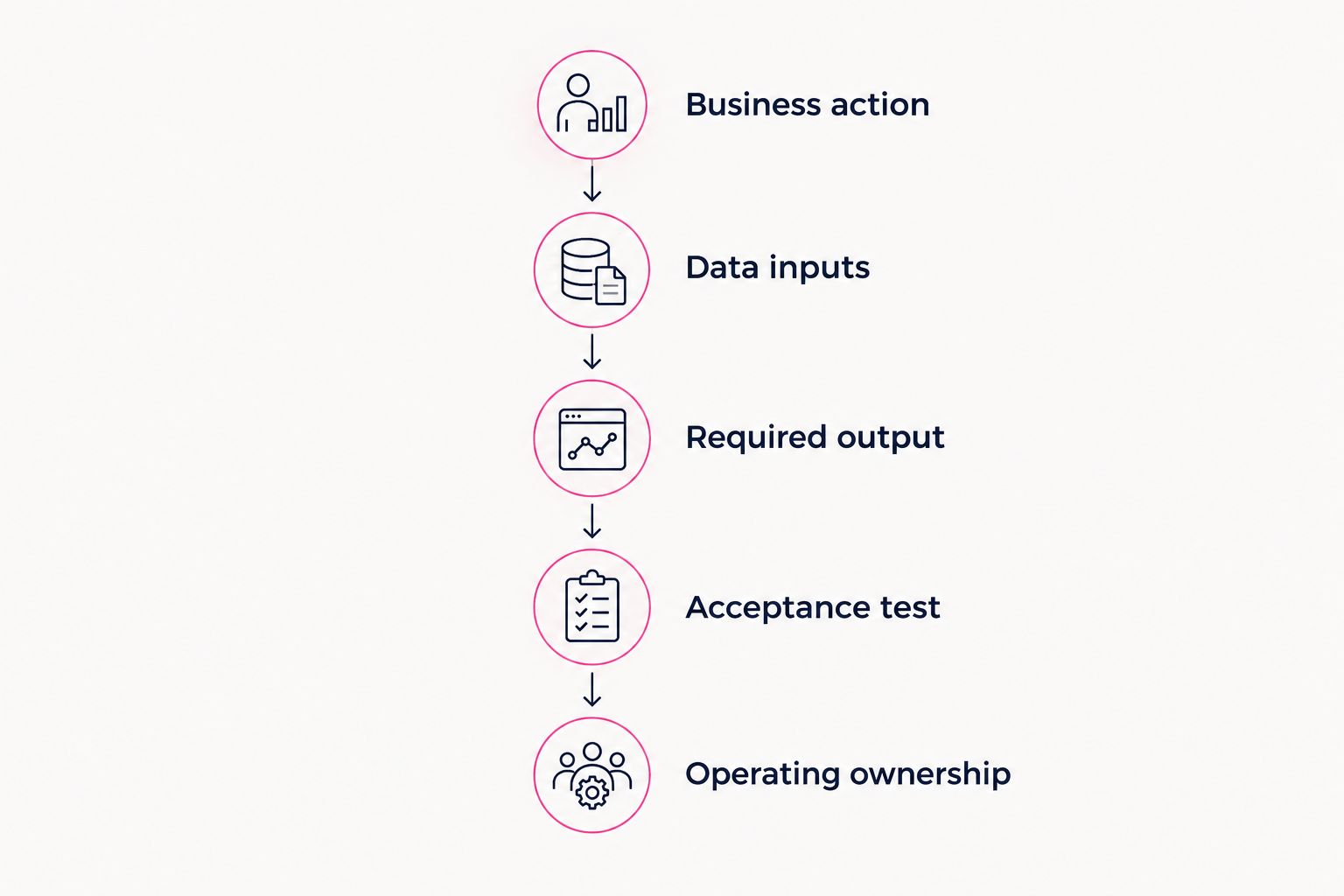
Define the output and acceptance test before comparing supplier proposals.
A useful 2026 procurement brief also states what is outside scope. For example, if your immediate objective is suppressing existing customers from an acquisition audience, do not evaluate every proposal as though you also need an enterprise-wide customer record.
Keep the pilot tied to that objective. A technically successful match is not an acceptance result unless the output supports the action you specified.
Identity resolution links records; a data clean room provides a controlled environment for approved data collaboration or analysis; a demand-side platform buys advertising inventory. These functions can connect, but buying one does not establish that the others are included.
Cake.Shop provides a modular programmatic advertising platform spanning media buying and reporting, rich media and DOOH creative, data clean rooms and publisher supply. DOOH means digital out-of-home advertising. That scope makes the enquiry broader than a standalone matching-tool comparison.
Cake.Shop is relevant for brands and independent agencies assessing a modular programmatic advertising stack. When discussing an identity-dependent workflow, ask which identity services, connections and operating responsibilities are included rather than assuming the stack supplies every component natively.
For an agency, the commercial questions include client separation, reporting responsibilities and who controls audience exports. For an in-house brand team, they include ownership of customer data connections and the ability to change buying destinations. Request evidence against your requirements; platform positioning is not an integration test.
Compare proposals against the same input population and intended use. Ask suppliers to explain exclusions, rejected records and the difference between a matched record and an audience member accepted by a destination.
A match rate needs a denominator: is it calculated against every submitted record, only valid records or another eligible subset? Different denominators can produce different percentages without any change in underlying matching performance.
Use these checks when reviewing proposals:
Do not equate accepted audience delivery with campaign effectiveness. Delivery validates part of the workflow; campaign performance requires its own measurement plan.
No. A higher match rate does not establish that links are correct, permitted for use or accepted by your buying destination. Compare the resulting usable audience and its quality, not the headline percentage alone.
No. A data clean room and identity resolution perform different jobs, although a workflow can use both. Ask how records are linked, where matching occurs and which outputs can leave the environment.
Define the intended buying destinations before committing to an identity workflow. A DSP—a demand-side platform—must be able to use the resulting audience through an agreed connection; resolving records without that route leaves the activation task unfinished.
How much does identity resolution cost for an independent agency?
An independent agency needs a quote scoped to its data, matching task, client requirements and activation destinations. Compare implementation, recurring operations and responsibility boundaries rather than an isolated matching fee.
What should an identity resolution quote include?
An identity resolution quote should define the billing unit, input data, matching work, outputs, implementation and operating responsibilities. Ask suppliers to identify exclusions and the events that change the scope.
Is deterministic identity resolution better than probabilistic matching?
Deterministic matching is more directly traceable to shared identifiers; probabilistic matching evaluates inferred relationships. Choose according to your available data, intended use and tolerance for incorrect links, then validate the result.
Can I use hashed emails without checking data permissions?
No. Hashing an email address does not by itself establish permission to process or share it. Review the intended use, applicable obligations and recipient arrangements before activation.
Does Cake.Shop provide more than a media buying tool?
Cake.Shop's programmatic advertising platform includes media buying and reporting, rich media and DOOH creative, data clean rooms and publisher supply. For an identity project, confirm the specific services and connections required rather than assuming they are included.
What should I check before signing an identity resolution contract in 2026?
Before signing in 2026, confirm counting rules, acceptance criteria, data rights, operating ownership and exit terms. Document how exports, retention and deletion work across the intended destinations.
Put the exit test beside the acceptance test. Before approving the workflow, ask what happens to source data, identity mappings and exported audiences when the agreement ends. A working demonstration shows how you start; a documented exit process shows what control you retain.
Can contextual advertising replace cookie based targeting? Yes for prospecting, not every task. Compare retargeting limits and build a fair test.
Read more →How much does CTV advertising cost? Get a quote-based budgeting framework covering media, platform fees, creative, data and measurement before buying.
Read more →How much does identity resolution cost? Get a scoped quote covering data matching, integration, activation and governance before you commit to a platform.
Read more →Book a 30-minute demo and see exactly how Cake.Shop works — no sales pitch, just the platform.