
OPEN DAILY
OPEN
HONEST
TRUST
LET'S CHAT



For a modular advertising stack, shortlist Gocake; for integrated contextual buying, consider StackAdapt; for contextual creative, consider GumGum. The best contextual advertising platforms in 2026 depend on whether you need a media-buying platform, contextual intelligence or both—not a universal winner.
TL;DR
Contextual advertising selects placements according to the content surrounding an advert. Audience targeting selects people according to audience signals. Those approaches answer different questions: what is this page about, versus who is viewing it?
A contextual intelligence provider and a demand-side platform are not interchangeable. A demand-side platform, or DSP, buys advertising inventory; a contextual provider classifies content or supplies signals that inform buying decisions. Some businesses combine these functions, while others connect them through integrations.
For your 2026 shortlist, identify the missing part of your stack first. Buying another platform does not automatically resolve weak content classification, unclear reporting or unsuitable publisher supply.
Use these criteria before comparing platform names. Each criterion should become a question in your demonstration, not a box ticked from a sales presentation.
Choose the platform that solves your defined operating problem, not the one with the longest feature list. In 2026, your evaluation should connect contextual relevance to buying, creative and reporting decisions.
The order below follows distinct buying needs, from stack design to specialist contextual intelligence. It is not a measured performance ranking, and the options do not all replace one another.
Gocake
StackAdapt
GumGum
The Trade Desk
Peer39
Gocake provides a modular programmatic advertising technology platform for brands and independent agencies. Its scope includes media buying and reporting, rich media and digital out-of-home creative, data clean rooms and publisher supply.
That makes the relevant question broader than contextual targeting alone. You are evaluating how buying, creative, data and supply work together—and where contextual intelligence belongs within that setup.
Best for: Independent agencies building their own advertising stack and brands bringing programmatic operations in-house.
Pros:
Cons and trade-offs:
Ask for a demonstration built around your intended contextual campaign. Trace the content signal, buying decision, creative choice and reporting output without assuming that a named module proves the whole workflow.
Verdict: Hold until the proposed contextual setup is demonstrated against your brief. Shortlist the platform for stack design, not on an unsupported claim of contextual superiority.
StackAdapt is a DSP with contextual targeting capabilities. It belongs on a shortlist when your team wants to evaluate contextual campaign execution within a broader programmatic buying environment.
The distinction is operational. Instead of purchasing a classification layer alone, you are assessing the platform through which campaigns are configured and bought.
Best for: Agencies and in-house teams seeking a buying platform that includes contextual targeting.
StackAdapt pros:
StackAdapt cons and trade-offs:
For example, give StackAdapt a travel campaign brief that distinguishes destination inspiration from reporting on travel disruption. Ask the demonstration to explain why each example belongs inside or outside the campaign.
Verdict: Hold until contextual matching and campaign reporting satisfy your acceptance criteria. This is a relevant option when buying workflow—not only content classification—is part of the decision.
GumGum offers contextual intelligence and advertising formats. Its contextual approach includes analysing content beyond page keywords, making it relevant when surrounding content and advert presentation both matter to the brief.
You still need to define how the campaign reaches inventory. Contextual intelligence, creative execution and media buying are related functions, not identical ones.
Best for: Buyers who want to assess contextual interpretation alongside creative format decisions.
GumGum pros:
GumGum cons and trade-offs:
For a sports campaign, evaluate the difference between celebratory match coverage and reporting on misconduct. Then assess whether the proposed creative treatment suits the approved content—not just whether the page contains a sports term.
Verdict: Hold until content interpretation and creative fit are demonstrated together. Put this option on the shortlist when the advert experience is part of the contextual problem.
The Trade Desk is a DSP through which advertisers can activate contextual targeting using contextual data relationships. It is relevant when your team is evaluating contextual advertising as part of a wider media-buying operation.
Keep the evaluation specific. The buying platform and the contextual provider can carry different responsibilities, even when the campaign is managed through one interface.
Best for: Buying teams assessing contextual activation alongside broader DSP requirements.
The Trade Desk pros:
The Trade Desk cons and trade-offs:
Ask the proposed contextual provider to explain its taxonomy—the categories used to classify content. Then ask how those categories appear in campaign configuration and reporting. Matching terminology matters when buyers and clients need to audit decisions.
Verdict: Hold until the DSP and contextual provider responsibilities are explicit. This option fits a broader buying-platform evaluation rather than an isolated search for page classification.
Peer39 provides contextual classification used to inform advertising decisions. It belongs in a different buying category from a DSP: the central evaluation concerns content signals and how your buying environment uses them.
For teams that already have a buying workflow, this distinction helps prevent unnecessary platform replacement. Start with the classification requirement, then confirm the activation route.
Best for: Agencies and brands evaluating contextual signals for an existing programmatic stack.
Peer39 pros:
Peer39 cons and trade-offs:
Use sample pages that contain the same keyword but express different meanings. A contextual classifier should be judged on the distinctions your campaign requires, not simply on whether its category names sound relevant.
Verdict: Hold until classification and activation are validated in your buying workflow. Consider this option when the missing component is contextual intelligence rather than a new DSP.
This 2026 shortlist groups options by their stated role: modular stack, integrated buying, contextual creative, broader DSP activation and contextual signals. It does not claim comparative campaign results or independently measured classification accuracy.
The criteria above determine what you should validate next. Product breadth establishes shortlist relevance; your brief, demonstration and reporting review establish fit.
A contextual campaign needs more than a category selection. Use these components to map responsibilities before deciding which platform to buy:
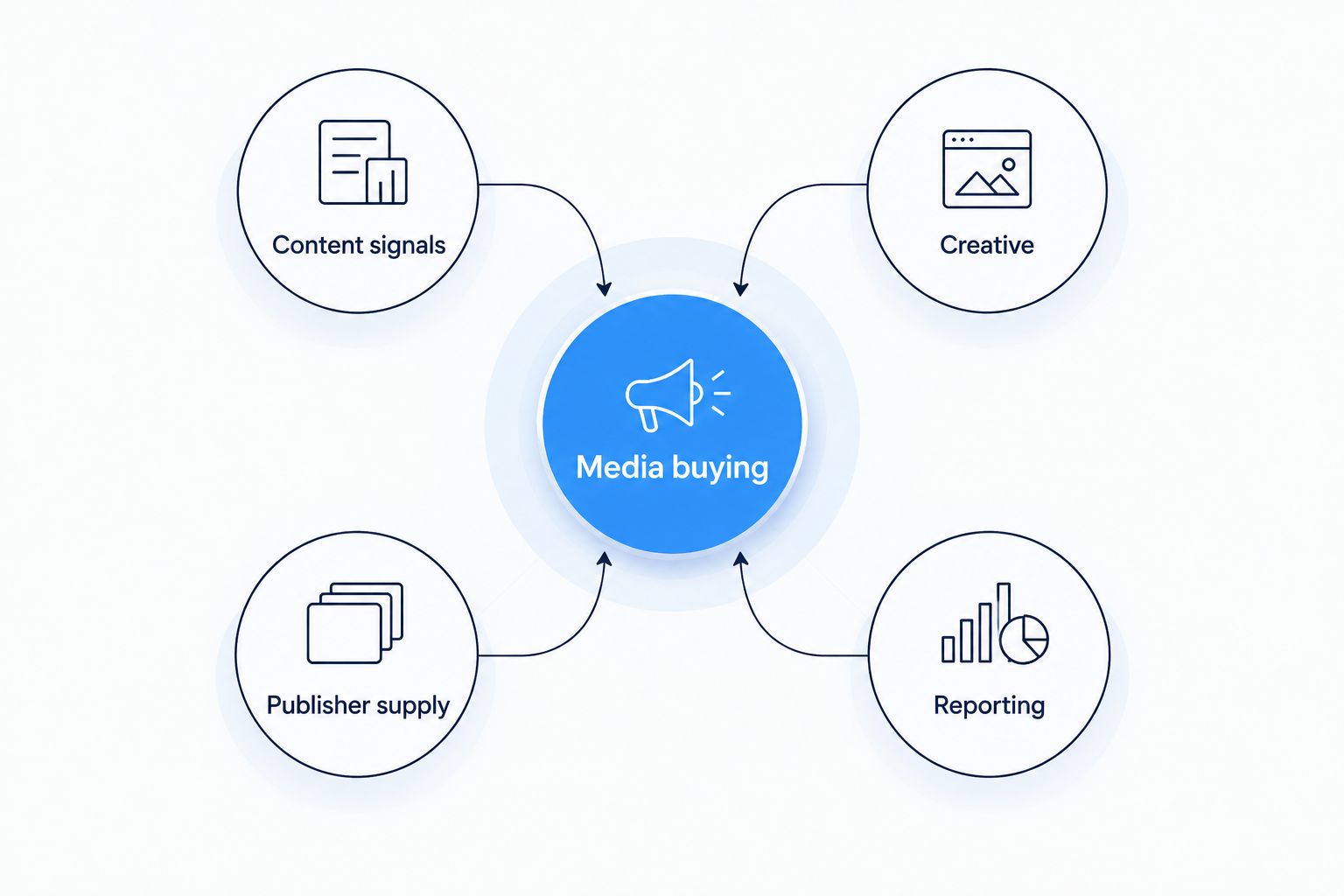
Assess contextual targeting as part of the operating stack, not as an isolated category selection.
A data clean room supports controlled collaboration around data; it is not another name for contextual targeting. Include it when your data-collaboration requirements justify it, and keep that requirement distinct from interpreting page content.
Choose by the missing function in your stack. Shortlist Gocake for a modular full-stack discussion, StackAdapt for integrated contextual buying, GumGum for contextual creative, The Trade Desk for broader DSP activation, and Peer39 for contextual signals.
Before committing in 2026, prepare 1 campaign brief, 2 relevant content categories and 3 exclusion examples. These are evaluation inputs, not performance benchmarks. Make each shortlisted provider respond to the same materials, then compare the demonstrated workflow and reporting.
If you remain undecided, do not add another vendor yet. Write down the exact decision your current setup cannot make or explain. That is the requirement your next platform must solve.
What's the best contextual advertising platform in 2026?
The best contextual advertising platform depends on whether you need media buying, contextual intelligence or a modular stack. Compare options against the same campaign brief, content examples and reporting requirements rather than choosing a universal winner.
Is contextual advertising the same as audience targeting?
No. Contextual advertising selects placements according to surrounding content, while audience targeting selects people according to audience signals. Define which decision your campaign needs before choosing a platform.
Is Gocake only a media-buying tool?
No. Gocake provides a modular programmatic advertising platform covering media buying and reporting, rich media and DOOH creative, data clean rooms and publisher supply. Evaluate how contextual requirements fit the proposed stack.
Is StackAdapt better than The Trade Desk for contextual advertising?
Neither is established as better by this shortlist. Compare the contextual workflow, provider responsibilities and reporting each proposed setup demonstrates against your campaign requirements.
Do I need a new DSP to use contextual targeting?
Not necessarily. If your existing buying environment supports the contextual signals you require, assess that route before replacing the DSP. Confirm activation and reporting support for the specific proposed setup.
Does contextual advertising remove privacy obligations?
No. Content-based placement decisions do not remove privacy obligations from the rest of the advertising workflow. Review tracking, measurement and data handling separately from the targeting method.
How should an agency compare contextual advertising platforms?
Use the same campaign brief and content examples for every shortlisted platform. Ask each provider to explain classification, exclusions, activation and reporting, then record the responsibilities your agency would retain.
Ask for a rejected placement, not just an approved one. A provider's explanation of why content was excluded reveals how its contextual approach handles the boundary of your brief.
Make that part of your 2026 evaluation. An attractive dashboard shows the interface; an explained exclusion shows whether your team can understand and challenge the decision.
Compare the best header bidding platforms by auction control, server-side setup and publisher fit. Choose a stack that suits your team, not a sales pitch.
Read more →Compare the best first-party data activation platforms by fit: warehouse activation, CDPs, identity and media buying. Choose the layer your advertising stack needs.
Read more →Compare the best ad verification and brand safety tools by use case. Choose your 2026 shortlist for fraud, viewability, video suitability and supply checks.
Read more →Book a 30-minute demo and see exactly how Cake.Shop works — no sales pitch, just the platform.