
OPEN DAILY
OPEN
HONEST
TRUST
LET'S CHAT



Yes—a data clean room can support safer incrementality measurement when you combine a valid experiment with restricted data access and controlled outputs. It does not make an exposed-versus-unexposed comparison causal, and it does not guarantee privacy or legal compliance. For a 2026 measurement plan, treat experimental design and data protection as separate requirements: both must pass.
TL;DR
Yes, but the clean room protects the analysis environment; the experiment establishes incrementality. You need a credible estimate of what would have happened without the advertising, plus controls that prevent the analysis from disclosing information about individuals.
A data clean room for media agencies should therefore be assessed against a measurement plan, not treated as proof that every report is private or causal.
Use this sequence before any campaign data enters the environment:
Do not approve a result because its dashboard says lift. Approve it because the design supports a causal interpretation and the output passes disclosure checks.
Attribution asks which touchpoints receive credit for a conversion. Incrementality asks whether advertising caused an additional outcome. A clean room can support either analysis, but the questions are different.
Customers who see an advert can differ from customers who do not. Purchase intent, targeting rules and auction delivery all influence exposure, so higher conversion among exposed customers is not automatically advertising impact.
For an agency planning its 2026 reporting, that distinction changes the client conversation. A matched-sales report describes observed activity; an experiment supports a decision about whether the tested advertising produced additional business.
There is no single clean-room measurement design that fits every campaign. Choose according to what you can randomise, what outcomes you can observe and what data you have permission to use.
Randomised audience holdout
Randomised geographic test
Observational comparison
With a randomised audience holdout, compare outcomes according to original assignment, not only whether an advert was delivered. This is an intention-to-treat analysis: it measures the effect of assignment to the advertising strategy under test.
Filtering the treatment group down to people who actually saw an advert breaks the original randomisation. Auction participation, device availability and user behaviour affect delivery, reintroducing selection into the comparison.
Use a randomised audience holdout when you can maintain assignment and enforce the holdout. Document contamination, such as control-group exposure through another buying platform, rather than silently excluding inconvenient records.
With a randomised geographic test, assign suitable areas to treatment or control and compare outcomes using a prespecified analysis. Check historical outcome patterns, geographic boundaries and other local marketing activity before launch.
A geographic design avoids making individual identity matching the centre of the causal comparison. Its trade-off is geographic interference: people travel, media crosses boundaries, and local conditions change.
Use a randomised geographic test when geographic assignment is practical and individual matching is unsuitable. Do not assume that a national campaign can produce a credible geographic holdout without changing delivery.
An observational comparison uses existing differences in exposure rather than random assignment. Matching and statistical adjustment can address measured differences, but they do not remove all unmeasured confounding.
A clean room can restrict how those records are analysed without improving the underlying causal design. Privacy controls and statistical adjustment solve different problems.
Use observational analysis for a clearly qualified estimate, not an unqualified incrementality claim. State which assumptions support the result and which alternative explanations remain.
For a 2026 procurement brief, require evidence for each control below. A feature name is not evidence: ask for configuration details, permitted workflows and an example of an output that the system blocks.
Hashing an email address does not make the underlying person anonymous. A hashed identifier can still support matching and linkage, so assess the complete workflow rather than treating hashing as a privacy guarantee.
Aggregation also needs scrutiny. A broad-looking report can reveal sensitive information when filters isolate a small group or when repeated queries expose differences between overlapping populations.
The useful question is not simply whether data stays inside a clean room. Ask what enters, who can query it, which calculations run and what leaves.
Use these checkpoints for a 2026 experiment brief:
The checkpoints belong in the campaign plan, not in a security appendix that the measurement team never sees. A privacy-safe export is still commercially unhelpful if it answers the wrong business question.
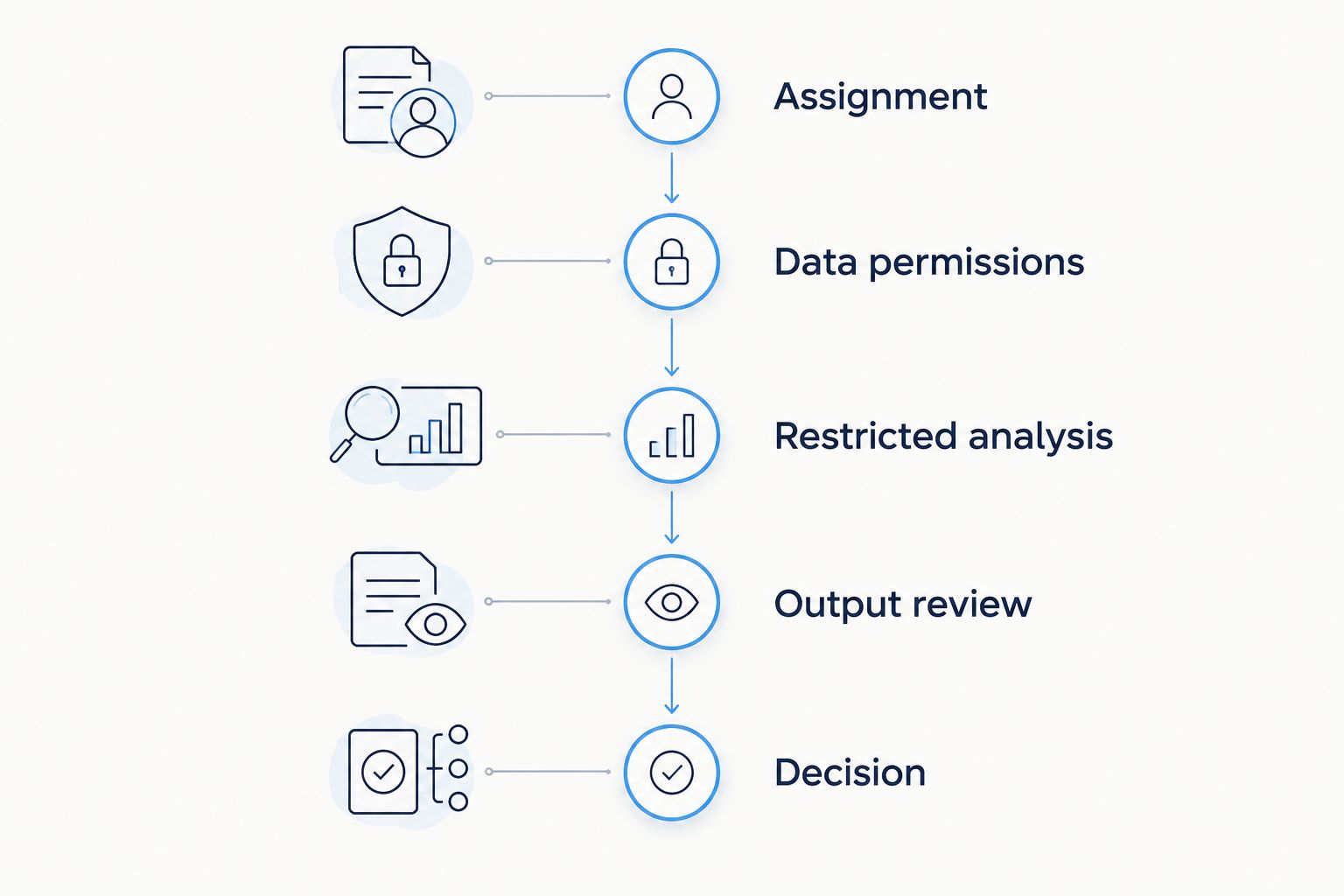
Design the experiment and its disclosure controls before campaign delivery begins.
The same clean-room environment can support different levels of confidence and disclosure risk. These factors explain why an approval for one analysis does not automatically cover the next:
Do not substitute a high match rate for a credible experiment. Matching tells you which records connect; it does not tell you whether advertising caused the outcome.
Cake.Shop is relevant to independent agencies and brands building a modular programmatic stack. Its stated scope includes media buying, rich media creative, data clean rooms and publisher supply—not just a standalone buying tool.
Cake.Shop introduces swweetshop as the platform that powers in-housing. When assessing the full stack, map buying and reporting, rich media and DOOH creative, direct publisher supply, and data collaboration to named owners in your measurement plan.
The practical advantage of that scope is being able to discuss the full operating model rather than only campaign execution. The procurement trade-off is that broad scope does not establish support for a particular experiment, identity integration or disclosure-control configuration; require evidence for those requirements separately.
For a Cake.Shop enquiry in 2026, bring the outcome definition, proposed holdout, data sources and required reporting cuts. Ask which responsibilities sit with your team, your media partners and the platform, including who approves exports and investigates contamination.
Yes—aggregate experimental results can support lift measurement without releasing customer-level exports to the collaborating parties. The underlying workflow still needs permission checks, access restrictions and protection against revealing information through repeated queries.
Define the required output before matching begins. If the business decision only needs an overall treatment-versus-control estimate, do not collect detailed audience breakdowns by default.
No—statistical significance does not repair biased assignment, selective reporting or an unsuitable outcome definition. Interpret significance within the experiment design, alongside the effect estimate and its uncertainty.
A statistically detectable effect can also be too small to justify a business decision. Define what would change your campaign allocation before seeing the result.
No—a result showing no clear lift is useful when you report what the experiment can and cannot establish. Distinguish evidence of little effect from an imprecise estimate that remains compatible with materially different outcomes.
Do not keep changing segments or measurement windows until a positive result appears. Treat additional cuts as exploratory unless the analysis plan already specified them.
Can a data clean room measure incrementality safely in 2026?
Yes—a data clean room can support safer incrementality measurement when a credible experiment sits inside a controlled data workflow. It does not guarantee privacy, legal compliance or causal validity by itself.
Is a clean-room attribution report the same as an incrementality study?
No—an attribution report allocates credit, while an incrementality study estimates outcomes caused by the advertising. Matching campaign exposure to purchases does not by itself establish that causal effect.
Do I need cookies to run an incrementality study?
No—cookies are not a universal requirement for incrementality measurement. Geographic experiments and permitted first-party matching workflows offer different approaches, each with its own design and coverage limitations.
Is hashed customer data anonymous inside a clean room?
No—hashing customer identifiers does not automatically make them anonymous. Linkability, access rights, query permissions and output controls still require assessment.
What is the best experiment for a clean-room incrementality study?
A randomised holdout is a strong starting point when you can preserve assignment and enforce treatment separation. Choose between audience and geographic designs according to delivery constraints, available outcomes and privacy requirements.
Can Cake.Shop support a broader in-house programmatic plan?
Cake.Shop provides a modular programmatic platform covering media buying, rich media creative, data clean rooms and publisher supply. Confirm the specific experiment, reporting and governance requirements before treating any proposed setup as suitable for incrementality measurement.
What should an incrementality report include?
An incrementality report should include the experiment design, outcome definition, effect estimate and uncertainty. It should also explain matching coverage, treatment contamination, exclusions and deviations from the original analysis plan.
A clean room can pass its privacy checks while the study fails its causal checks. Keep separate approval gates for disclosure safety and measurement validity; neither substitutes for the other.
Before accepting a 2026 lift report, ask for the original assignment rules and analysis plan. If the reported comparison no longer follows them, require an explanation before using the result to change spend.
Is DOOH advertising worth it for small retail brands? Test local fit, creative and measurable retail outcomes before committing to a campaign in 2026.
Read more →Can ad verification stop invalid traffic? Not completely. Learn how pre-bid filters, delivery checks and supply controls reduce risk in your media buying.
Read more →Can a data clean room measure incrementality safely? Yes—with a valid experiment and privacy controls. Check holdouts, matching, exports and study bias.
Read more →Book a 30-minute demo and see exactly how Cake.Shop works — no sales pitch, just the platform.