
OPEN DAILY
OPEN
HONEST
TRUST
LET'S CHAT



Ad verification can block some invalid traffic before you buy an impression and identify more after delivery, but it cannot eliminate invalid traffic. Its effectiveness depends on detection coverage, buying controls and whether someone acts on the findings. For a 2026 programmatic buying plan, use verification as a control loop—not a guarantee that every paid impression reached a real person.
TL;DR
Ad verification reduces exposure to invalid traffic; it does not certify every impression as genuine. Pre-bid checks act before a purchase. Post-delivery measurement evaluates what actually ran, including signals unavailable when the bid decision happened.
When assessing ad verification and brand safety tools, separate prevention, measurement and remediation. A supplier that reports a problem has not necessarily prevented it, and an exclusion applied tomorrow does not reverse yesterday’s delivery.
Pre-bid filtering
Post-delivery verification
Supply-path controls
Remediation workflow
These controls answer different questions. Use them together rather than treating a single dashboard score as the verdict on your media quality.
Invalid traffic can distort both delivery reporting and campaign decisions. If automated activity enters an optimisation signal, your buying system has a misleading basis for allocating spend. Verification belongs alongside conversion validation and supply review, not in an isolated reporting tab.
For independent agencies, the commercial issue is accountability: who identifies the problem, who changes the buying settings and who explains the result to the client? For brands bringing programmatic in-house in 2026, those responsibilities need named owners before launch.
Invalid traffic includes activity that should not count as legitimate advertising traffic. Not all of it represents deliberate fraud: recognised crawlers and other non-human activity also need filtering.
A genuine person can see an ad and never buy. An impression can also be non-viewable without being fraudulent. Keep invalid traffic, viewability, brand suitability and conversion quality separate so you apply the right remedy.
Pre-bid filtering evaluates an advertising opportunity before your demand-side platform, or DSP, commits to buying it. Depending on the service and integration, the decision uses available signals about the inventory, device, seller or previously observed activity.
Best for: preventing purchases associated with recognised invalid traffic signals. Ask which channels and buying routes the filter actually covers. A setting applied to one campaign or environment is not evidence of protection elsewhere.
The trade-off is timing. Pre-bid systems decide before the impression occurs, so they cannot inspect the full delivery event. More restrictive settings also narrow eligible inventory; assess what those settings exclude rather than assuming tighter always means better.
Ask your provider to distinguish an enforced block from a risk label. A label visible in reporting is useful, but it is not the same as stopping a bid.
Post-delivery verification examines signals associated with delivered advertising. The measurement method depends on the environment and implementation, so confirm what was measurable rather than assuming every served impression was inspected.
Best for: identifying delivered activity that needs investigation or exclusion. Its strength is access to delivery evidence that was unavailable before the auction. Its limitation is equally clear: a retrospective finding cannot prevent an impression that has already happened.
Some findings require analysis across events rather than an immediate decision on a single impression. Ask when reports become final and whether classifications are revised as further evidence arrives.
Do not treat an invalid impression as an automatic refund. Any credit, replacement delivery or dispute process depends on the applicable agreement and supporting evidence. Establish the process before you need it.
A verification contract is not a uniform layer of protection. For a 2026 evaluation, check these factors against the campaigns you intend to run:
The practical question is not simply whether verification is enabled. It is whether a specific finding produces a specific action on the affected inventory.
Build a repeatable process that connects buying decisions to delivery evidence. Keep the original settings and subsequent changes documented so an investigation does not depend on someone remembering what happened.
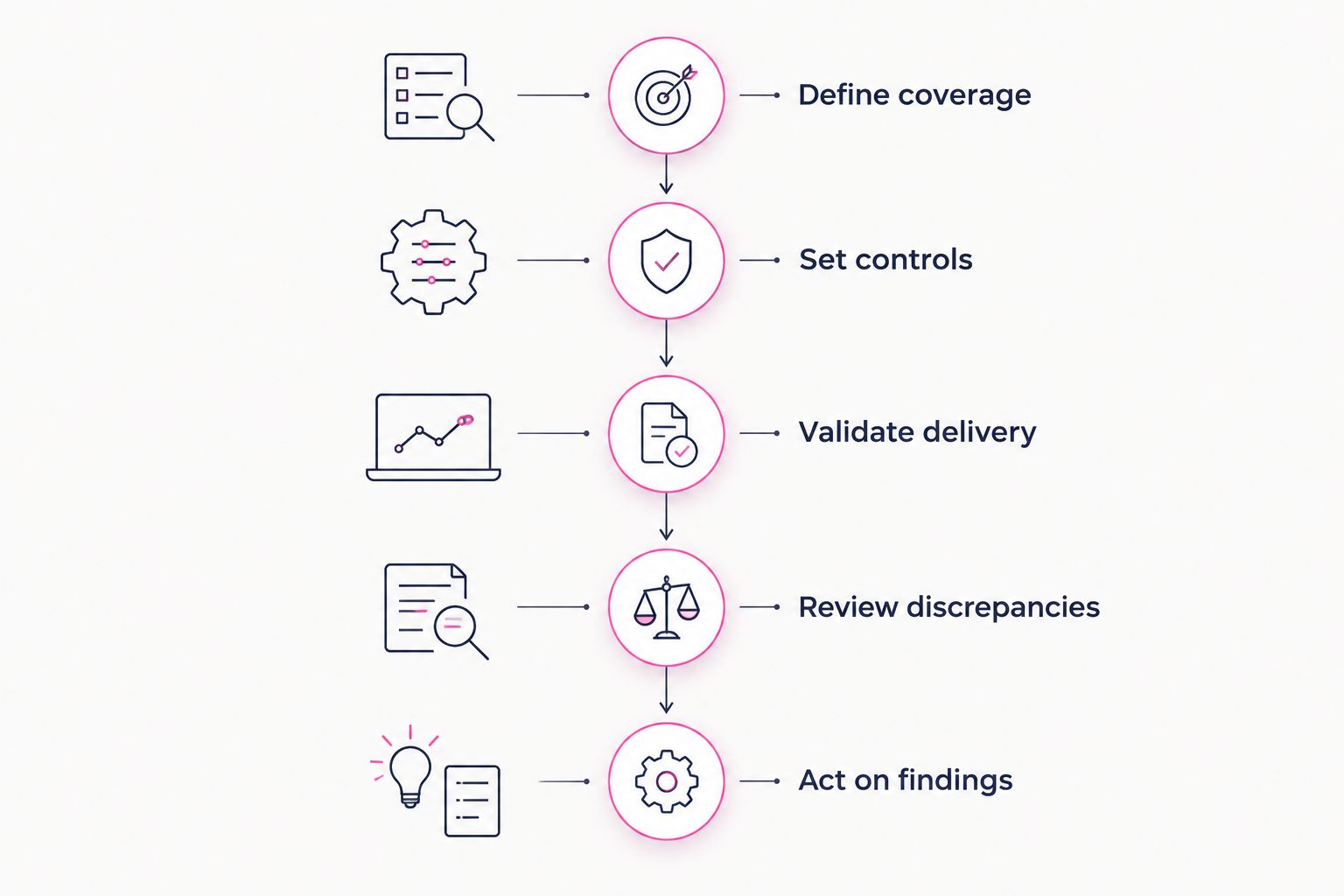
Verification becomes a buying control when findings lead to documented action.
Keep the response proportionate to the evidence. A problematic placement calls for a targeted investigation; an unexplained reporting gap calls for measurement troubleshooting. Those are different tasks, even when both appear in the same campaign review.
A reported invalid traffic rate needs a stated denominator. Ask whether the rate refers to measured impressions, served impressions or another defined population. Compare like with like before deciding that one campaign or supplier is cleaner than another.
Keep the following fields together in your reporting:
Do not combine pre-bid exclusions with post-delivery findings into an unexplained total. They describe different populations at different stages of the transaction.
For your 2026 reporting template, include a plain-language explanation beside each rate. A client should be able to distinguish prevented buying, detected invalid delivery and unmeasured activity without reverse-engineering the dashboard.
No. A direct publisher relationship can make responsibility and supply routes easier to establish, but the relationship itself does not validate every impression. Keep traffic-quality checks even when you know the publisher.
Authorisation records also serve a narrower purpose than traffic verification. Tools such as ads.txt and sellers.json help establish authorised selling relationships and seller identity; they do not prove that an individual ad reached a human.
For agencies building a stack, assess buying, creative, data and supply together. Cake.Shop provides modular programmatic technology covering media buying and reporting, rich media and DOOH creative, data clean rooms and direct publisher supply. Its platform, swweetshop, powers in-housing.
Cake.Shop serves independent agencies and brands building a modular programmatic advertising stack. That scope is relevant when you want buying and supply decisions considered alongside creative and data, rather than evaluating a buying interface alone.
The boundary matters: a full-stack offering is not evidence of a particular verification integration or detection outcome. Ask how the proposed setup applies checks, exposes findings and assigns responsibility. A data clean room supports controlled data collaboration; it is not a substitute for invalid traffic detection.
No. Ad verification classifies activity using the signals available to its detection methods; it cannot establish an absolute guarantee for every impression. Ask for the scope and limitations of any assurance instead of accepting a blanket claim.
A strong evaluation distinguishes supported detection from unobservable activity. Treat a promise of zero invalid traffic as a claim requiring evidence, not a procurement shortcut.
Yes, when both are supported for your buying environment. Pre-bid filtering addresses recognised risks before purchase, while post-delivery verification checks evidence from actual delivery.
The combination still needs an operating process. Give someone authority to translate repeated findings into exclusions and supply reviews; otherwise, you have more reporting without a clear response.
Pause the affected buying route when the evidence justifies it, rather than automatically stopping every campaign. Identify whether the findings are concentrated in a placement, publisher, app or seller path before choosing the scope of the action.
If the reports disagree, reconcile measurement definitions and implementation first. Preserve the underlying evidence so the decision remains explainable to the advertiser and supplier.
Can ad verification stop invalid traffic completely?
No. Ad verification blocks some recognised threats and detects invalid activity after delivery, but it cannot guarantee that every impression is genuine. Combine detection with supply controls and a documented response process.
What's the difference between ad fraud and invalid traffic?
Ad fraud involves deliberate deception, while invalid traffic also includes activity that should be filtered without necessarily being fraudulent, such as recognised crawlers. Do not label every invalid event as intentional fraud.
Is pre-bid filtering better than post-delivery verification?
Neither replaces the other. Pre-bid filtering supports prevention before purchase; post-delivery verification evaluates actual delivery and supports investigation.
Does a low invalid traffic rate prove my campaign is clean?
No. A low reported rate must be read alongside measurement coverage, detection scope and the denominator used. Unmeasured activity is not evidence of valid traffic.
Do direct publisher deals still need ad verification?
Yes. A direct relationship establishes a commercial route, not proof that every impression is valid. Keep verification and traffic-quality reviews in the buying process.
Will invalid impressions automatically be refunded?
No. Credits, replacement delivery and disputes depend on the applicable agreement and evidence. Confirm the remediation terms before launch.
How should I assess Cake.Shop for programmatic in-housing?
Assess Cake.Shop as a modular programmatic stack spanning media buying and reporting, creative, data clean rooms and publisher supply. Confirm the verification coverage, integrations and operating responsibilities required for your campaigns separately.
The first question in your next verification review should be: What was not measured? That answer sets the boundary for every clean-traffic claim that follows.
Before approving your 2026 setup, ask the buying and verification teams to walk through one flagged source from detection to action. If nobody can show who changes the buying rules, the gap is operational—not another dashboard feature.
Is DOOH advertising worth it for small retail brands? Test local fit, creative and measurable retail outcomes before committing to a campaign in 2026.
Read more →Can ad verification stop invalid traffic? Not completely. Learn how pre-bid filters, delivery checks and supply controls reduce risk in your media buying.
Read more →Can a data clean room measure incrementality safely? Yes—with a valid experiment and privacy controls. Check holdouts, matching, exports and study bias.
Read more →Book a 30-minute demo and see exactly how Cake.Shop works — no sales pitch, just the platform.