
OPEN DAILY
OPEN
HONEST
TRUST
LET'S CHAT


Yes, brands can in-house their programmatic media buying by taking responsibility for campaign decisions, platform access, data use and measurement. The right model depends on which responsibilities your team can actually support: you can own strategy and accounts while retaining outside trading support. A platform login alone does not give you operational control.
TL;DR
In 2026, the useful question is not whether your brand can access buying software. It is whether you can make, explain and change the decisions that software executes.
A demand-side platform, or DSP, lets buyers purchase advertising inventory programmatically. It does not replace your campaign strategy, creative production, privacy decisions or interpretation of results. Before choosing software, separate the work a self-serve DSP can replace from the responsibilities your team must retain.
In-housing is an operating-model decision, not a software purchase. If nobody owns daily delivery or measurement quality, moving the account inside your business simply moves the problem.
Yes. Start by deciding what the brand must own, then assign the work required to exercise that ownership. Use the following sequence for a 2026 transition plan rather than starting with a vendor shortlist.
These steps are a recommended sequence, not a promised implementation timetable. Expand according to demonstrated readiness, not a date chosen before your dependencies are understood.
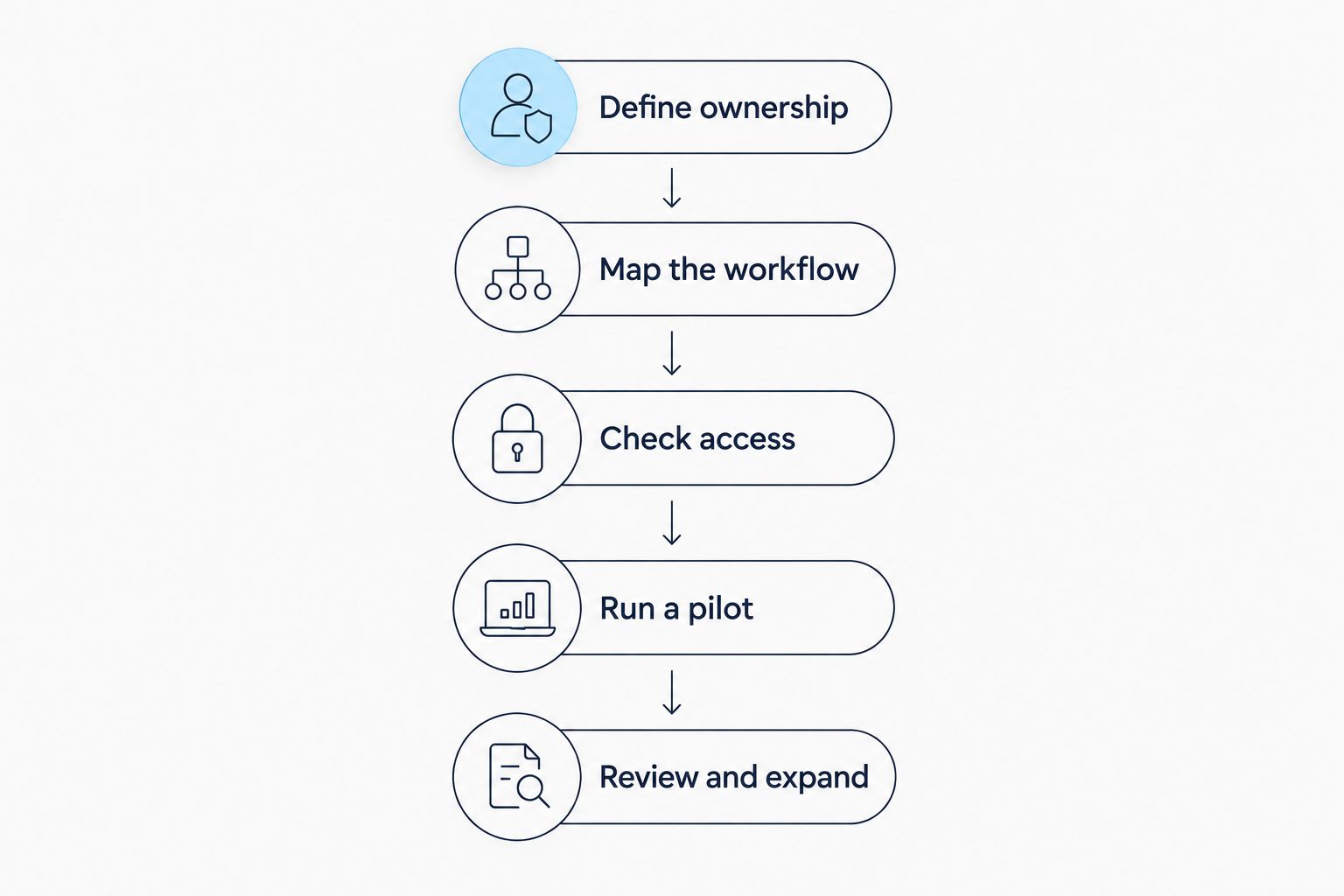
Set ownership and access before moving campaign execution.
You do not have to choose between doing everything internally and giving an agency complete control. Compare the responsibilities you want with the operating capacity you have.
Full in-house
Hybrid
Agency-operated, brand-controlled
Choose the model your team can operate, not the model that sounds most independent. Each option needs named owners and a documented escalation process.
Full in-housing means your team operates campaigns and owns the decisions around them. It suits a brand with the capacity to manage trading, coordinate creative changes, investigate reporting differences and handle supplier relationships.
The advantage is a direct connection between business priorities and buying decisions. The limitation is equally direct: your business must provide cover when a trader is absent or a campaign needs attention outside routine planning.
Before choosing this model, ask someone other than the lead trader to explain how a campaign is checked, changed and stopped. If the process exists only in that person's head, internal ownership still contains a dependency.
A hybrid model brings selected responsibilities inside while retaining external help elsewhere. Your brand might own strategy, platform administration and reporting while an agency handles campaign execution under agreed rules.
The advantage is control over the areas you are ready to manage. The drawback is coordination: unclear boundaries can leave both parties assuming the other has approved an audience, checked tracking or investigated underspend.
Write down who can change budgets, which changes need approval and how exceptions are recorded. Hybrid working needs an operating agreement, not just a shared login.
This model keeps buying execution outside your business while strengthening brand oversight. Specify the access, reporting, approval rights and handover materials you require in the agency agreement.
It fits a brand that wants greater visibility but is not ready to run daily trading. The trade-off is continued dependence on an external operator for execution and troubleshooting.
Treat this as a deliberate destination or a transition stage. Neither choice requires pretending the brand has already built an internal trading function.
For a 2026 readiness review, assess the work behind the account rather than the number of channels on a platform's feature list.
A gap does not automatically rule out in-housing; an unowned gap does. Assign the missing work internally or retain a provider for it.
Your 2026 stack assessment should connect the buying decision to the material being served, the audience rules and the evidence used to judge performance. Assess these components together, even when different providers supply them.
Define how campaigns are set up, monitored and changed, then specify the reports needed to explain those changes. Ask to see the reporting workflow against your own campaign brief rather than accepting a feature list.
For example, a trader needs to distinguish a delivery problem from a reporting delay. Your operating process should identify which system is checked, who investigates and when a campaign is paused.
Rich media uses interactive or dynamic ad elements rather than relying solely on a static image. Digital out-of-home, or DOOH, places advertising on digital screens in physical environments.
If either format is in scope, include creative specifications, approvals and quality assurance in the handover. Buying access does not establish that your creative team can produce and approve the required assets.
A data clean room supports controlled analysis or collaboration involving datasets. It does not remove your responsibility to establish permitted uses, access rules and appropriate outputs.
Publisher supply is the inventory side of the stack. Ask how the inventory required by your brief is accessed and how delivery will be reported; do not treat a broad supply claim as proof that a particular placement is included.
When assessing programmatic media buying platforms, separate buying features from the surrounding creative, data and supply workflow. A platform that meets your trading requirements still needs to fit the people, permissions and handoffs that make the campaign work.
Cake.Shop provides a modular programmatic advertising technology platform covering media buying and reporting, rich media and DOOH creative, data clean rooms and direct publisher supply. Its swweetshop platform powers in-housing.
Cake.Shop serves brands bringing programmatic in-house and independent agencies building their own advertising stack. Evaluate that full-stack scope against your required workflow rather than treating the platform as only a standalone buying tool.
The relevant advantage is scope: buying, creative, data collaboration and supply can be considered within the same platform assessment. The boundary is operational: technology does not decide your governance, provide your internal approvals or make someone accountable for measurement.
For a Cake.Shop enquiry, bring a campaign brief, an ownership map and the dependencies you want to retain or replace. Ask for the proposed workflow across each relevant module, including access requirements and handoffs; confirm the specific functionality your plan needs before committing to a transition.
Use a 2026 handover checklist that tests actions, not confidence. Ask the incoming operator to demonstrate the work using the agreed campaign setup.
Do not equate a successful launch with a completed transition. A campaign can start delivering before your team has demonstrated troubleshooting or reporting ownership.
No. You can retain an agency for execution, specialist advice or creative while your brand owns strategy and governance. Specify the retained work and decision rights so that the relationship supports internal control rather than obscuring responsibility.
Yes. You can operate licensed technology instead of developing a buying system yourself. The work you bring inside is campaign and operational ownership; building and maintaining advertising infrastructure is a separate decision.
No. Start with a clearly bounded campaign and expand after the team demonstrates control over delivery, creative and reporting. Moving everything together makes it harder to isolate an access problem from a workflow or measurement problem.
Can brands in-house their programmatic media buying without an agency?
Yes, brands can operate without an agency when they can cover trading, creative coordination, data governance and measurement internally. They still need technology and supply relationships, plus named owners for daily operations.
What's the difference between full and hybrid in-housing?
Full in-housing places campaign execution and its supporting responsibilities inside the brand. Hybrid in-housing divides the work between the brand and external specialists under agreed decision rights.
Do we need a data clean room to bring buying in-house?
No, a data clean room is not a prerequisite for taking campaign operations internally. Assess it against a specific data collaboration or analysis requirement rather than adding it automatically.
Will in-housing automatically improve our campaign results?
No, changing the operator does not establish better campaign performance. Judge the transition against agreed business objectives, reporting quality and operational control.
How much does it cost to bring programmatic buying in-house?
Build the business case around staffing, technology, creative production, data work, measurement and retained external support. Compare the full operating scope rather than a platform charge in isolation.
What should we ask a platform provider to demonstrate?
Ask the provider to demonstrate your campaign workflow, including setup, permissions, creative handoffs, reporting and exit arrangements. Confirm required capabilities rather than assuming a broad platform description covers them.
Can an independent agency use the same in-housing approach?
Yes, an independent agency can apply the same ownership and workflow checks when building its advertising stack. It must also define client approvals, account access and reporting responsibilities.
Test whether you can stop a campaign before celebrating that you can launch one. Ask an authorised backup operator to locate the campaign, identify its approvals and explain how to pause it. That exercise tests whether control belongs to your business or only to the person who set everything up.
Can brands in-house their programmatic media buying? Yes. Compare operating models, ownership requirements and a practical plan for a controlled handover.
Read more →How long does it take to in-house programmatic advertising? Use readiness milestones, not a generic deadline, to plan ownership, testing and handover.
Read more →Is first party data activation worth the investment? Yes, with a measurable use case. Assess permissions, operating costs and incremental campaign value.
Read more →Book a 30-minute demo and see exactly how Cake.Shop works — no sales pitch, just the platform.