
OPEN DAILY
OPEN
HONEST
TRUST
LET'S CHAT


Yes—first-party data activation is worth the investment in 2026 when permissioned customer data changes a buying decision and you can measure the resulting business value against the full operating cost. It is not worth funding simply to move customer records into another platform: integration, audience maintenance, privacy controls and measurement also need an owner.
TL;DR
Invest when you can explain what customer data will change, how that change reaches media buying, and how you will judge the result. Wait when the proposed benefit is only a larger audience file or a more detailed dashboard.
For a practical starting point, the first-party loyalty data to cookieless targeting workflow covers the connection between customer records and activation. Your investment decision should test whether that connection serves a commercial purpose.
Customer suppression
Customer reactivation
Customer-informed prospecting
Contextual targeting
These are different strategies, not a ranking. Compare each against the decision you actually need to make rather than assuming customer matching is always preferable.
For a 2026 investment decision, separate data ownership from useful activation. A customer database can support analysis without being ready for advertising: records still need appropriate permissions, usable identifiers and a route to the intended media destination.
First-party data is information collected through your direct relationship with customers or users. Activation means using eligible information to change an action, such as excluding customers from an acquisition campaign or selecting a relevant message.
Cake.Shop's modular programmatic advertising platform brings media buying, rich media creative, data clean rooms and publisher supply into this discussion. The relevant question is how those parts support your use case—not whether owning more technology makes your advertising better.
Customer data has commercial value when it improves a decision, not merely when it reaches a platform. That distinction stops an infrastructure project being presented as an advertising result.
Best for: advertisers whose acquisition campaigns should not target existing customers. Suppression gives customer data a specific job: identify people who should be excluded from a defined campaign.
Write the rule before building the connection. For example, decide whether exclusion applies to all customers, recent purchasers or customers already eligible for another campaign. Those groups serve different commercial purposes.
The benefit is a clearer acquisition policy. The limitation is that a customer record does not guarantee a match to an advertising identity, and a successful match does not prove that an impression would otherwise have reached that customer.
Judge suppression against acquisition outcomes and the cost of maintaining the exclusion process. Do not label every excluded record as saved media spend.
Best for: brands with a clear reason to contact an eligible customer group again. Reactivation can connect a customer relationship to a relevant advertising message, provided that the proposed use meets applicable permission requirements.
Define what makes someone eligible and what removes them from the audience. A customer who purchases again should not remain in a campaign built around inactivity simply because the source file has not refreshed.
The advantage is a concrete audience and message relationship. The drawback is measurement: customers who already know your brand can return without seeing an advert.
Reported sales among exposed customers are therefore not enough. Your evaluation needs to distinguish campaign response from demand that would have happened anyway.
Best for: advertisers who can describe a valuable customer group using reliable business data. Customer-informed prospecting uses knowledge about existing customers to inform how you seek new ones.
Keep the definition tied to your business objective. A group selected for repeat purchasing is not interchangeable with a group selected for recent engagement, and neither automatically represents profitable acquisition.
The benefit is a business-grounded starting point. The limitation is that patterns in an existing customer group do not establish how unfamiliar audiences will respond.
Before committing, ask the proposed provider to explain how customer information influences targeting, what leaves your environment, and what reporting you receive. Treat an unexplained audience label as an unanswered question.
Evaluate these factors before approving the investment. They determine whether the proposed workflow can produce a result you can defend.
A strong answer in one area does not cancel a failure elsewhere. A technically successful transfer cannot repair an invalid permission basis or an undefined business objective.
Use a narrow pilot before expanding the architecture. The following sequence is a recommended evaluation plan, not a promised implementation timetable or performance benchmark.
Choose a decision that customer data can change. State whether you are excluding an audience, re-engaging eligible customers or informing prospecting, and explain why your current approach is insufficient.
Keep the initial scope to 1 campaign. That constraint makes ownership and interpretation clearer than launching unrelated use cases together.
Document the source, permitted purpose, required identifiers and deletion process. Include the route through processors and advertising partners rather than stopping at your own database.
Hashing an email address does not automatically make its advertising use anonymous or permitted. Ask your privacy and legal owners to assess the actual processing arrangement.
Confirm how an eligible record becomes usable at the destination. Ask what happens to unmatched records, how audience changes propagate and how failures are reported.
Do not assume a connection exists because both systems appear in a platform diagram. Require confirmation for your source, destination and intended use.
Choose 1 primary outcome, such as completed purchases or qualified enquiries. Define what qualifies before the campaign starts, including how cancellations or duplicate events will be treated.
Where the design supports it, compare 2 groups: an eligible group receiving the treatment and a comparable holdout that does not. Check that audience overlap, other campaigns and sample size do not undermine the comparison.
Compare the contribution from additional outcomes with the full cost of delivering them. Include media, technology, implementation, ongoing maintenance and measurement work without counting the same expense twice.
Revenue alone is not the investment return. Use a contribution measure agreed with finance and state which costs it already includes.
Write the expansion rule before reviewing results. Continue when the evidence supports the business objective; revise or stop when it does not.
An inconclusive test is not a positive result. If the design cannot detect a commercially meaningful difference, improve the measurement plan before expanding the rollout.
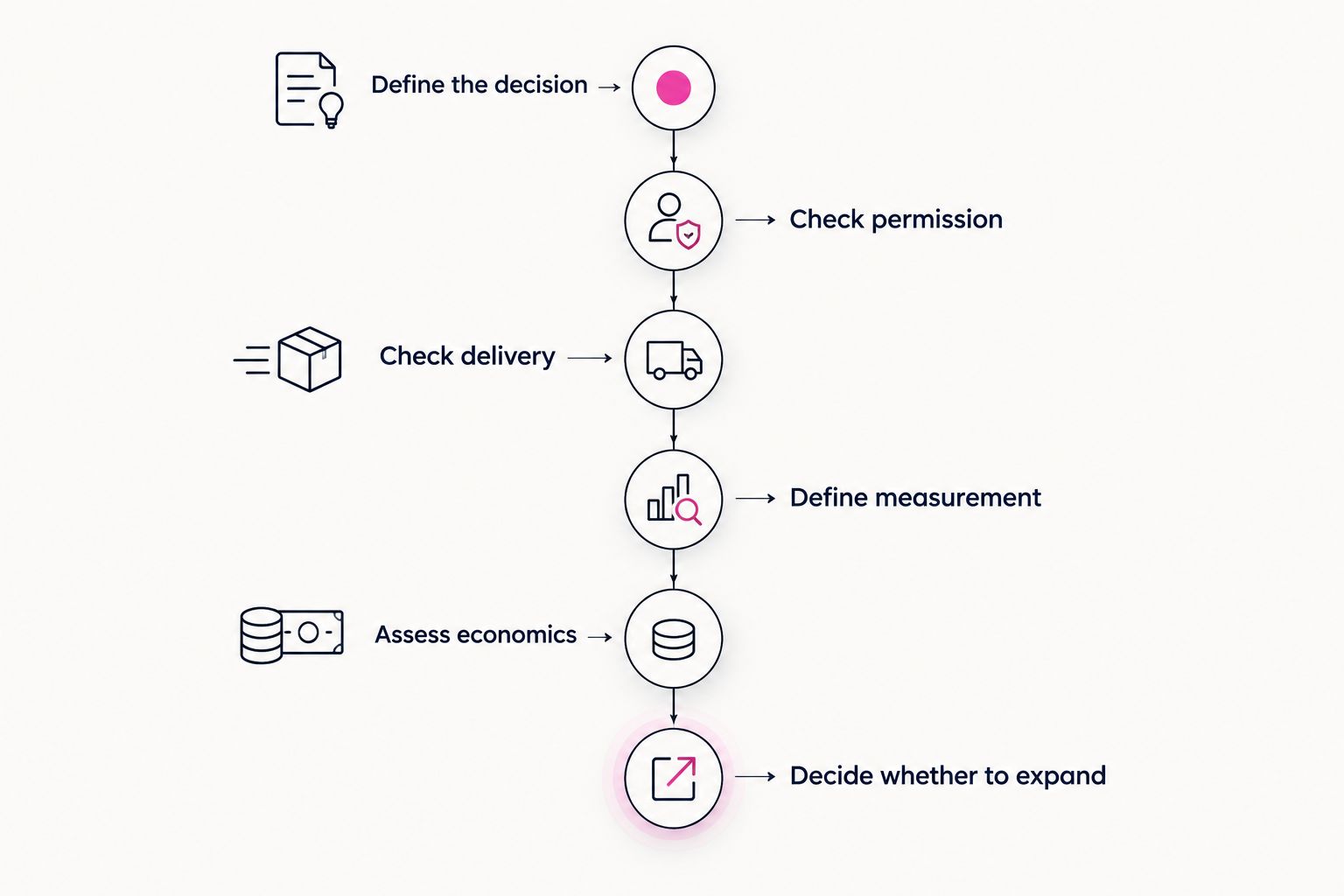
Define the outcome and evaluation rule before expanding the activation workflow.
An activation project crosses several functions. Media buying puts the audience decision into a campaign; creative determines the message; publisher supply provides the advertising environments; reporting supports evaluation. A data clean room provides a controlled environment for approved data collaboration when that is needed.
Cake.Shop is for independent agencies and brands building a modular programmatic advertising stack. Its offering includes media buying and reporting, rich media and digital out-of-home creative, data clean rooms and direct publisher supply. Swweetshop is the platform that powers in-housing.
For a 2026 evaluation, assess those functions together without assuming every customer-data use case applies to every channel. Digital out-of-home, or DOOH, means advertising on digital screens in physical locations; a customer-level activation plan does not automatically establish a suitable DOOH targeting method.
Cake.Shop's modular approach fits a discussion about which parts you need to operate yourself. The trade-off to assess is the responsibility your team takes on: campaign decisions, data permissions, creative approvals and result interpretation still need named owners.
Ask for confirmation of the specific source connections, destination support, reporting detail and contractual responsibilities your workflow requires. A full-stack description is not evidence that every proposed integration is supported.
Discuss your activation workflow
Bring your data source, media destination and measurement requirements to the discussion.
No—a data clean room is not a universal prerequisite for first-party data activation. Assess it when your use case requires controlled collaboration between parties rather than assuming every audience workflow needs one.
A clean room does not replace permission checks, establish an advertising connection by itself or prove incremental value. Ask what collaboration it enables that your approved existing process cannot support.
An independent agency should bring activation in-house when ownership serves its client model and the team can operate the workflow responsibly. Direct control is a reason to evaluate the approach, not proof that internal delivery will perform better.
Agree who controls client data, campaign accounts, reporting and offboarding. If those responsibilities remain unclear, resolve the operating model before selecting technology.
Yes—contextual targeting is a better starting point when your objective concerns relevant content environments and does not require customer-level matching. It avoids making customer identity the organising principle of that campaign.
It also has a clear limitation: it cannot substitute for an explicit customer suppression list. Choose the approach that serves the decision rather than treating either as a universal replacement.
Is first party data activation worth the investment for a small brand?
First-party data activation is worth evaluating when a small brand has permissioned customer data, a specific buying decision and a credible measurement plan. Database ownership alone does not establish a business case.
What's the first thing I should activate?
Start with the customer-data use case that changes a clearly defined campaign decision. Customer suppression is a practical candidate when acquisition campaigns should exclude existing customers, but matching limitations still need assessment.
Can I activate customer data without third-party cookies?
Yes, some activation workflows use identifiers or collaboration methods other than third-party cookies. Confirm the exact source, destination, permission requirements and measurement method rather than assuming cookieless means identity-free.
Does hashing customer emails make activation anonymous?
No, hashing customer emails does not automatically make activation anonymous. Assess whether the information remains linkable to people and what obligations apply to the proposed use.
What should I measure besides attributed conversions?
Measure whether activation creates additional business outcomes and whether their contribution exceeds the full operating cost. Attributed conversions show assigned credit, not necessarily the effect caused by advertising.
How much customer data do I need before starting?
There is no universal customer-record threshold for a useful activation project. Assess eligible records, destination matching, expected outcomes and whether your test can answer the business question.
Will a data clean room improve campaign performance?
A data clean room does not guarantee better campaign performance. Its role is controlled data collaboration; results still depend on the audience decision, media execution, creative and measurement design.
Removing an audience can be a more useful first test than adding one. Suppression asks a concrete question: should this campaign reach these customers at all? It still needs measurement, but it does not require a speculative new audience proposition.
Before approving a broader 2026 rollout, write the buying decision and the evidence required to expand it on the same page. If they do not connect, fix the brief before buying more infrastructure.
Can brands in-house their programmatic media buying? Yes. Compare operating models, ownership requirements and a practical plan for a controlled handover.
Read more →How long does it take to in-house programmatic advertising? Use readiness milestones, not a generic deadline, to plan ownership, testing and handover.
Read more →Is first party data activation worth the investment? Yes, with a measurable use case. Assess permissions, operating costs and incremental campaign value.
Read more →Book a 30-minute demo and see exactly how Cake.Shop works — no sales pitch, just the platform.