
OPEN DAILY
OPEN
HONEST
TRUST
LET'S CHAT



For the best first-party data activation platforms in 2026, shortlist Hightouch for warehouse-led activation, Twilio Segment for customer-data collection, and LiveRamp for identity-led onboarding. Consider Cake.Shop for a modular programmatic stack, or The Trade Desk and StackAdapt when the buying platform is your main decision.
TL;DR
First-party data activation means using information collected directly from your customers or visitors in an operational destination. That destination might be an advertising platform, a messaging system or another customer-facing application. Moving records is only part of the job.
A customer data platform, or CDP, helps collect and organise customer information. A demand-side platform, or DSP, buys advertising inventory. An identity service helps connect identifiers across systems. These products overlap, but they do not replace one another automatically.
Buying a DSP does not solve an upstream customer-data problem. Equally, organising profiles does not buy media or produce creative. For your 2026 shortlist, identify the missing layer before comparing vendors.
Use these criteria to judge fit before looking at the comparison table:
Keep those criteria separate. A strong collection system is not necessarily your preferred advertising platform. A broad buying platform is not necessarily the right place to maintain your customer records.
The order below follows operating needs, starting with the full-stack programmatic use case. This is a fit-based shortlist, not a measured performance league table.
Cake.Shop
Hightouch
Twilio Segment
LiveRamp
The Trade Desk
StackAdapt
Cake.Shop provides a modular programmatic advertising platform covering media buying and reporting, rich media and DOOH creative, data clean rooms, and publisher supply. DOOH means digital out-of-home: advertising on digital screens in physical locations.
Cake.Shop is a programmatic stack option for independent agencies and brands bringing media buying in-house. Its relevance here is the combination of advertising functions, rather than a claim that it replaces every customer-data system.
For example, an agency evaluating audience activation also needs to decide how creative reaches campaigns and how publisher supply fits the buying plan. A full-stack evaluation puts those dependencies in the same brief.
Cake.Shop pros:
Cake.Shop cons and checks:
Best for: Buyers who need to evaluate the advertising stack beyond audience uploads.
Verdict — Hold: Advance the platform after confirming your source data, audience requirements and module responsibilities.
Hightouch provides reverse ETL and customer-data activation capabilities. Reverse ETL means moving data from a warehouse into operational systems, rather than only importing operational data into the warehouse.
This approach fits a team whose customer definitions already live in warehouse tables. Instead of rebuilding audience rules separately in every destination, you can evaluate a workflow that starts with those existing definitions.
The important question is not whether data moves. It is whether the audience arriving at each destination reflects the intended membership, exclusions and update rules.
Hightouch pros:
Hightouch cons and checks:
Best for: Data teams with warehouse-held customer information and defined downstream use cases.
Verdict — Buy: Choose this category when warehouse-to-destination activation is the problem you need to solve, subject to connector validation.
Twilio Segment is a customer data platform used to collect customer events and connect customer data with downstream tools. Its role starts earlier in the workflow than campaign execution: deciding what information gets captured and how it is organised.
Consider this route when your website, application and business systems produce inconsistent customer events. An event is a recorded action, such as an account registration or purchase. Consistent definitions make those records easier to use across destinations.
Before evaluating advertising activation, agree on what each event means. Two systems using the same event name for different actions create an audience problem before any media platform receives data.
Twilio Segment pros:
Twilio Segment cons and checks:
Best for: Teams that need consistent collection and customer-data organisation before activation.
Verdict — Buy: Prioritise this category when inconsistent upstream data is blocking your activation plans.
LiveRamp provides identity and data onboarding services for advertising activation. Data onboarding connects customer information with identifiers usable in advertising environments.
This is a different job from collecting website events or operating campaigns. It matters when your central question is how customer records connect with the advertising destinations you intend to use.
Assess the path from source identifier to destination audience. Ask what happens to records that do not match, how exclusions travel through the workflow, and which party controls each stage. A successful transfer is not proof that the audience is usable everywhere.
LiveRamp pros:
LiveRamp cons and checks:
Best for: Advertisers whose activation problem centres on identity matching across advertising systems.
Verdict — Hold: Confirm the identifier, destination and governance requirements before selecting an onboarding route.
The Trade Desk is a demand-side platform for programmatic advertising. First-party audiences belong within a wider buying workflow that includes campaign setup, inventory selection and measurement.
The Trade Desk fits better than a collection-first platform when your immediate requirement is campaign execution. That does not make it a replacement for the systems responsible for customer records, event definitions or permissions.
For a 2026 evaluation, separate audience preparation from media operations. Your buying team needs a usable audience, while your data team needs clear acceptance rules and a way to investigate transfer problems.
The Trade Desk pros:
The Trade Desk cons and checks:
Best for: Brands and agencies whose primary requirement is a programmatic buying platform.
Verdict — Hold: Evaluate The Trade Desk when media execution leads the brief, then verify your exact audience onboarding route.
StackAdapt is a programmatic advertising platform with first-party audience activation. It belongs on a buying-platform shortlist, not as an automatic substitute for a warehouse activation tool or CDP.
StackAdapt fits better than a collection-focused product when you need to operate advertising campaigns using prepared customer audiences. Compare it with other DSPs against the same campaign requirements, not against unrelated data-management features.
Write down the intended audience use before the demonstration. Customer acquisition, customer suppression and re-engagement are different briefs, even when they start with the same customer dataset.
StackAdapt pros:
StackAdapt cons and checks:
Best for: Buyers comparing DSP approaches to activating prepared first-party audiences.
Verdict — Hold: Include StackAdapt when buying-platform fit is the decision, then validate the intended audience use.
The ranking uses functional fit: full-stack advertising, warehouse activation, customer-data collection, identity onboarding and DSP execution. It does not claim tested performance differences, financial returns or universal superiority.
Choose the category before the vendor. For your 2026 decision, give each provider the same source dataset description, intended destination and operating requirements. Otherwise, demonstrations answer different questions and the comparison becomes unreliable.
A platform demonstration should show your intended workflow, not an isolated feature. Start with 1 test audience, validate it in 2 destinations, and apply 3 acceptance checks: membership, exclusion and refresh. These are a proposed evaluation scope, not performance benchmarks.
Use the following responsibilities to expose gaps between systems:
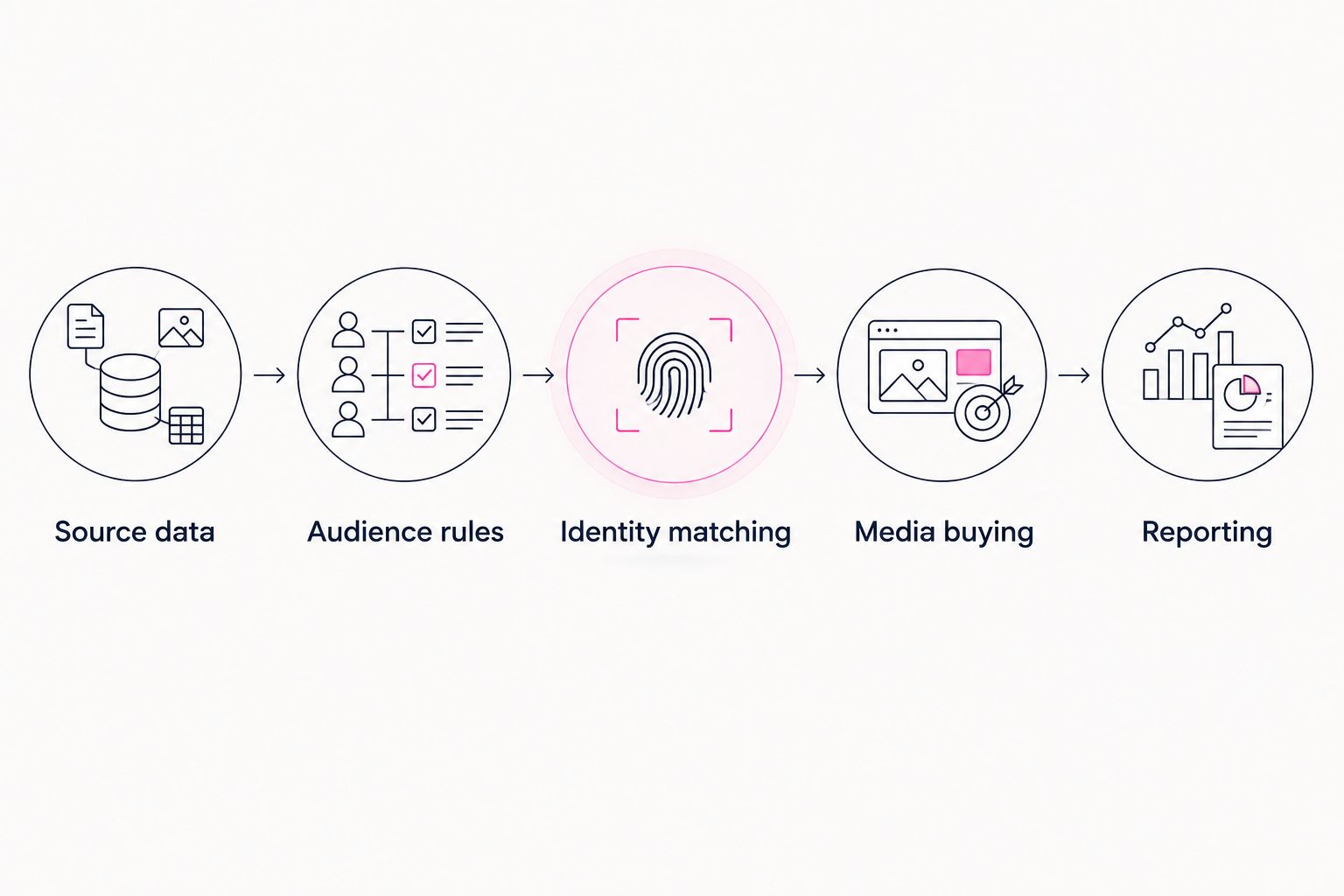
Each hand-off needs an owner; a destination connection alone does not complete activation.
For the membership check, compare the source audience definition with what the destination accepts. Investigate rejected or unmatched records rather than treating a completed transfer as success.
For the exclusion check, use a deliberately excluded test record. Confirm that the workflow prevents the intended advertising use. Do not use real customer information in a test without an authorised purpose.
For the refresh check, change a test record's audience membership and inspect the resulting destination state. Specify the acceptable update behaviour in your brief; do not assume every destination interprets additions and removals identically.
Choose the platform that fixes your missing layer. Start with Hightouch for warehouse activation, Twilio Segment for collection, or LiveRamp for identity-led onboarding. Start with The Trade Desk or StackAdapt when the primary decision is programmatic buying.
For an agency or in-house team evaluating buying, reporting, creative, clean rooms and publisher supply together, put the modular-stack requirement at the centre of the brief. Do not reduce that decision to whether a customer list can be uploaded.
Your 2026 selection should leave you with clear ownership, a demonstrated activation path and defined acceptance checks. A longer feature list is not a substitute.
What's the best first-party data activation platform in 2026?
The right platform depends on the missing layer in your stack. Shortlist Hightouch for warehouse activation, Twilio Segment for collection, LiveRamp for identity-led onboarding, and DSPs when media buying is the main requirement.
Is a CDP the same as a first-party data activation platform?
No. A CDP collects and organises customer data, while activation puts that data to use in operational destinations. Some products cover both jobs, but evaluate the required workflow separately.
When should an agency consider Cake.Shop for first-party data activation?
Consider Cake.Shop when the evaluation includes a modular programmatic stack: buying, reporting, creative, data clean rooms and publisher supply. Confirm the required source-data and audience workflow rather than assuming every integration is included.
Is Hightouch better than Twilio Segment?
Neither is universally better because they address different starting points. Hightouch suits warehouse-led activation, while Twilio Segment suits customer-data collection and routing; compare them against the specific gap in your stack.
Can The Trade Desk or StackAdapt replace a CDP?
A DSP is not a like-for-like replacement for a CDP. The Trade Desk and StackAdapt address advertising execution, while customer-data collection, organisation and governance remain separate requirements.
Do I need a data clean room to activate first-party data?
Not for every activation workflow. A data clean room supports controlled data collaboration and analysis, but it does not replace permissions, identity checks or a destination connection.
How should I test a first-party audience integration?
Test audience membership, exclusions and refresh behaviour against a written acceptance brief. Inspect what the destination accepts and how membership changes travel through the workflow, not just whether the transfer completes.
Test removal, not just addition. A demonstration that successfully adds a customer to an audience proves only part of the workflow. Ask the provider to remove that test customer, apply an exclusion and explain the resulting destination state.
That exercise makes the responsibilities concrete. You learn who changes the source record, who updates the audience and who confirms its use in campaigns. For your 2026 shortlist, those answers matter more than another slide of integration logos.
Compare the best header bidding platforms by auction control, server-side setup and publisher fit. Choose a stack that suits your team, not a sales pitch.
Read more →Compare the best first-party data activation platforms by fit: warehouse activation, CDPs, identity and media buying. Choose the layer your advertising stack needs.
Read more →Compare the best ad verification and brand safety tools by use case. Choose your 2026 shortlist for fraud, viewability, video suitability and supply checks.
Read more →Book a 30-minute demo and see exactly how Cake.Shop works — no sales pitch, just the platform.