
OPEN DAILY
OPEN
HONEST
TRUST
LET'S CHAT



In-housing programmatic advertising takes as long as your team needs to assume control of buying, creative, data, publisher access and reporting—not just open a platform account. Set the completion date against demonstrated operating readiness, rather than a generic deadline. Your first programmatic campaign launch is a milestone, not proof that the handover is complete.
TL;DR
Your in-housing timetable should end when your team can run, explain and govern the agreed scope without relying on undocumented external knowledge. Getting access to a demand-side platform, or DSP, only gives you the interface used to buy advertising inventory.
For a 2026 transition plan, work backwards from that operating standard. Use the following sequence to establish what must happen before you commit to a handover date.
Decide what you are bringing inside: campaign strategy, buying, creative production, audience activation, reporting or the full operating model. Write down what stays with external specialists as well.
Assign an accountable person to each responsibility. An independent agency also needs to distinguish its own responsibilities from the approvals, account access and data permissions retained by each client.
Completion test: everyone involved can explain who makes decisions, who executes them and who steps in when something fails.
Check platform accounts, user permissions, billing responsibility, creative assets, measurement configuration and reporting access. Establish who controls each account and what happens to that access when a supplier relationship ends.
Do not treat an emailed report as equivalent to operational access. Your team needs to inspect the settings and definitions behind the campaign results it will be responsible for explaining.
Completion test: the people responsible for operating and reviewing campaigns have the access their roles require.
Launch within a clearly defined scope and test the actual workflow. Check that approved creative reaches the intended placements, measurement behaves as expected and the team can identify configuration errors.
Use the pilot to test the handover, not simply the platform. A campaign that delivers does not establish that your team understands its targeting, exclusions, reporting definitions or escalation process.
Completion test: your team can explain what ran, why it ran and how it would correct an unexpected result.
Move responsibility only after the internal team has operated the agreed workflow and reviewed the results. Document recurring decisions, exceptions and escalation routes before external support steps back.
Make the final handover explicit. Otherwise, an internal team can appear responsible while an external trader still holds the practical knowledge needed to keep campaigns running.
Completion test: the internal owner accepts the operating scope, and any continuing external support has a defined role.
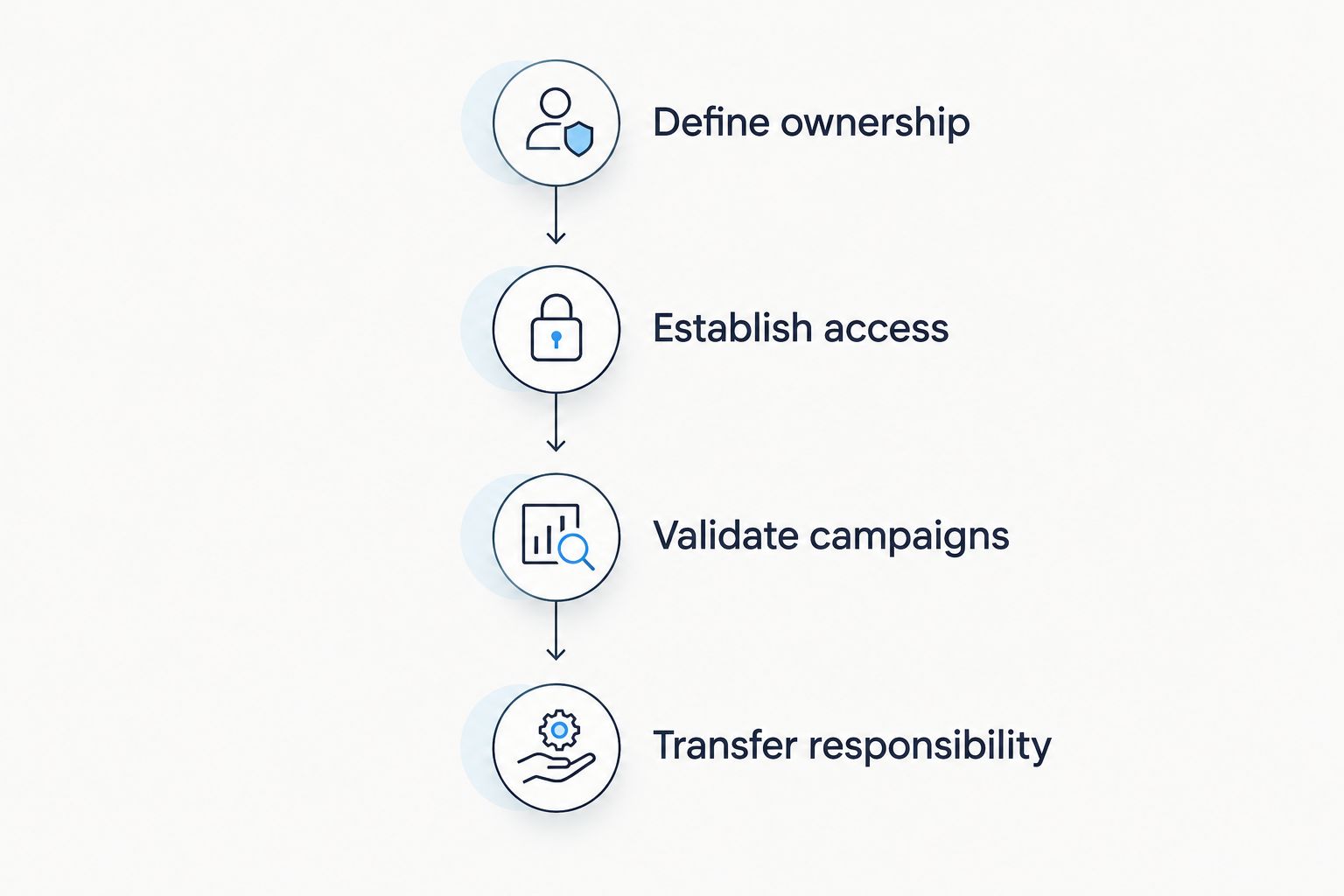
Complete the operating handover, not just the platform setup.
A launch date answers whether advertising can start. An in-housing completion date answers whether your team can sustain the operation, review its decisions and remain accountable for the results.
That distinction belongs in your 2026 project brief. If the brief only specifies account setup and campaign activation, it leaves training, reporting interpretation, creative handoffs and supplier responsibilities unresolved.
For brands, ownership means knowing which decisions employees control and which remain outsourced. For independent agencies, it also means being able to explain the operating model to clients without passing every technical question to another supplier.
Set separate acceptance criteria for activation and operational ownership. You can complete the former while still working towards the latter.
Choose the scope before estimating the schedule. A buying-only transition and a full-stack transition involve different responsibilities, even when both are described as bringing programmatic in-house.
The options below are operating models, not claims about provider performance. Match the model to the responsibilities your team is prepared to accept.
Staged in-housing
Hybrid operation
Full-stack ownership
Start with a function your team can own and describe precisely. For example, internal campaign management can sit alongside external creative production, provided approvals and asset handoffs are documented.
The benefit is a clear initial boundary. The limitation is that bringing one function inside does not remove dependencies elsewhere, so describe the result as a staged transition rather than a completed full-stack handover.
A hybrid model keeps selected responsibilities with external specialists while your team takes ownership of others. Define whether those specialists advise, execute or approve; those are different roles.
The advantage is retaining help where your team wants it. The trade-off is continued coordination, particularly when a problem crosses buying, data and creative responsibilities.
A full-stack transition includes the connections between buying, creative, audience data, publisher supply and reporting. Each function needs an owner, but the handoffs between functions need owners too.
The advantage is a broader internal operating scope. The trade-off is broader accountability: an issue cannot simply sit between the media, creative and data teams without a named person responsible for resolving it.
For your 2026 schedule, assess these factors before assigning dates. Treat them as dependencies to resolve, not reasons to accept an open-ended project.
Ask each workstream owner for a dependency, an acceptance condition and an accountable decision-maker. That creates a usable schedule without pretending every transition follows the same timetable.
A 2026 pilot should test whether your operating model works under live conditions. Define the evidence you need before launch so campaign delivery does not become the only measure of readiness.
Start with the intended campaign objective and the decisions the team must make. Then identify the reports, permissions and approval records needed to explain those decisions afterwards.
Use this acceptance checklist:
Do not approve the handover solely because the campaign delivered impressions. Approve it when your team can explain the workflow and demonstrate control over its assigned responsibilities. Record unresolved issues and keep the relevant support in place until they are addressed.
Cake.Shop provides a modular programmatic advertising platform spanning media buying and reporting, rich media and digital out-of-home creative, data clean rooms, and direct publisher supply. It introduces swweetshop as the platform that powers in-housing.
Cake.Shop fits brands and independent agencies building a modular programmatic advertising stack. The relevant decision is which parts of that stack your team needs to own now, and how those parts connect to the responsibilities retained elsewhere.
For example, your plan can assess how buying and reporting connect, how creative moves into activation, and where publisher supply enters the workflow. If data collaboration is part of the scope, define the clean-room requirements separately rather than treating data access as an automatic consequence of platform access.
The modular approach gives you a way to discuss scope by function. Its limit is equally important: a platform does not replace internal accountability, operating knowledge or data governance. Those responsibilities still need named owners.
When discussing Cake.Shop for an in-housing project, bring the actual handover requirements: buying ownership, creative responsibilities, reporting definitions, data dependencies and supply questions. Ask for the proposed workflow against those requirements rather than treating a product demonstration as an implementation plan.
Yes. You can define an initial scope around buying while retaining external creative production or postponing audience-data activation that is not required for the initial campaign objective.
The condition is clear responsibility at each boundary. Your buyer still needs approved assets, an agreed measurement approach and a documented route for resolving questions outside the buying function.
For your 2026 roadmap, separate essential launch dependencies from later additions. Do not make a future data project a condition of the initial handover unless the initial campaign genuinely depends on it.
Your existing partner should step back when the internal team has accepted the agreed responsibilities and demonstrated the corresponding workflow. Tie that decision to evidence from the pilot and operating review, not to account creation alone.
Keep any continuing support explicit. State who handles routine execution, who answers technical questions and who takes responsibility when an issue crosses organisational boundaries.
Give prospective platform providers and implementation partners the same operational brief. That makes discussions about support and handover more useful than asking each provider for an isolated launch estimate.
Include your intended ownership model, campaign objectives, required channels, creative workflow, measurement approach, data dependencies and reporting responsibilities. Distinguish requirements already in place from tasks that belong in the transition.
Finish the brief with acceptance conditions. Ask each provider to identify what your team must supply, what the provider will handle, and what evidence will establish that the handover is complete.
How long does it take to in-house programmatic advertising?
The timetable depends on when your team can own the agreed buying, creative, data, supply and reporting responsibilities. Set completion against demonstrated operating readiness rather than platform access alone.
Is launching a campaign the same as completing in-housing?
No. A campaign launch demonstrates activation, while a completed handover requires your team to operate, explain and govern the agreed workflow.
Can we bring programmatic in-house without replacing every supplier?
Yes. A staged or hybrid model can retain external creative, data or specialist execution responsibilities. Document who decides, who executes and who resolves problems at each boundary.
Do we need a data clean room before bringing buying in-house?
A data clean room is not an automatic prerequisite for taking ownership of media buying. Include it when your planned data collaboration requires that workflow, and assess its permissions and governance separately.
What should an independent agency check before taking buying in-house?
An independent agency should establish client approvals, account access, reporting responsibilities and escalation routes. It should also distinguish responsibilities held by the agency from those retained by each client.
How do we know our team is ready to take over?
Your team is ready for the agreed scope when it can operate the workflow, explain its decisions and handle exceptions through a documented process. Use the pilot to test those responsibilities before approving the handover.
Should we end managed support as soon as the platform is live?
No. End or reduce managed support when the internal team has demonstrated control of the responsibilities being transferred. Any remaining support should have a defined scope and accountable owner.
Ask your future internal operator to explain a campaign change without help from the outgoing partner. Then ask where the decision, approval and reporting impact are recorded.
If the explanation depends on someone outside the agreed operating model, that dependency still belongs in your handover plan. A working campaign is useful; a team that understands and controls its operation is the point of in-housing.
Can brands in-house their programmatic media buying? Yes. Compare operating models, ownership requirements and a practical plan for a controlled handover.
Read more →How long does it take to in-house programmatic advertising? Use readiness milestones, not a generic deadline, to plan ownership, testing and handover.
Read more →Is first party data activation worth the investment? Yes, with a measurable use case. Assess permissions, operating costs and incremental campaign value.
Read more →Book a 30-minute demo and see exactly how Cake.Shop works — no sales pitch, just the platform.