
OPEN DAILY
OPEN
HONEST
TRUST
LET'S CHAT


DOOH advertising is worth testing for small retail brands when the screens reach a relevant local audience, the creative gives people a clear reason to visit, and the campaign has a measurable business objective. It is not a substitute for capturing existing purchase intent or fixing weak store economics. For a 2026 decision, assess the whole campaign—including creative, buying and measurement—not just the screen placement.
TL;DR
A digital screen near your shop is not automatically a good advertising placement. You need to know who passes it, whether they can reasonably reach your store, and what the message asks them to do.
The commercial question is whether DOOH deserves budget alongside your existing channels. The broader programmatic advertising guide for retail brands addresses that channel context. Here, the decision starts with geography, creative and evidence—not the appeal of seeing your brand on a large screen.
Yes, as a defined local test—not as an automatic addition to your media plan. Digital out-of-home advertising uses digital screens in public or commercial spaces. Its relevance to a retailer depends on the relationship between the screen audience and the store, rather than the screen's size alone.
Compare DOOH with the job your other channels already perform:
DOOH
Paid search
Paid social
These channels are not interchangeable. A retailer seeking immediate enquiries from people already searching has a different brief from a retailer introducing a new shop to its neighbourhood.
Keep DOOH only if its role is distinct and its results justify that role. Do not ask a visibility campaign to pass a last-click test, then describe the absence of clicks as failure.
Treat your 2026 campaign as a business experiment with a written decision rule. Agree on what you will measure before anyone selects screens.
Choose 1 primary outcome: for example, store transactions, qualified enquiries or measured store visits. Supporting measures can explain the result, but they should not replace the business objective after the campaign finishes.
If you choose sales, distinguish revenue from contribution after variable costs. More transactions do not automatically mean a commercially worthwhile campaign.
A catchment is the area from which your store realistically draws customers. Use your own customer and transaction information where you have permission to do so, alongside practical access considerations.
Assess walking routes, transport connections and the direction people travel. A nearby screen facing people moving away from your store deserves a different assessment from one along an established shopping route.
Where practical, use 2 comparison groups: locations receiving advertising and comparable locations without it. Check whether their trading patterns were similar before the campaign.
A before-and-after comparison is weaker when seasonality, promotions or changed opening hours also affect sales. Record those changes rather than attributing every movement to DOOH.
Set 3 decision rules: continue, revise or stop. Base each rule on your business objective and the evidence you can actually collect.
Continue when the evidence supports the commercial case. Revise when delivery or execution failed the brief. Stop when the campaign met the brief but did not justify further investment.
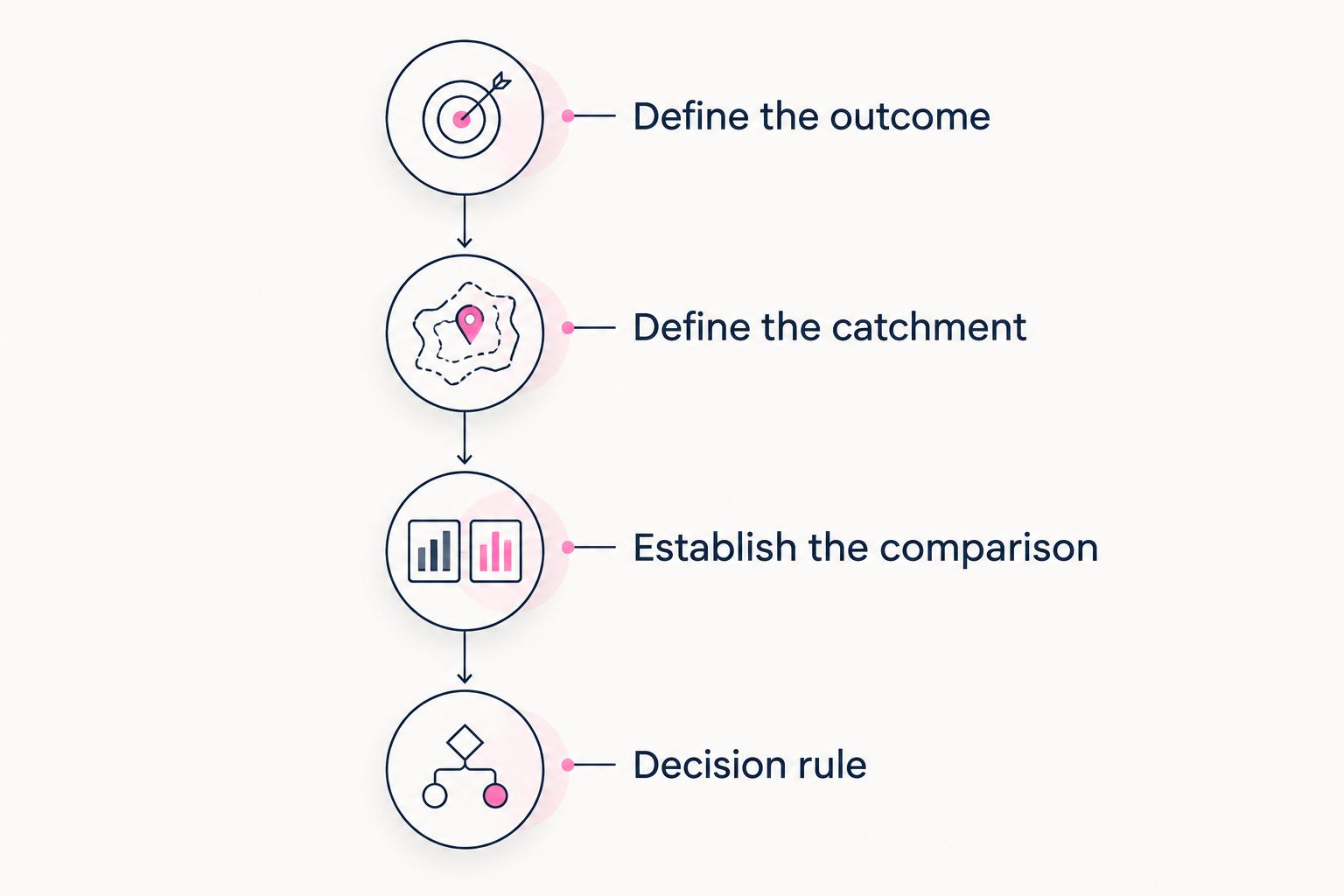
Set the business test before selecting screens.
A comparison does not become a controlled experiment just because it appears in a dashboard. Document how the groups were chosen and what else changed during the campaign.
The same screen can serve different retailers very differently. Assess these factors before approving a placement:
For your 2026 plan, turn each factor into a buying question. Request location details, format specifications, reporting definitions and the proposed evaluation method.
Reject vague answers. A large impression estimate does not resolve a poor geographic fit, and a polished creative concept does not resolve an unclear objective.
Best for: retailers with a clear store catchment and a concrete message. A shop opening, an in-store event or a locally relevant product message gives the campaign a defined purpose.
The benefit is focus: you can connect the placement, message and destination. The trade-off is that a narrow campaign still needs enough evidence to support a decision. Specify that evidence before launch.
Best for: retailers deciding whether to fix an established customer journey first. If people already search for your business but cannot find accurate opening hours or a clear route to purchase, address those problems before adding another channel.
Waiting protects attention and budget for an identifiable issue. The trade-off is postponing a test of local visibility; make that a deliberate sequencing decision, not an indefinite delay.
Best for: retailers assessing a tempting but poorly matched screen proposal. Skip a placement when its location, viewing conditions or reporting cannot answer the campaign's requirements.
That decision rejects the placement, not necessarily the entire channel. Reconsider DOOH when the proposal changes enough to support a credible business test.
Give the viewer a recognisable brand, a reason to care and an understandable next step. Do not compress an entire website into a screen advertisement.
A pedestrian placement and a roadside placement have different viewing conditions. Build for the actual environment rather than treating the same file as universally suitable. Check text size, contrast, motion requirements and the destination message against the publisher's specifications.
Use 1 primary message per creative execution. This is a planning recommendation, not a performance benchmark. It forces you to decide what someone should remember instead of filling the layout with competing claims.
Production belongs in the business case. The question of video production costs for small businesses matters because concept development, format adaptation and revisions require a defined scope alongside the media plan. Agree on deliverables before approving the campaign.
Do not assume every DOOH placement requires video. Confirm the accepted formats and choose the execution that communicates the message clearly within those requirements.
For a 2026 brief, require approval of the actual placement-ready files—not merely a presentation mock-up. A concept that reads well on a laptop still needs checking against its intended viewing context.
A retailer bringing programmatic in-house needs more than a buying interface. Someone must own the creative brief, supply decisions, reporting definitions and commercial assessment.
Cake.Shop provides a modular programmatic advertising platform covering media buying and reporting, rich media and DOOH creative, data clean rooms, and direct publisher supply. Its swweetshop platform powers in-housing. That scope is relevant when a brand or independent agency wants to consider the advertising stack together rather than purchase an isolated buying tool.
Cake.Shop serves brands and independent agencies building modular programmatic advertising stacks. For a DOOH enquiry, the practical discussion should start with the proposed locations, creative requirements and evidence needed to judge the campaign.
The trade-off of in-housing is responsibility. Your team still needs clear ownership of campaign decisions and supplier oversight. A broader platform scope does not remove the need to verify which inventory, reporting and workflows meet your particular brief.
A data clean room—a controlled environment for analysing permitted datasets—also does not make measurement automatic. Establish the data permissions, matching method and limits before treating any analysis as evidence of advertising impact.
Yes. A small retailer can assess DOOH using aggregate business outcomes and a planned comparison without claiming to identify every viewer. The strength of the conclusion depends on the comparison design and the quality of the underlying records.
Separate delivery evidence from outcome evidence. Playback records describe campaign delivery; sales records describe trading. Connecting the two requires an evaluation method, not just putting both charts on the same page.
For your 2026 assessment, label estimated exposure, observed transactions and modelled results separately. They answer different questions and should not share an unexplained headline number.
Neither buying route is inherently better. Programmatic buying uses software to transact advertising inventory; a direct arrangement is negotiated with the media owner or its representative.
Assess both routes against the same requirements: suitable screens, campaign controls, creative acceptance, reporting and commercial terms. Do not treat the buying mechanism itself as proof of better retail results.
The practical recommendation is simple: choose the route that satisfies your brief with terms you understand. Ask who is responsible when delivery differs from the plan.
Use these questions in the buying conversation:
Do not approve a campaign that cannot explain what it will deliver and how you will judge it. Clear answers are more useful than an impressive-looking forecast with undefined terms.
Is DOOH advertising worth it for a small shop?
DOOH is worth testing when the screen audience matches the shop's catchment and the campaign has a measurable business objective. It is not automatically worthwhile because a screen is nearby.
What's the best DOOH location for a local retailer?
The best candidate is a location that matches the retailer's customer catchment, travel patterns and campaign message. Screen size alone does not establish relevance.
Do I need a video advert for DOOH?
You do not need to assume video is required for DOOH. Confirm the placement's accepted formats and choose creative that communicates clearly in its viewing environment.
Can DOOH prove that someone bought from my store?
A screen play alone cannot prove that someone bought from your store. Assess any sales-attribution claim against its data sources, permissions, comparison method and stated limitations.
Should I replace paid search with DOOH?
Do not replace paid search with DOOH simply to try a different channel. Search captures expressed queries, while DOOH places messages in physical environments; assign each a distinct business role.
Can Cake.Shop support a broader stack than DOOH creative?
Cake.Shop provides modular media buying and reporting, rich media and DOOH creative, data clean rooms, and direct publisher supply. Its swweetshop platform powers in-housing for brands and independent agencies.
What should I measure first in a retail DOOH campaign?
Choose 1 primary outcome before launch, such as store transactions, qualified enquiries or measured visits. Define the comparison and decision rule before reviewing campaign results.
Ask what would make you stop the campaign before asking what would make you expand it. That question exposes an unclear brief quickly.
If no result could persuade you to stop, you are not running a business test. Write the decision rule first, then buy the media that can answer it.
Is DOOH advertising worth it for small retail brands? Test local fit, creative and measurable retail outcomes before committing to a campaign in 2026.
Read more →Can ad verification stop invalid traffic? Not completely. Learn how pre-bid filters, delivery checks and supply controls reduce risk in your media buying.
Read more →Can a data clean room measure incrementality safely? Yes—with a valid experiment and privacy controls. Check holdouts, matching, exports and study bias.
Read more →Book a 30-minute demo and see exactly how Cake.Shop works — no sales pitch, just the platform.