
OPEN DAILY
OPEN
HONEST
TRUST
LET'S CHAT



Best shortlist for broad campaign verification: DoubleVerify and Integral Ad Science. Best for specialist fraud evaluation: HUMAN Security. Best for app and connected TV supply investigation: Pixalate. Best for video-context suitability: Zefr. This 2026 guide ranks options by the problem you need to solve, not an unsupported claim that one vendor is best overall.
TL;DR
Ad verification checks whether advertising meets defined delivery and quality conditions. Brand safety addresses unacceptable content; brand suitability adds the distinctions specific to your brand. Neither replaces campaign measurement, and neither proves that an impression caused a sale.
For independent agencies and brands bringing programmatic in-house, the practical question is where these controls sit. Cake.Shop provides a modular programmatic platform spanning media buying and reporting, rich media and DOOH creative, data clean rooms, and publisher supply. Verification needs to fit that wider stack, rather than become another report nobody acts on.
Choose the control you can apply and audit, not just the dashboard you can demonstrate. A fraud alert, a suitability exclusion and a viewability result answer different questions. Your buying team needs an agreed response to each.
Use these criteria for your 2026 shortlist. Ask each vendor to demonstrate the same campaign scenario, with the same channels and policy settings.
A useful viewability reference comes from the Media Rating Council: standard display measurement uses at least 50% of pixels in view for 1 continuous second; video uses at least 50% for 2 continuous seconds. These are measurement thresholds, not proof of attention, and they do not describe every format or environment.
Ask vendors to explain the applicable standard rather than treating all reported impressions as equivalent. In particular, distinguish an impression that fails a test from an impression the system cannot measure.
The order below moves from broad campaign verification to narrower specialist requirements. It is a decision sequence, not a performance league table. The evaluation method is functional fit: verification scope, intervention point, context depth and operational usefulness.
DoubleVerify
Integral Ad Science
HUMAN Security
Pixalate
Zefr
DoubleVerify provides media-quality measurement covering areas including invalid traffic, viewability and brand suitability. Start here when your brief requires several verification disciplines rather than a single specialist check.
For example, an agency buying display and video needs to separate fraud findings from viewability failures and unsuitable placements. Request a demonstration showing those categories separately, then trace an issue from the report to the action available in your buying environment.
DoubleVerify pros:
DoubleVerify cons:
Best for: Agencies or in-house teams evaluating a broad campaign-verification layer in 2026.
Verdict: Hold until DoubleVerify demonstrates coverage and actionable reporting for your actual media plan.
Integral Ad Science, commonly called IAS, provides media-quality measurement and contextual brand-suitability capabilities. Evaluate IAS when interpreting the surrounding content is central to your verification brief, while fraud and viewability remain part of the requirement.
A brand advertising alongside news needs a policy more precise than excluding every mention of a difficult subject. Ask IAS to demonstrate how your chosen categories distinguish acceptable reporting from content your brand prohibits. Review examples, not just category names.
Integral Ad Science pros:
Integral Ad Science cons:
Best for: Advertisers whose verification decision depends heavily on contextual policy design.
Verdict: Hold until Integral Ad Science demonstrates your policy against representative placements, including acceptable edge cases.
HUMAN Security focuses on protecting digital systems and advertising from automated and fraudulent activity. Include HUMAN Security when the central problem is invalid traffic, rather than treating it as an interchangeable substitute for every brand-safety product.
An agency investigating suspicious delivery needs to understand the fraud classification, where intervention occurs and what evidence reaches its team. Build the evaluation around that investigation workflow. A detection claim alone does not tell you how to resolve a disputed campaign result.
HUMAN Security pros:
Offers a specialist focus on automated and fraudulent activity.
Makes fraud detection a distinct evaluation workstream.
Fits briefs where invalid traffic is the primary operational concern.
HUMAN Security cons:
Best for: Teams evaluating a dedicated fraud-control layer within a wider advertising stack.
Verdict: Hold until HUMAN Security shows how detection, intervention and investigation work in your environment.
Pixalate provides ad-fraud intelligence and analytics spanning digital advertising environments, including mobile apps and connected TV. Consider it when you need to investigate the quality of inventory and supply, rather than only review a campaign-level summary.
An app or CTV evaluation should establish what identifiers appear in reports and how your team traces questionable inventory. Ask for a worked investigation that starts with a delivery concern and ends with a documented buying decision. Keep the evidence available to the people managing supply exclusions.
Pixalate pros:
Pixalate cons:
Best for: Agencies and brands investigating app or CTV inventory quality.
Verdict: Hold until Pixalate demonstrates the supply evidence your team needs to make an exclusion or escalation decision.
Zefr focuses on contextual brand suitability for video advertising. Evaluate it when the decision turns on what a video contains and whether that context matches your brand's policy.
For a video campaign, broad topic labels are only a starting point. Bring examples your brand accepts and rejects, then ask how those distinctions translate into supported controls and reporting. Confirm each platform and placement separately; do not assume that video coverage means every video environment.
Zefr pros:
Zefr cons:
Best for: Brands whose main verification challenge is video-context suitability.
Verdict: Hold until Zefr demonstrates your accepted and rejected content examples on the placements you intend to buy.
Cake.Shop's ad verification and brand safety context is a wider modular advertising stack, not a claim to replace the specialist tools above. Buying and reporting, rich media and DOOH creative, data clean rooms, and publisher supply each have a role. Keep those roles distinct when you define verification requirements.
Use these workstreams to connect the decision:
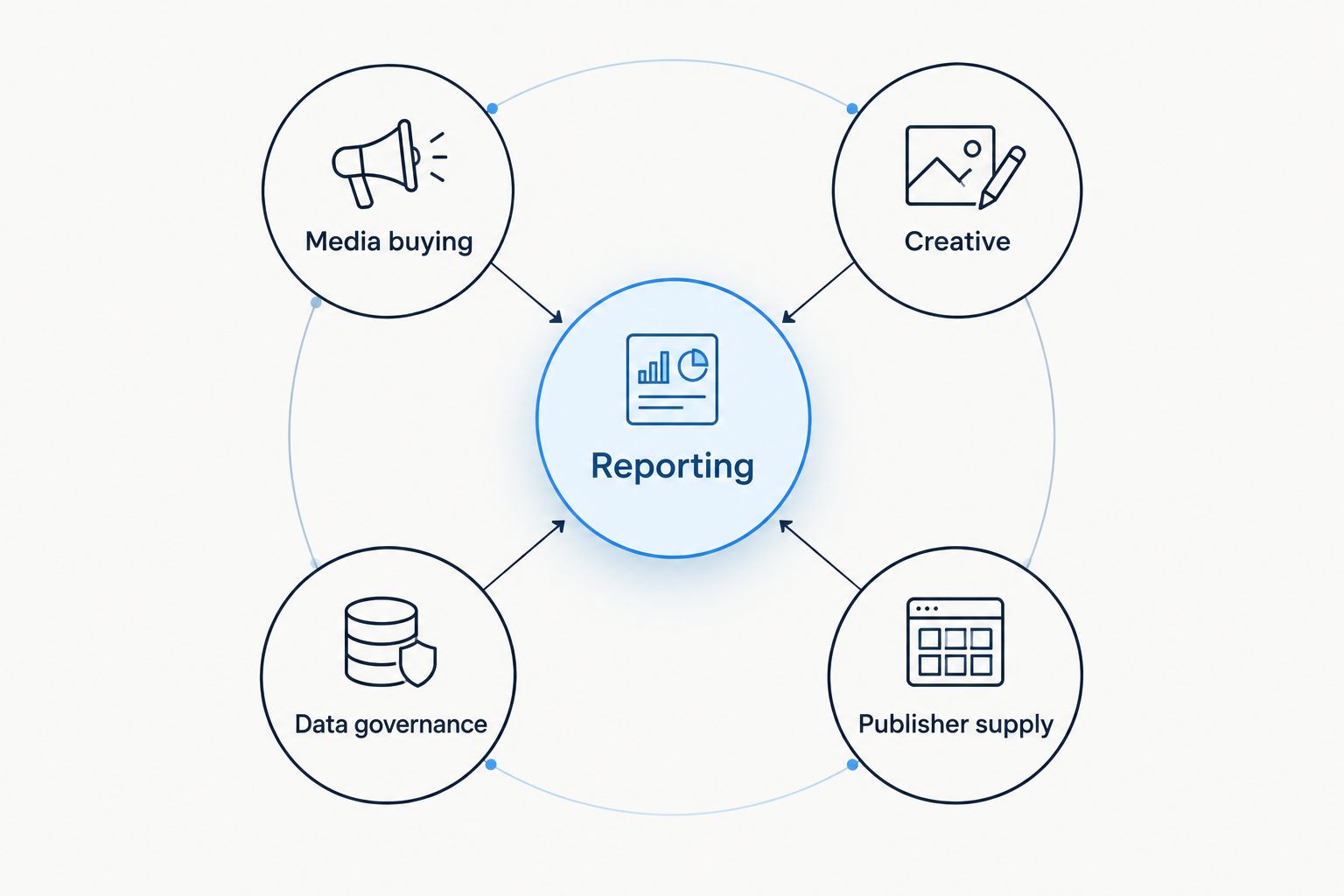
Verification requirements need an owner across buying, creative, data and supply.
Cake.Shop serves agencies and in-house brands building modular programmatic stacks. For a 2026 platform enquiry, bring your channel plan, existing verification arrangements and reporting requirements. Ask how those requirements fit the proposed stack without assuming a named integration exists.
Review your programmatic stack
Discuss buying, creative, data and publisher supply alongside your verification requirements.
Use a written brief and the same evidence requests for every vendor. This guide ranks by use-case fit; it does not claim independent performance testing or a measured winner.
Separate prohibited content, brand-specific sensitivity and allowed content. Give examples of each. For an agency, assign policy ownership to the client rather than letting different account teams invent different rules.
Pre-bid filtering acts before a purchase decision. Post-delivery measurement reports what happened after delivery. Ask which mechanism applies to each placement and what remains outside measurement; the distinction determines what your team can actually change.
Request representative reporting with definitions for failed, passed and unmeasurable impressions. Ask how duplicate classifications and discrepancies are explained. Do not combine unlike metrics into a single quality score without understanding the denominator.
Write down who investigates a finding, who approves exclusions and who communicates with the publisher or client. Review legitimate placements caught by restrictive policies as well as harmful placements that passed. A verification policy needs an exception process, not just a blocklist.
For a broad 2026 verification brief, begin with DoubleVerify and Integral Ad Science and compare the same placement requirements. Choose the specialist branch when your problem is narrower: HUMAN Security for fraud evaluation, Pixalate for app and CTV supply investigation, or Zefr for video-context suitability.
The default recommendation is a documented evaluation, not an automatic purchase. Select the tool that demonstrates the required coverage, produces usable evidence and gives your team a clear intervention path. Reject a proposal that leaves those questions unanswered.
What are the best ad verification and brand safety tools in 2026?
The shortlist depends on the task: DoubleVerify and Integral Ad Science for broad verification, HUMAN Security for specialist fraud evaluation, Pixalate for app and CTV supply investigation, and Zefr for video-context suitability. Confirm placement coverage and intervention methods before selecting a vendor.
Is DoubleVerify better than Integral Ad Science?
There is no supported universal winner in this comparison. Evaluate DoubleVerify and Integral Ad Science against the same channels, policy examples, reporting fields and operational requirements.
What's the difference between brand safety and brand suitability?
Brand safety addresses content a brand considers unacceptable; brand suitability defines the additional contextual distinctions specific to that brand. A suitable policy identifies acceptable sensitive content as well as content to exclude.
Does ad verification prove that people saw my advertising?
No: a viewability result measures whether an impression met defined visibility conditions, not whether a person paid attention. Standard MRC thresholds include 50% of pixels for 1 continuous second for display and 2 continuous seconds for video, with format-specific exceptions.
Do I need fraud detection and contextual suitability?
You need both requirements when your campaign must address invalid traffic and surrounding content. They solve different problems, even when a vendor supplies both capabilities.
Can one verification tool cover all my advertising channels?
Do not assume complete coverage from a vendor's channel list. Confirm measurement, controls and reporting for every placement and format in your media plan.
Where does Cake.Shop fit in an ad verification stack?
Cake.Shop provides modular programmatic technology across buying and reporting, rich media and DOOH creative, data clean rooms, and publisher supply. Define specialist verification requirements alongside that stack rather than assuming those platform functions replace verification.
Ask each vendor to show a legitimate placement your proposed policy would exclude. That example exposes whether your rules distinguish harmful content from acceptable coverage of a sensitive topic. Review what you would lose, not just what you would block.
Compare the best header bidding platforms by auction control, server-side setup and publisher fit. Choose a stack that suits your team, not a sales pitch.
Read more →Compare the best first-party data activation platforms by fit: warehouse activation, CDPs, identity and media buying. Choose the layer your advertising stack needs.
Read more →Compare the best ad verification and brand safety tools by use case. Choose your 2026 shortlist for fraud, viewability, video suitability and supply checks.
Read more →Book a 30-minute demo and see exactly how Cake.Shop works — no sales pitch, just the platform.