
OPEN DAILY
OPEN
HONEST
TRUST
LET'S CHAT



Celtra offers creative automation for teams producing and managing digital advertising at scale. That creative focus does not, by itself, resolve a wider requirement to bring media buying, reporting and publisher supply in-house. For your 2026 shortlist of Celtra alternatives, consider Cake.Shop for a modular programmatic stack and Airtory for a rich media creative brief; neither is a universal replacement.
TL;DR
Replacing a creative platform and rebuilding an advertising stack are different decisions. Define which problem you need to solve before comparing demonstrations: production capacity, campaign handovers, reporting ownership or access to publisher inventory.
This 2026 shortlist separates creative production from broader programmatic operations. It is a scope comparison, not a scored performance ranking.
Celtra
Airtory
Choose the scope first, then test the platform. A broader platform is not automatically a better creative tool, and a strong creative tool is not automatically a complete advertising stack.
Cake.Shop provides a modular programmatic advertising platform for brands and independent agencies. Its scope includes media buying and reporting, rich media and digital out-of-home creative, data clean rooms and direct publisher supply. swweetshop is the platform that powers in-housing.
That makes the relevant comparison bigger than an ad builder. If your agency wants ownership across creative production, campaign activation and reporting, evaluate how those responsibilities fit together rather than treating each as an isolated purchase.
These are reasons to include the platform in your evaluation, not evidence that every existing workflow transfers unchanged. Ask for the exact production, activation and reporting path your team intends to use.
The principal trade-off is scope. If you only need to replace a rich media authoring workflow, evaluating buying, data and supply introduces decisions that your creative team does not need to make.
A full-stack brief also requires operational ownership. Someone must define campaign permissions, reporting responsibilities, data access and publisher requirements; buying software does not remove that work.
Evaluation scope
Creative brief
Wider operating brief
Best for: independent agencies assembling their own advertising stack and brands bringing programmatic operations in-house.
Verdict: Hold until a live workflow demonstrates the modules, handovers and reporting your team requires.
Airtory is a rich media ad-building platform. Include Airtory when your main question is how to create the required advertising experiences, rather than how to reorganise the entire media operation.
Keep the comparison specific. Give Airtory and Celtra the same creative brief, source assets and placement requirements, then examine the output and the work needed to produce it.
A creative-focused evaluation leaves your wider operating questions unresolved. You still need to establish how the resulting ads enter your buying workflow, how publishers accept them and how reporting reaches the people making decisions.
Do not assume feature parity from the phrase rich media. Require demonstrations of your specific interactions, revision process and destination requirements before treating Airtory as a Celtra replacement.
Shortlist rationale
Practical test
Decision boundary
Best for: teams whose immediate requirement is a rich media creative platform rather than a broader in-housing programme.
Verdict: Hold until the required formats and revision workflow pass your acceptance test.
A defensible reason to switch starts with a requirement your current setup does not satisfy. It does not start with an unsupported claim about Celtra's service, commercial terms or performance.
For a 2026 evaluation, separate these decision triggers:
Treat each trigger as something to prove inside your organisation. Record the failed requirement, the person affected and the acceptance condition for a replacement; otherwise, the shortlist becomes a collection of attractive demonstrations.
The relationship between media buying software and agency overhead belongs in this assessment when operational workload, rather than ad design alone, drives the enquiry. Count the actual handovers before asking a vendor to remove them.
Use 1 campaign brief, 3 placement formats and 2 revision rounds as a proposed evaluation exercise. These are test instructions, not platform limits or performance benchmarks; change them to match your real campaign.
Keep the source assets, approval rules and delivery requirements identical across candidates. Your 2026 decision needs evidence from your workflow, not a vendor's easiest example.
Ask the operator to create the required ads from your supplied assets. Record which steps need a designer, developer, media buyer or external party, and distinguish initial setup from work that repeats on every campaign.
Introduce a genuine revision: changed copy, a replacement image or an amended destination. Check who can request, approve and publish the change, and establish how the team distinguishes the approved version from an earlier draft.
Take the approved output into the intended buying and publisher workflow. For DOOH, use the actual screen requirements; for interactive placements, test the intended interaction in the relevant environment rather than relying on a preview alone.
Follow the campaign identifiers and creative versions into reporting. Establish which events are recorded, what those events mean and which team owns reconciliation when creative and media records disagree.
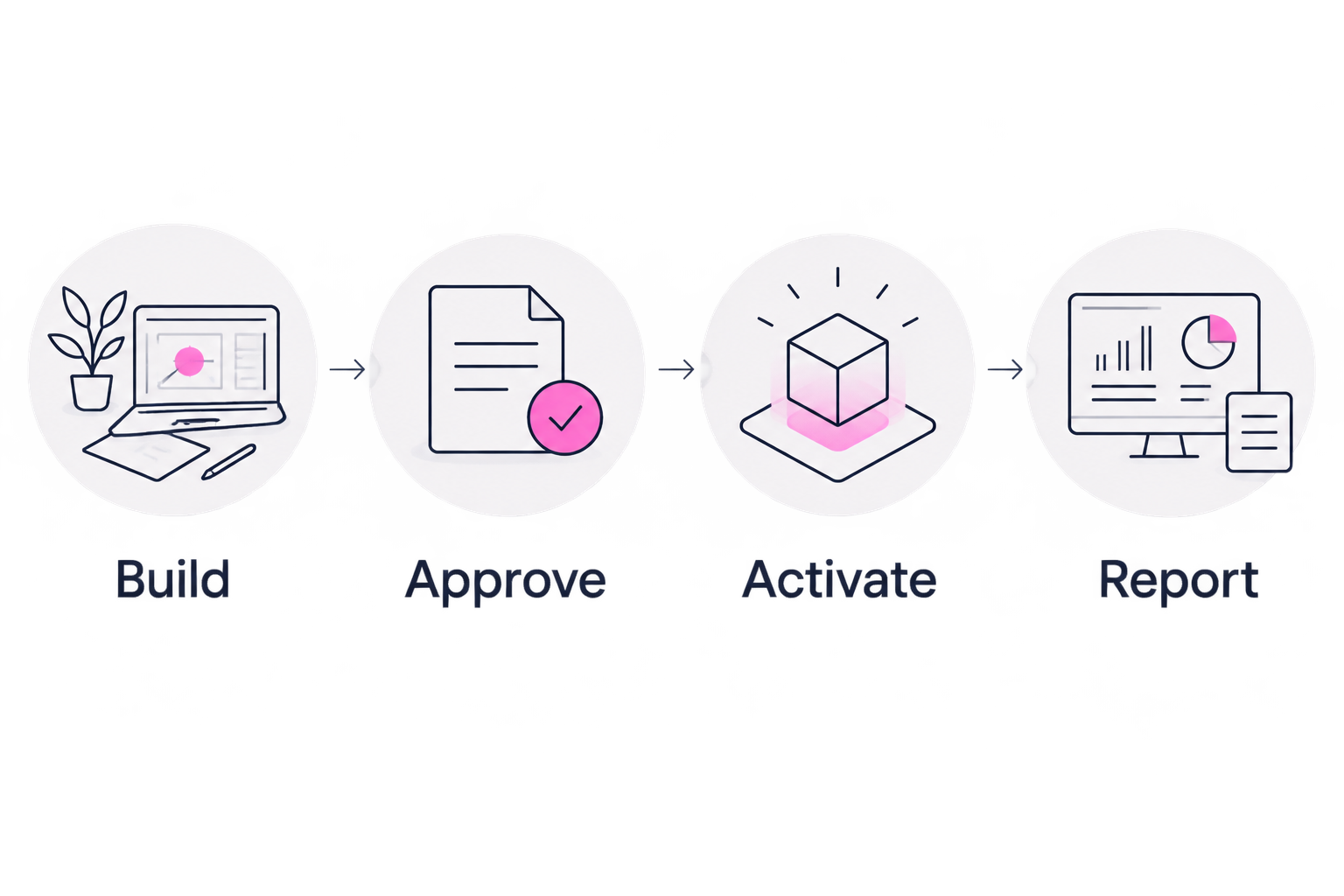
Test the complete workflow rather than stopping at the creative preview.
Score the exercise against written acceptance conditions, not a general impression. A successful test shows who did the work, what moved between systems and whether the final reporting answers the campaign question.
Creating an image or video is not the same as producing an ad that meets a placement's requirements. An asset can look finished while still needing adaptation, tracking decisions, approval and delivery checks.
This distinction matters when comparing AI video ad generators with rich media platforms: generating source video does not establish that an interactive ad works in its intended advertising environment. Treat asset creation and ad delivery as separate acceptance gates.
Ask your creative lead to identify the source files your team needs to retain. Then ask the campaign operator to show what happens after an asset changes: which versions need rebuilding, which approvals reopen and which placement checks must run again.
Neither a visually impressive asset nor a working preview proves a complete production workflow. Your test should end with accepted output and intelligible reporting, not a download button.
Transparency, ownership and control need operational definitions. For your 2026 shortlist, turn each word into a question that has a demonstrable answer.
Ownership
Access
Reporting
Portability
Supply
Do not accept a promise of control where you need an export, permission setting or contractual right. Likewise, do not assume that modular means every connection already exists; name the systems and require the relevant workflow to be shown.
For an independent agency, include whoever owns client reporting and campaign operations. For an in-house brand, include procurement and the people accountable for data use before the shortlist becomes a preferred supplier.
Keep Celtra if its creative automation meets your requirements and the surrounding stack already works. A broader platform brief is not a reason to discard a functioning creative workflow without testing the consequences.
Celtra's creative focus is a reason to consider staying when production and automation are the actual job. The corresponding limitation is that choosing a creative platform does not, on its own, decide your media buying, publisher supply or data architecture.
Document what staying preserves and what it leaves unresolved. Then compare that with the migration work: rebuilding assets, transferring knowledge, changing approvals and validating reporting. Treat each as an item to investigate, not an assumed switching penalty.
The right 2026 decision is the one that satisfies the written brief with acceptable operational work. A change of vendor name is not an outcome.
What's the right Celtra alternative for an independent agency?
Cake.Shop belongs on the shortlist when an independent agency needs modular programmatic operations spanning creative, buying, reporting and publisher supply. Airtory belongs on a creative-focused shortlist. Choose through a common workflow test rather than an unsupported overall ranking.
Is Airtory a replacement for Celtra?
Airtory is a candidate for a rich media creative replacement, not an automatic like-for-like substitute. Test your required formats, revisions and delivery workflow against the same brief you use for Celtra.
What is swweetshop?
swweetshop is the platform that powers in-housing. Assess it against the responsibilities your brand or agency intends to bring under internal control.
Should we replace our creative platform when we bring buying in-house?
No, bringing buying in-house does not automatically require replacing your creative platform. First establish whether the existing creative workflow meets your new activation, approval and reporting requirements.
How should we compare rich media platforms in 2026?
Compare rich media platforms using the same campaign brief, source assets and placement requirements. Follow the work through creation, revision, activation and reporting, and record who performs each step.
Can a video creation tool replace a rich media platform?
A video creation tool does not by itself replace the requirements of a rich media platform. Separate source-asset production from interaction design, placement acceptance, tracking and campaign delivery.
When should we stay with Celtra?
Stay with Celtra when its creative automation meets your requirements and changing platforms does not solve a documented problem. Evaluate any wider buying or supply requirements separately before deciding that a full replacement is necessary.
Ask every shortlisted provider to demonstrate a correction after approval, not just a clean first build. A changed destination or replacement asset exposes the permissions, version handling and handovers that a polished demonstration can leave out.
Make your enquiry a workflow brief: name the required creative, buying, reporting and supply responsibilities, then state what must remain under your control. That gives a platform provider something concrete to answer.
Compare Celtra alternatives for rich media and in-house programmatic. Shortlist by workflow, test delivery and reporting, and know when to stay put.
Read more →Compare Amazon DSP alternatives for 2026: modular in-housing, Google-led buying and rich media creative, with clear trade-offs and practical checks.
Read more →Compare adtelligent alternatives for publisher supply. Shortlist by operating model, then assess supply access, reporting ownership and migration work.
Read more →Book a 30-minute demo and see exactly how Cake.Shop works — no sales pitch, just the platform.