
OPEN DAILY
OPEN
HONEST
TRUST
LET'S CHAT



An e-commerce DSP platform is software for buying advertising across publisher inventory with the aim of acquiring customers and generating profitable orders. Choosing a DSP platform for e-commerce brands in 2026 means checking how media buying, creative, customer data and reporting connect—not just whether the buying interface looks useful.
TL;DR
A demand-side platform, or DSP, lets an advertiser manage programmatic media buying: the automated purchase of advertising inventory. Start with the buying requirements below, then use the DSP platform comparison to organise your shortlist. The right selection starts with your operating model, not a platform ranking.
An e-commerce campaign has a measurable destination: an order. But the path to that order creates difficult decisions about customer acquisition, repeat purchases, attribution and margin. Your DSP evaluation needs to reflect those decisions rather than treat every conversion as equally valuable.
Prospecting reaches potential customers; retargeting reaches people who have already interacted with your business. Those audiences require different exclusions, creative and reporting. Combining them makes it harder to see whether advertising introduces new customers or follows people already close to buying.
Your team also has to connect multiple responsibilities. Media buyers control campaigns, creative teams produce ads, data teams manage customer information, and finance checks whether results justify spend. A buying platform alone does not settle who owns those hand-offs.
For a 2026 evaluation, write down which responsibilities stay with your brand, which sit with an independent agency, and which require a technology provider. That document becomes the basis for a useful demonstration and a commercial enquiry. Without it, every platform can present a convincing but irrelevant tour.
Start manually with your order records, campaign reports and a spreadsheet. Decide what the campaign must achieve and which business records will confirm it. Software cannot resolve a brief that treats revenue, new customers and repeat purchases as interchangeable outcomes.
Use net order revenue where your reporting permits it, and keep cancellations and refunds visible. If your business sells products with different margins, identify how those differences affect campaign decisions before asking a platform to optimise purchases.
Write a primary objective and a separate guardrail. For example, customer acquisition can be the objective while an agreed acquisition-cost ceiling is the guardrail. The ceiling must come from your economics, not a generic platform benchmark.
Build an audience map before uploading customer data. A spreadsheet is enough to record each audience, its source, its intended use and its owner. Keep prospecting and retargeting distinct so each campaign has a clear job.
A first-party audience uses information collected through your own customer relationships. Contextual targeting selects advertising environments by their content rather than requiring a customer identifier. These approaches answer different buying questions; neither removes your responsibility to check data use and consent requirements.
For your 2026 brief, specify permitted uses rather than simply requesting customer-data activation. A data clean room is an environment for controlled analysis or collaboration on data; it is not permission to use every available customer record.
Draw the workflow yourself first. List the tools and people handling Media buying, Reporting, Rich media, Customer data and Publisher supply. Then mark the hand-offs that require exports, manual work or another supplier.
Cake.Shop provides a modular programmatic advertising platform spanning media buying and reporting, rich media and digital out-of-home creative, data clean rooms, and publisher supply. That scope makes it a relevant option when your enquiry concerns the advertising stack rather than the buying interface alone.
Cake.Shop suits e-commerce brands and independent agencies evaluating a modular programmatic advertising stack. The trade-off is that a modular approach still requires decisions about component selection, ownership and integration. Ask for a demonstration against your workflow; the stated platform scope does not establish compatibility with your particular systems.
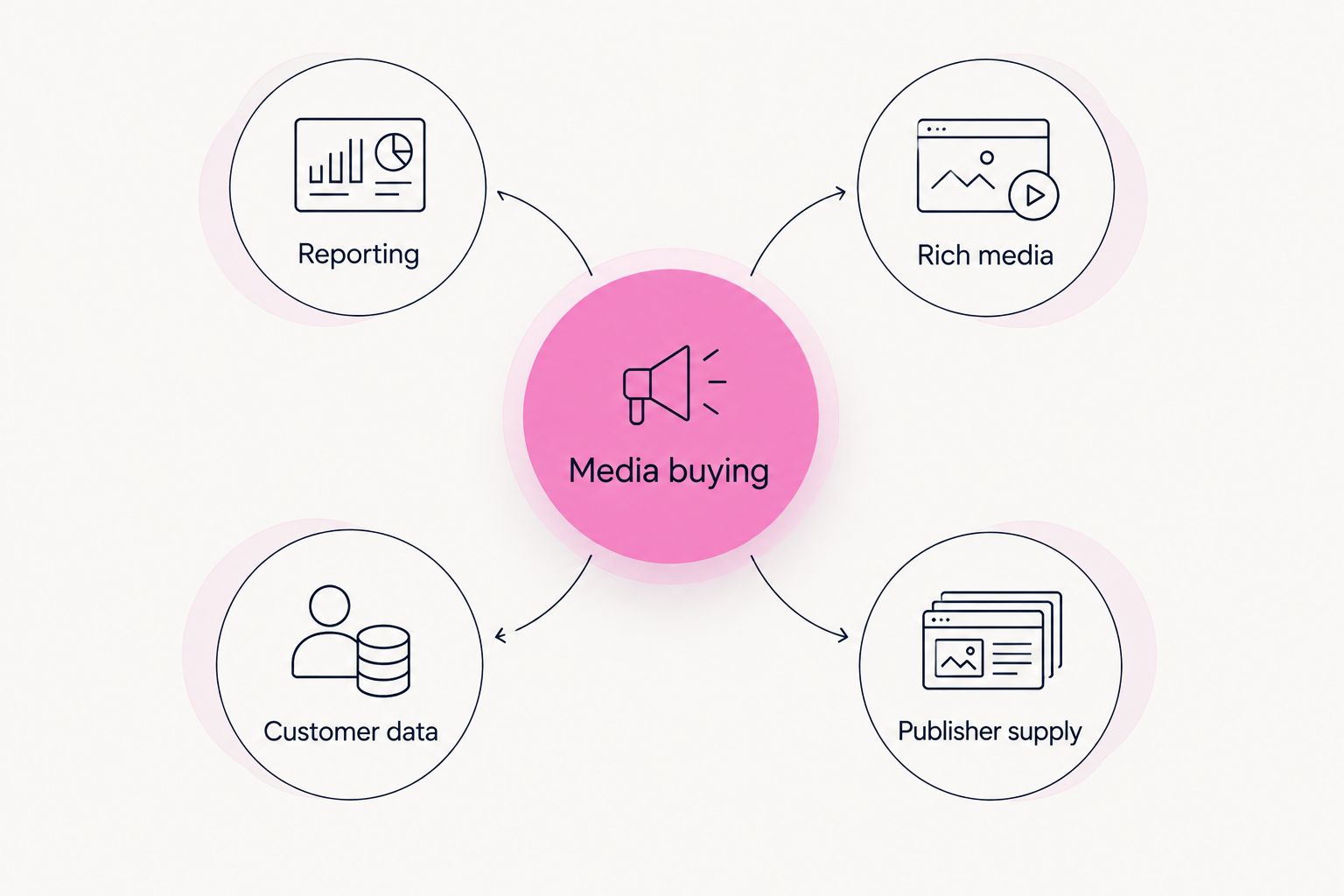
Evaluate the connections and ownership between components, not the buying interface alone.
The diagram describes your evaluation framework, not a promised integration architecture. Use it to ask where data moves, who controls each component and what happens when a supplier changes. Clear boundaries make both an in-house setup and an agency-managed setup easier to assess.
Start with a manual creative brief: audience, shopping task, message, landing page and measurement event. Existing assets can reveal gaps before you commission new formats. A rich media ad adds interactive or expanded creative elements, but the format still needs a clear reason to exist.
For prospecting, explain the product category or purchase problem. For retargeting, address the next decision without assuming every visitor needs the same message. Keep the landing page consistent with the ad; a strong creative concept cannot repair a contradictory destination.
Digital out-of-home, or DOOH, refers to advertising on digital screens in physical locations. Its exposure context differs from a clickable display ad. Evaluate it against its intended role rather than forcing every placement into an identical click-to-purchase expectation.
Reconcile a small campaign manually before automating decisions. Compare the advertising report with your analytics and order records, then investigate disagreements. Differences can come from attribution windows, event definitions, time zones and the treatment of repeat purchases.
Return on ad spend, or ROAS, divides attributed revenue by advertising spend. It describes the result under the selected attribution rules; it does not establish that every attributed order happened because of the ad. Incrementality asks a different question: what changed because the advertising ran?
For a 2026 platform demonstration, request campaign-level evidence rather than a dashboard screenshot. Check whether your team can reproduce the calculation and identify the inventory behind the reported result. Export access and understandable definitions matter more than attractive charts.
Create a scorecard before vendor demonstrations. Your scorecard should cover the buying workflow, creative hand-offs, data responsibilities, reporting and supply visibility. Define which requirements are mandatory and which are useful but optional.
Use the same campaign brief for every candidate. A manual walkthrough exposes responsibilities; a platform-assisted workflow is valuable when it reduces those hand-offs without removing the information you need. Ask the provider to show the work, not merely describe the outcome.
Cake.Shop enquiries should explain whether your brand is bringing programmatic in-house or your agency is assembling a stack for clients. Include the creative formats, publisher requirements and reporting obligations that shape the decision. Those details make the discussion commercially specific without presuming capabilities that have not been demonstrated.
Evaluate your advertising stack
Explore the platform before discussing your media buying, creative, data and publisher requirements.
The options below are procurement paths, not performance rankings. For your 2026 shortlist, select the path that matches the responsibilities you want to own. Named providers still need to pass the same demonstration and commercial review.
Manual evaluation using current tools
Cake.Shop modular platform
StackAdapt evaluation
The Trade Desk evaluation
Agency-managed operation
StackAdapt or The Trade Desk fits a buyer better when its demonstrated workflow meets that buyer's requirements more closely. Existing team familiarity is also a legitimate consideration, provided the reporting and ownership checks still pass. No brand name substitutes for evidence.
What is a DSP platform for e-commerce brands?
A DSP platform for e-commerce brands is software for buying programmatic advertising with the aim of generating customer acquisition and orders. Evaluate it alongside creative production, customer-data handling, publisher supply and purchase reporting.
Does an e-commerce brand need a DSP to start advertising?
No, a DSP is not a prerequisite for advertising. Evaluate one when programmatic publisher inventory and its operating requirements fit a defined business objective.
Is Cake.Shop only a media buying tool?
No, Cake.Shop provides a modular programmatic advertising platform covering media buying and reporting, rich media and DOOH creative, data clean rooms, and publisher supply. Confirm the specific components and workflows needed for your business during evaluation.
Is StackAdapt or The Trade Desk better for my brand?
The better fit is the platform that demonstrates your required workflow under the same evaluation brief. Compare creative support, data responsibilities, reporting, supply visibility and operating requirements rather than assuming a universal winner.
Should I combine prospecting and retargeting reports?
Report prospecting and retargeting separately when evaluating campaign performance. Their audiences have different existing relationships with your business, so combined results obscure what each campaign contributes.
Can a DSP's ROAS report prove incremental sales?
No, attributed ROAS alone does not prove incremental sales. Reconcile attributed revenue with order records and use a suitable control or holdout design to investigate additional sales.
What should I include in an e-commerce DSP enquiry?
Include your business objective, operating model, audience permissions, creative formats, publisher requirements and reporting obligations. State whether your brand will operate campaigns internally or work through an independent agency.
Ask a prospective provider to explain how you would leave before asking how you would launch. Request a walkthrough of campaign exports, audience responsibilities, creative ownership and account access. A clear transition plan tests the control your business will retain long after the first campaign starts.
Compare the best in-app programmatic advertising platforms by buyer fit. Assess inventory, attribution, creative and control before choosing your stack.
Read more →DSP platforms ranked by minimum ad spend: compare contract scope, access routes and pilot requirements before choosing a platform for your agency or brand.
Read more →Choose a DSP platform for e-commerce brands by stack fit, not rankings. Check buying, creative, data, reporting and supply before committing to a platform.
Read more →Book a 30-minute demo and see exactly how Cake.Shop works — no sales pitch, just the platform.