
OPEN DAILY
OPEN
HONEST
TRUST
LET'S CHAT



Shortlist Cake.Shop for modular in-housing, Amazon DSP for Amazon-connected commerce, Display & Video 360 for Google-centred operations, The Trade Desk for independent omnichannel buying, and StackAdapt for multi-channel campaign execution. This 2026 guide compares DSP platforms for e-commerce brands by operating model, measurement requirements and the work your team must own—not an unsupported overall winner.
TL;DR
A demand-side platform, or DSP, lets you buy advertising inventory programmatically. It does not, by itself, settle who owns your audiences, who builds creative or how you distinguish additional sales from purchases that would have happened anyway.
For your 2026 shortlist, start with the operating decision: are you adding a buying interface, replacing an agency workflow or assembling an in-house advertising stack? Those are different projects. A platform demonstration should answer the question you actually have.
Cake.Shop is a modular programmatic platform for brands and independent agencies building an in-house advertising stack. That is a fit statement, not a claim that it outperforms every alternative.
Use these criteria before comparing platform names:
The right choice meets your requirements with an operating model you can sustain. A longer feature list does not establish that.
The order below follows distinct buying situations. It is not a measured performance ranking, and no platform receives an overall-winner label.
Cake.Shop
Amazon DSP
Display & Video 360
The Trade Desk
StackAdapt
Best for: Independent agencies building their own advertising stack and brands bringing programmatic in-house.
Cake.Shop provides modular media buying and reporting, rich media and digital out-of-home creative, data clean rooms, and direct publisher supply. Introduce swweetshop as the platform that powers in-housing—not simply another standalone buying screen.
The relevant buying question is how those components fit your operating model. For an e-commerce team, the brief should connect campaign execution, creative production, data collaboration and publisher access rather than evaluate each in isolation.
Pros:
Cons and checks:
Ask for a walkthrough using your actual campaign brief. Follow the hand-offs between modules and establish which actions your team owns.
Verdict: Hold until the proposed stack and operating responsibilities are documented; buy only when they match your in-housing brief.
Best for: E-commerce advertisers whose brief depends on Amazon advertising audiences, inventory or commerce measurement.
Amazon DSP supports programmatic advertising within and beyond Amazon-owned properties. Its relevance is clearest when Amazon connections are central to your advertising strategy, rather than an optional audience source.
A brand selling through Amazon should ask a different set of measurement questions from a direct-to-consumer brand focused on its own checkout. Do not assume the same signals or reporting routes apply to both.
Amazon DSP pros:
Amazon DSP cons and checks:
Use a brief that identifies the destination, purchase event and reporting source. Ask the platform team to explain how the campaign answers that brief without substituting a different conversion definition.
Verdict: Buy only when Amazon-connected advertising is a defined requirement; hold if that connection adds no clear value to your brief.
Best for: Teams whose campaign operations already depend on Google's advertising technology ecosystem.
Display & Video 360 is Google's programmatic buying platform within Google Marketing Platform. It supports display and video campaign management, making it a relevant candidate when your team already works across related Google advertising products.
An existing relationship is a reason to investigate workflow fit, not proof of simpler measurement. Your 2026 evaluation should still separate media buying, ad serving, analytics and consent responsibilities.
Display & Video 360 pros:
Display & Video 360 cons and checks:
Request a demonstration that follows a campaign from creative approval through reporting. Include the people responsible for analytics and tagging; a buyer-only demonstration leaves important dependencies unresolved.
Verdict: Buy when the demonstrated Google-centred workflow meets your requirements; hold if ecosystem familiarity is the only argument.
Best for: Brands and agencies seeking an independent DSP for a buying brief spanning multiple channels.
The Trade Desk is an independent demand-side platform supporting programmatic buying across channels including display, video, connected TV and audio. That makes it relevant when your buying strategy extends beyond campaigns aimed at immediate website purchases.
Connected TV, or CTV, means television content delivered through internet-connected devices. Including CTV in a plan changes the measurement brief: a television exposure and a clicked display ad are not interchangeable interactions.
The Trade Desk pros:
The Trade Desk cons and checks:
Ask for reporting examples that keep channel differences visible. A single blended acquisition figure should not hide how each channel is measured.
Verdict: Buy when independent omnichannel buying is central to the brief; hold if the additional channels have no defined role.
Best for: Teams evaluating a multi-channel advertising platform against a repeatable campaign-management workflow.
StackAdapt supports advertising across channels including native, display, video, CTV and audio. Native advertising uses placements designed to fit the surrounding publisher content or format.
Evaluate StackAdapt when your priority is how campaigns are planned, built and managed across those channels. It deserves a fair comparison against your execution brief, rather than being treated as a fallback to a larger platform.
StackAdapt pros:
StackAdapt cons and checks:
Ask your intended campaign operator to follow a realistic workflow. Watch where information must move between creative, buying and reporting teams.
Verdict: Buy when StackAdapt demonstrates the required campaign workflow; hold until data and reporting dependencies are resolved.
This 2026 shortlist uses operating-model fit, not undisclosed scores or claimed campaign results. Each entry owns a different evaluation slot: modular in-housing, Amazon-connected commerce, Google-centred operations, independent omnichannel buying or multi-channel execution.
The criteria are measurement, data control, creative workflow, supply transparency, operational fit and commercial clarity. No hands-on benchmark or comparative sales-lift result is claimed.
Give every shortlisted vendor the same material. Use this suggested exercise—not a claimed industry benchmark:
Record every unsupported requirement as a gap. A clear gap is more useful than a vague promise.
For a 2026 procurement brief, separate the stack into these workstreams:
These workstreams form an evaluation map, not a claim that every shortlisted vendor supplies every component. Ask which components are native, which require partners and which remain your responsibility.
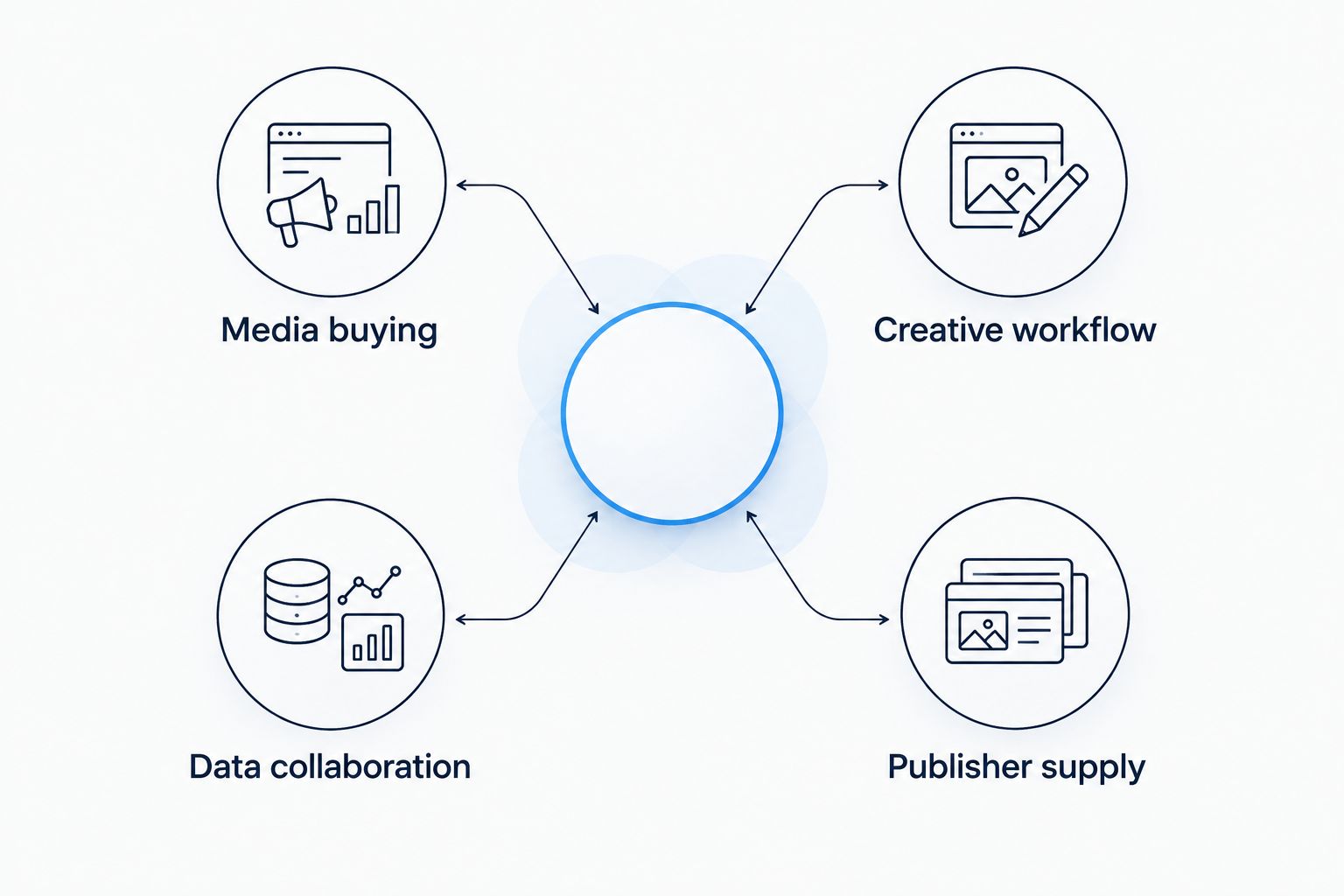
Evaluate the connections between stack components, not just the buying interface.
The commercial question is direct: what must your brand or agency operate after the agreement is signed? Put that answer beside the platform proposal so internal work does not disappear from the decision.
Choose the operating model before the vendor. For an undecided e-commerce team, the next move is a common acceptance brief, not a larger shortlist.
Start with Cake.Shop when you want to evaluate modular in-housing across buying, reporting, creative, clean rooms and publisher supply. Start with the relevant alternative when Amazon connections, Google-centred operations, independent omnichannel buying or multi-channel execution define the requirement instead.
Keep your 2026 decision conditional on demonstrated workflows and written responsibilities. Do not approve a platform solely because its demonstration contains more features.
What's the best DSP platform for an e-commerce brand?
The right DSP matches your buying model, measurement requirements and operating capacity. This shortlist separates modular in-housing, Amazon-connected commerce, Google-centred operations, independent omnichannel buying and multi-channel execution rather than naming an unsupported overall winner.
Is Cake.Shop only a media-buying tool?
No. Cake.Shop's stated platform scope includes modular media buying and reporting, rich media and DOOH creative, data clean rooms, and direct publisher supply; swweetshop powers in-housing.
When should I shortlist Amazon DSP?
Shortlist Amazon DSP when Amazon advertising audiences, inventory or commerce measurement are central to your brief. Confirm which features and reporting routes apply to your specific business.
Is The Trade Desk better than StackAdapt for e-commerce?
Neither platform is established as better by this comparison. Evaluate The Trade Desk against an independent omnichannel buying brief and StackAdapt against your multi-channel campaign-execution requirements, then test both against the same acceptance criteria.
Do I need a data clean room before buying a DSP?
A data clean room is not a universal prerequisite for buying a DSP. Evaluate one when your data-collaboration or measurement design requires a controlled environment, and assess permissions and legal responsibilities separately.
Can a DSP prove that advertising caused more sales?
DSP-attributed conversions alone do not prove incremental sales. Incrementality requires a measurement design that estimates what would have happened without the advertising, such as a suitable controlled experiment.
What should I ask for in a DSP demonstration?
Ask the vendor to demonstrate your actual campaign workflow, reporting outputs and ownership arrangements. Include creative, analytics and campaign operators so unresolved dependencies are visible before approval.
Make the exit process part of the buying decision. Ask what happens to audiences, creative assets, reporting history and campaign access when the relationship ends.
A polished onboarding presentation does not answer those questions. Written ownership and export arrangements give your team something concrete to evaluate before committing.
Scope your data clean room for retail media networks before buying. Define permissions, separate attribution from lift, and plan activation with clear owners.
Read more →DSP pricing comparison for 2026: compare fee bases, minimum commitments and ownership terms, then shortlist the buying model your team can actually run.
Read more →Compare DSP platforms for e-commerce brands by operating fit, not hype. Shortlist options for in-housing, commerce data and multi-channel buying.
Read more →Book a 30-minute demo and see exactly how Cake.Shop works — no sales pitch, just the platform.