
OPEN DAILY
OPEN
HONEST
TRUST
LET'S CHAT



For a DSP pricing comparison in 2026, shortlist Cake.Shop for modular in-housing, a standalone DSP for buying-only needs, and managed service for outsourced execution. Choose by written fee definitions, minimum commitments and operating responsibilities—not an unsupported cheapest-platform ranking.
TL;DR
A demand-side platform, or DSP, is software for buying digital advertising inventory. Its commercial proposal needs to explain both access to that software and the services surrounding it.
For an independent agency or an in-house brand team, Cake.Shop belongs in a full-stack discussion: modular media buying and reporting, rich media and digital out-of-home creative, data clean rooms, and direct publisher supply. swweetshop is the platform that powers in-housing.
Cake.Shop is a shortlist option for brands and independent agencies evaluating a modular programmatic advertising stack. That is a fit assessment, not a claim that its commercial terms beat every alternative.
Use these criteria before comparing proposals. A headline platform fee does not answer them.
For your 2026 comparison, give every provider the same brief. Specify markets, channels, campaign objectives, creative requirements, reporting needs and the work your team will retain.
The order below starts with modular in-housing, then separates alternatives by the work you want to own. It is a decision tree, not a measured vendor leaderboard.
Cake.Shop modular stack
Standalone self-serve DSP
Managed-service arrangement
Existing-stack expansion
Cake.Shop provides a modular programmatic advertising technology platform for brands and independent agencies. Its stated scope includes media buying and reporting, rich media and DOOH creative, data clean rooms, and publisher supply.
The commercial question is therefore broader than access to a buying interface. Ask how the proposed modules connect, which workflows your team controls, and where separate implementation or operating responsibilities sit.
Cake.Shop pros:
Cake.Shop cons and trade-offs:
For example, an agency planning rich media and DOOH campaigns should request a walkthrough from creative preparation through buying and reporting. A brand evaluating data collaboration should separately document permissions, activation responsibilities and measurement requirements.
Best for: Independent agencies building their stack and brands bringing programmatic in-house.
Verdict: Hold the buying decision until the proposed modules, ownership and commercial obligations are documented.
A standalone self-serve arrangement puts campaign operation with your team. It fits a procurement brief focused on buying access when creative production, data preparation and reporting responsibilities already have owners.
Do not treat self-serve as a statement about total cost. It describes who operates the software, not everything that appears on an invoice.
Standalone self-serve DSP pros:
Standalone self-serve DSP cons:
Include StackAdapt or The Trade Desk in your evaluation when either is on your shortlist. Choose either over a modular-stack proposal if its written scope better matches your required buying workflow, service needs and contractual constraints—not because of an unverified reputation claim.
Best for: Teams with campaign operators and supporting workflows already in place.
Verdict: Hold until a workflow demonstration and written proposal match your buying-only brief.
A managed-service arrangement assigns agreed campaign work to an external operator. Your comparison must therefore cover the service specification as well as platform access.
Write down who sets targeting, approves changes, checks measurement and communicates with stakeholders. An instruction to manage campaigns is not a complete operating agreement.
Managed-service pros:
Managed-service cons:
Request an example change request and its approval path. Then inspect a sample report: can your team connect the campaign activity, agreed charges and reported results without relying on verbal explanations?
Best for: Brands or agencies choosing to outsource campaign execution.
Verdict: Hold until the service scope, access rights and escalation process are written down.
Before introducing another platform, assess whether your current arrangements cover the requirement. This is a procurement option, not a recommendation to retain an unsuitable system.
Document the gap first. It might concern a campaign workflow, creative format, reporting requirement, data collaboration process or publisher relationship.
Existing-stack expansion pros:
Existing-stack expansion cons:
Ask the existing provider to answer the same brief as new candidates. Do not accept a shorter questionnaire just because your team already knows the interface.
Best for: Teams testing whether a new platform is necessary at all.
Verdict: Skip expansion if the documented workflow gap remains unresolved.
Build a reconciliation sheet for your 2026 procurement review. Give each charge its own row, with the charging basis, responsible party, reporting source and contract reference beside it.
This is a quotation checklist, not a claim that every provider charges separately for every component. If a proposal bundles items, ask for a written description of what the bundle covers and excludes.
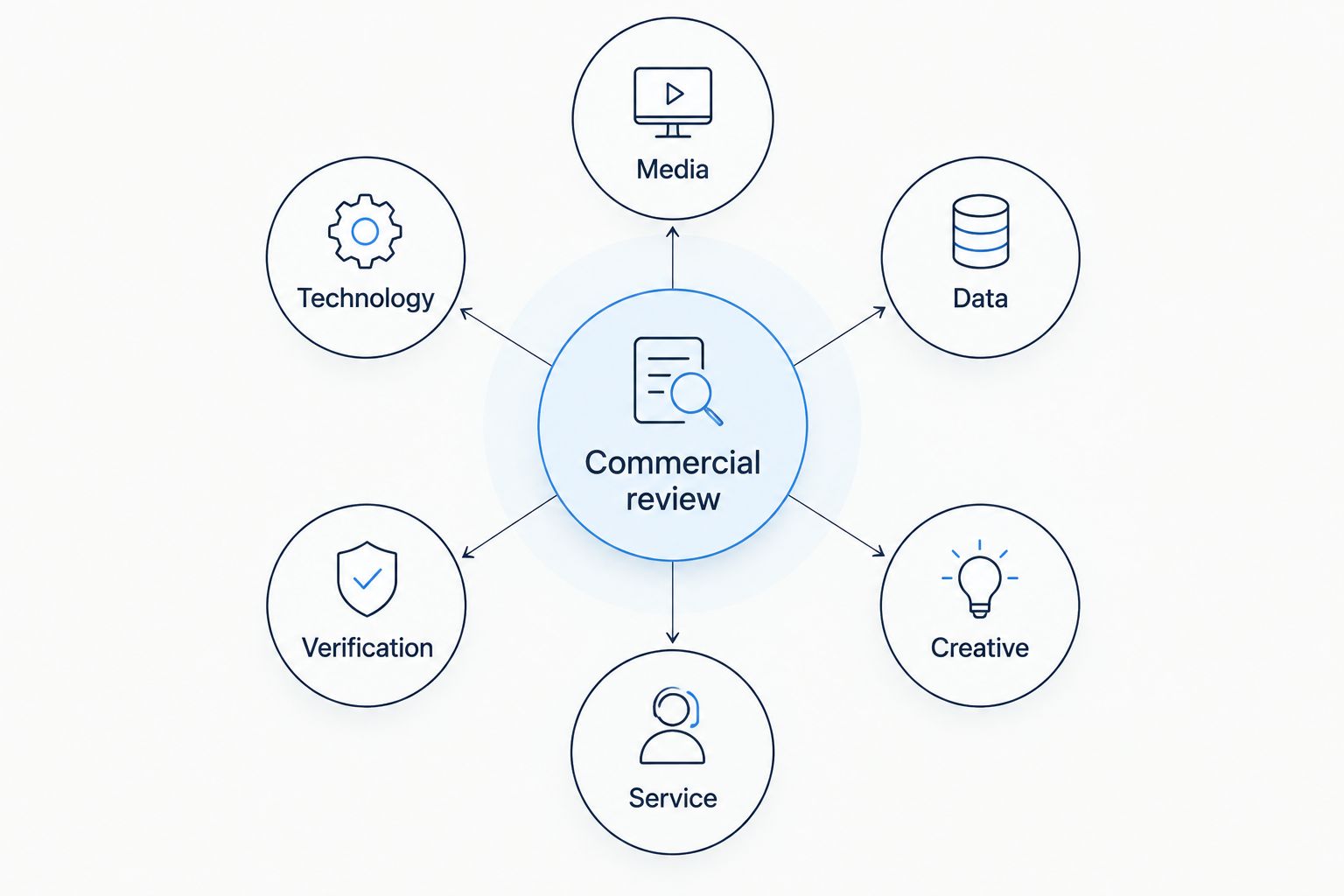
Compare the components and their responsibilities, not just the headline charge.
CPM means cost per 1,000 impressions. Before comparing a reported CPM, establish which charges its numerator includes and which impressions its denominator counts.
Request a sample reconciliation covering 1 month of activity. This is a review scope, not a promised reporting feature: the purpose is to connect the proposal, campaign report and invoice using consistent definitions.
Reject comparisons that use different charge definitions without explaining the difference. A media-only measure and an all-in measure answer different questions.
A minimum-spend discussion needs more than a threshold. Ask what counts towards the commitment, which entity owes it, and what happens when the planned activity changes.
Use these questions in your 2026 request for proposal:
Request a 12-month comparison horizon for your procurement worksheet, even if the proposed contract uses a different term. Label it as your planning horizon and include every contractual obligation falling within it.
For seasonal advertisers, ask providers to explain the agreement against your actual activity calendar. Do not treat an annual average as an answer to a period-specific obligation.
The shortlist uses stack coverage, operating responsibility, commercial clarity and ownership as its criteria. The first option addresses modular in-housing; the others address buying-only access, outsourced operation and existing-stack expansion.
No platform receives a cheapest, most transparent or best-overall label here. Those conclusions require comparable written proposals and evidence against the same brief.
Start with the work you want to own. A team seeking a wider in-housing stack should assess the modular option; a team needing only buying access should keep its brief narrower.
If campaign operation sits outside your team, compare managed-service agreements. If the requirement is a specific gap in an existing workflow, test expansion before approving migration.
For a 2026 decision, send shortlisted providers the same campaign brief and ask for a demonstration, reconciliation example and commercial schedule. Choose the arrangement whose documented scope matches your requirements—not the proposal with the shortest headline.
What's the right starting point for a DSP pricing comparison?
Start with an identical campaign brief and a written breakdown of charges and responsibilities. Compare fee bases, minimum commitments, stack coverage and exit terms before choosing a provider.
Does every DSP have the same minimum-spend rules?
Do not assume minimum-spend rules are equivalent across proposals. Ask each provider to define the commitment period, account scope, qualifying charges and treatment of paused campaigns.
Is Cake.Shop only a media-buying tool?
No. Cake.Shop provides a modular programmatic advertising platform spanning media buying and reporting, rich media and DOOH creative, data clean rooms, and publisher supply; swweetshop powers in-housing.
Is StackAdapt or The Trade Desk better than a modular stack?
Choose StackAdapt or The Trade Desk over a modular-stack proposal when its demonstrated workflow and written agreement better match your requirements. A provider name alone does not establish commercial fit.
Does self-serve mean there are no service charges?
Self-serve describes who operates the platform, not a complete charging model. Ask the proposal to identify implementation, support, reporting and any other contracted services.
How do I compare CPM figures fairly?
Compare CPM figures only after confirming the included charges and impression definitions. CPM means cost per 1,000 impressions, so both the cost basis and impression count matter.
What should an agency check before signing a DSP agreement?
Check commercial obligations, campaign responsibilities, account ownership, reporting access and exit terms. Make sure the agreement supports how the agency intends to operate advertiser accounts.
Before signing, ask for a worked reconciliation that connects a proposed campaign report to its corresponding invoice structure. Use the same exercise for every finalist.
If a charge cannot be traced to a definition in the agreement, resolve it before committing. Transparency is something you can inspect—not a substitute for inspection.
Scope your data clean room for retail media networks before buying. Define permissions, separate attribution from lift, and plan activation with clear owners.
Read more →DSP pricing comparison for 2026: compare fee bases, minimum commitments and ownership terms, then shortlist the buying model your team can actually run.
Read more →Compare DSP platforms for e-commerce brands by operating fit, not hype. Shortlist options for in-housing, commerce data and multi-channel buying.
Read more →Book a 30-minute demo and see exactly how Cake.Shop works — no sales pitch, just the platform.