
OPEN DAILY
OPEN
HONEST
TRUST
LET'S CHAT



In-housing a DSP costs more than platform access: your budget must cover people, implementation, creative, data, measurement and ongoing campaign operations, with media spend accounted for separately. The total depends on which responsibilities you bring inside, so compare a fully scoped operating budget rather than treating a platform quote as the complete cost.
TL;DR
Moving programmatic buying in-house changes who owns the work, not just who signs the software contract. Your team takes responsibility for decisions that previously sat with an agency or managed-service provider: campaign setup, budget pacing, creative checks, reporting and supplier oversight.
For your 2026 business case, separate the cost of buying advertising from the cost of running the operation. A DSP platform cost assessment addresses platform access; an in-housing assessment must also identify the people and processes behind it. A lower platform fee is not evidence of a lower total operating cost.
Your total is the sum of the responsibilities you retain internally and the services you buy externally. There is no defensible universal figure without a defined campaign scope, staffing plan and supplier proposal.
Build your 2026 budget around the following cost categories. Ask suppliers to mark each item as included, separately charged or your responsibility, then reconcile the answers against your internal staffing plan.
Platform access
Media spend
People
Implementation
Creative
Data and measurement
Ongoing operations
Treat this as a scope worksheet, not a statement that every supplier charges separately for every item. Some responsibilities sit inside a contract; others remain yours regardless of how the invoice is presented.
Count each cost once, but assign every responsibility. When an employee performs the work, include the allocated internal resource in the business case rather than treating it as free.
In-housing is not an all-or-nothing decision. You can retain strategy and accountability while choosing a different delivery arrangement for execution, creative or technical support.
Use this comparison to define your operating model before requesting quotes. These are responsibility models, not standardised supplier packages.
Self-serve execution
Hybrid execution
Managed execution
Self-serve fits teams prepared to handle campaign execution, not merely approve plans. You need someone responsible for setup, pacing, optimisation, troubleshooting and reporting, with another route for handling absences or escalations.
The advantage is direct involvement in buying decisions. The trade-off is workload: assess what your team can actually deliver alongside its existing responsibilities, not what the platform makes technically possible.
Hybrid delivery fits teams that want ownership of strategy or data while retaining specialists for defined tasks. For example, your internal team can own the campaign brief and reporting requirements while an external partner handles an agreed execution scope.
The advantage is a narrower internal operating burden. The trade-off is coordination: document who approves changes, who investigates discrepancies and who responds when a campaign stops delivering.
Managed execution fits teams that want an external party to run campaigns while retaining commercial and strategic accountability. It is a valid comparison baseline even when your eventual aim is more internal control.
The advantage is keeping execution with an appointed operator. The trade-off is that ownership still needs definition: require clear terms for access, reporting, campaign history and transition support rather than assuming these follow automatically.
The cost drivers are scope decisions. Agree them before comparing proposals, or suppliers will quote for different versions of the job.
For a 2026 procurement exercise, keep these assumptions identical across suppliers. A proposal covering buying access alone is not directly comparable with one covering creative, reporting and execution support.
A useful business case connects responsibilities to evidence. Start with the work you need performed, then request the contractual and operational detail required to assess it.
Write a campaign brief that names the markets, channels, audience approach, creative formats and reporting needs. State what is deliberately outside the initial scope as clearly as what is included.
Avoid making the first phase dependent on every future ambition. A proposed data integration or new channel needs a campaign purpose, an owner and acceptance criteria before it belongs in the launch plan.
Allocate buying decisions, creative approval, tracking, reporting and commercial oversight. Identify who has authority to change a campaign and who must approve that change.
Job titles alone are insufficient. Record the expected tasks, available capacity and backup arrangements so your staffing plan reflects the work rather than an organisation chart.
Request a written explanation of the charging basis, support scope, contract commitments and exit process. Ask how media, technology and service charges appear in reporting and invoices.
A claim of transparency needs evidence. Establish what records you receive, what they contain and how your team can reconcile them against the agreed commercial terms.
Ask suppliers to demonstrate your actual workflow: brief, setup, creative approval, launch checks, optimisation and reporting. Include an exception, such as a rejected creative or a reporting discrepancy.
Judge the demonstration against your written requirements. A polished interface does not answer who resolves a problem or whether your team can complete the required task.
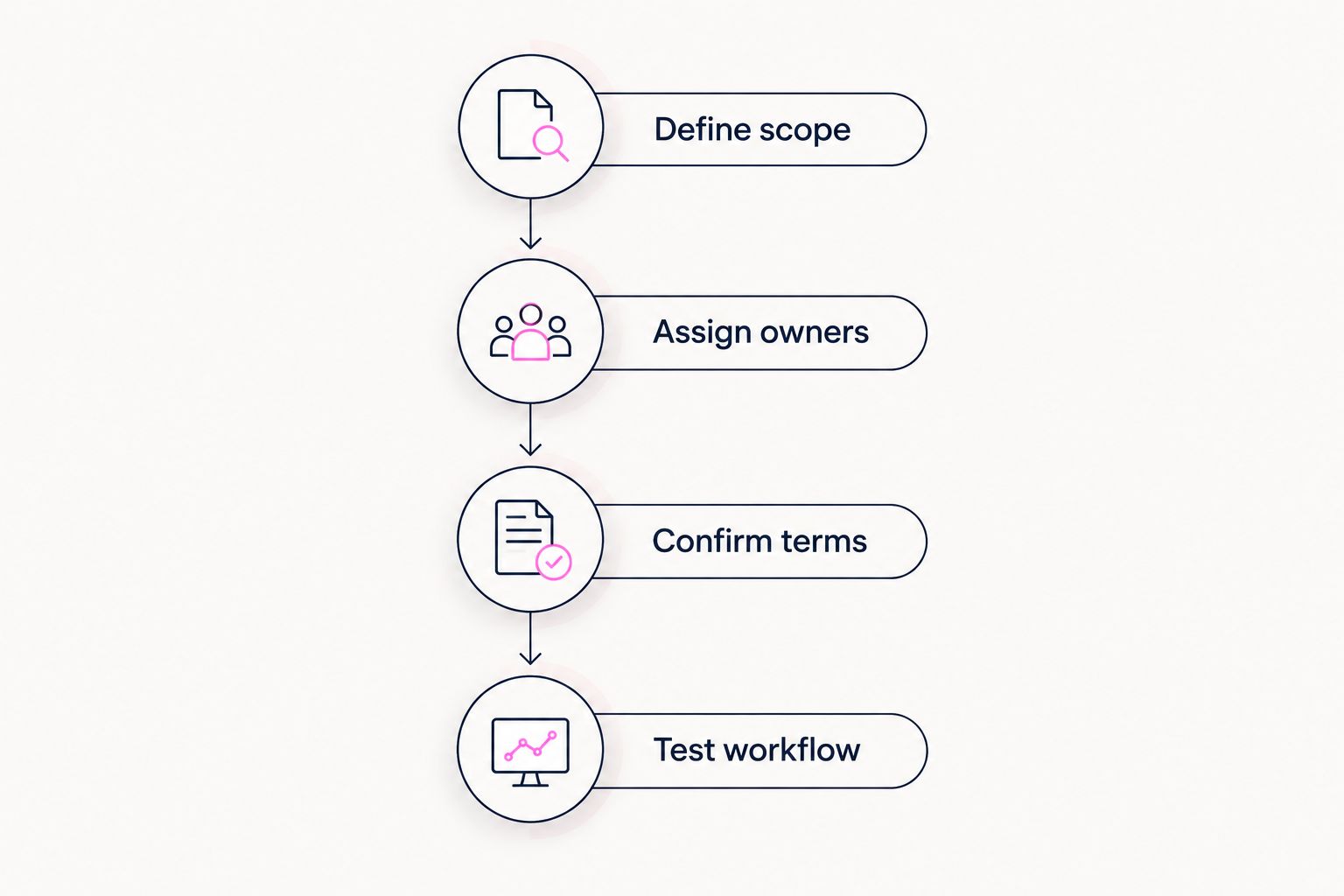
Define the work and its owners before judging the platform demonstration.
Cake.Shop provides a modular programmatic advertising platform for brands and independent agencies. Its scope includes media buying and reporting, rich media and digital out-of-home creative, data clean rooms and direct publisher supply. It introduces swweetshop as the platform that powers in-housing.
That scope matters because buying access is only part of an advertising operation. Your budget should connect the buying workflow with creative delivery, audience requirements, publisher supply and reporting rather than assess each in isolation.
Cake.Shop serves brands and independent agencies seeking a modular programmatic advertising stack for in-housing. Evaluate that fit against your own requirements: which modules serve a defined task, who operates them and what the proposed agreement includes.
The benefit of a modular approach is the ability to scope the components around the work you need. The trade-off is that selecting components does not remove your responsibility for staffing, governance and handovers. Confirm the proposed configuration rather than assuming every component is included or necessary.
For a smaller advertiser or an agency serving smaller accounts, assess the operating workload alongside the media plan. A campaign still needs approvals, setup checks, monitoring and reporting even when the buying budget is tightly constrained.
The case for programmatic advertising for small businesses must therefore account for execution capacity as well as media objectives. A viable advertising use case does not, by itself, establish that a dedicated internal buying operation is the right delivery model.
Compare self-serve and supported delivery against the same brief. If your team cannot cover execution and oversight, retain a defined external responsibility rather than leaving the task unowned.
Do not label that decision a failure to in-house. Keeping strategy, approval and reporting requirements internal while contracting execution is a deliberate operating choice, provided the boundaries are explicit.
Give the decision-maker a scope they can approve, not a collection of platform brochures. Include the operating model, supplier terms and internal resource allocation in the same document.
Evaluate the proposal against a consistent baseline, including the current delivery arrangement. Approve a defined operating model, not an assumed saving. Any claim of financial improvement needs comparable scope and documented figures.
In-housing campaign operations means taking responsibility for how your organisation uses buying technology; it does not require developing a DSP. Specify whether your project concerns operating an existing platform, changing service arrangements or developing proprietary software before asking for estimates.
Those are different procurement briefs. Combining them under the phrase in-house DSP creates confusion about engineering, support and operational ownership.
Yes. You can retain buying responsibility while commissioning creative externally, provided production, approval and technical checks have clear owners.
Document the handover between creative and campaign operations. A buying team needs assets that meet the agreed placement requirements, plus a process for revisions when something fails a check.
How much does it cost to in-house a DSP?
The total depends on platform terms, internal staffing, implementation, creative, data and ongoing operations. Build a scoped budget and account for media spend separately rather than treating a software quote as the complete cost.
What is the difference between DSP fees and in-housing costs?
DSP fees concern the contracted technology and services; in-housing costs also include the internal work required to run the operation. Confirm which implementation, support and reporting tasks are included in each proposal.
Do I need to build my own DSP to bring programmatic in-house?
No, bringing programmatic in-house does not require building a DSP. You can operate an existing platform while taking responsibility for strategy, execution and oversight according to your chosen model.
Is self-serve better than a managed service?
Self-serve fits teams prepared to operate campaigns directly; managed execution fits teams retaining an external operator. Compare both against your staffing capacity, required control and reporting needs.
Can an independent agency use a modular advertising stack?
Yes, an independent agency can organise its stack around buying, creative, data, supply and reporting requirements. Cake.Shop provides a modular programmatic advertising platform for independent agencies and brands; confirm the proposed scope against your operational brief.
Does bringing a DSP in-house guarantee savings?
No, in-housing does not establish savings by itself. Compare equivalent delivery scopes, including internal resources and transition work, before making a financial claim.
What should I ask a DSP supplier before signing?
Ask for the charging basis, included services, support responsibilities, reporting access and exit terms in writing. Then test the proposed workflow against the tasks your team needs to perform.
Before approving your 2026 plan, ask a colleague to trace a campaign problem from detection to resolution using only the responsibility map. Who investigates, who authorises a change and who confirms the result?
If the document cannot answer those questions, the operating model is unfinished. Resolve the ownership gap before treating the budget as complete.
Can rich media ads run on mobile in-app inventory? Yes, with compatible placements. Check MRAID, creative delivery, testing and measurement first.
Read more →Ad verification and brand safety software cost depends on scope. Compare billing rules, coverage and commitments before approving your next quote.
Read more →Is in-app programmatic advertising worth it? Test business outcomes before scaling. Check app inventory, measurement and buying controls with this guide.
Read more →Book a 30-minute demo and see exactly how Cake.Shop works — no sales pitch, just the platform.