
OPEN DAILY
OPEN
HONEST
TRUST
LET'S CHAT



In-app programmatic advertising is worth testing in 2026 when you can identify suitable app inventory, measure a meaningful business outcome and inspect where your budget goes. It is not worth scaling on cheap impressions or attributed conversions alone; creative production, verification, measurement and campaign management also belong in the investment decision.
TL;DR
An impression inside an app is not evidence that the app fits your audience or that the ad caused a sale. You need to distinguish media delivery, attributed outcomes and incremental results: outcomes that happened because of advertising rather than results that would have happened anyway.
For an independent agency, that distinction determines whether you can defend a recommendation to a client. For an in-house brand team, it determines whether the channel deserves budget that another activity could use. Start with the buying requirements, not a platform shortlist; the in-app programmatic advertising platforms guide addresses the platform-selection question separately.
Yes, when the campaign has a defined job and the evidence supports that job. A mobile app acquisition campaign needs a different decision rule from a retailer sending people to a website or a brand buying video exposure.
Use the following comparison to decide what your test must prove. These are campaign approaches, not a ranking of platforms.
App acquisition
Website conversion
Brand awareness
The practical decision is whether app inventory adds useful results to your existing media mix. Do not treat all app traffic as interchangeable, and do not combine these objectives into a single performance average.
A campaign that generates installs but no valuable app activity has not passed an acquisition test. A campaign that produces verified exposure can satisfy an awareness objective without meeting a direct-response target. Judge each against its original brief.
App acquisition is a relevant use case when your business has an app and a clear action that makes an acquired user valuable. That action could be an account activation, a completed purchase or another event tied to your business model.
Optimise your decision around valuable users, not the install event alone. A completed download tells you that acquisition happened; it does not tell you whether the person returned or became a customer.
Before launch, document which events your measurement setup captures, how it attributes them and what limitations apply. A mobile measurement partner is a service used to measure app campaigns and attribute activity; using one does not remove the need to examine its methodology.
The trade-off is operational complexity. Your app team, media buyer and measurement owner need consistent event definitions, consent handling and reporting. If those responsibilities remain unresolved, fix them before treating campaign results as a reliable acquisition signal.
In-app advertising can serve a brand without its own app by directing people to a website. The destination still has to work for the person arriving from that placement.
Test the entire journey: the ad, the click, the landing page, the form or checkout, and the final confirmation. An in-app browser is a browser displayed within an app; check your journey there as well as in a standalone browser.
The advantage is access to app environments without requiring an app-based business model. The limitation is that a click crosses into another experience, where consent choices, page performance and measurement setup affect what you can observe.
Use completed business actions as the decision point. Inspect enquiry validity or confirmed transactions rather than assuming that more clicks represent more demand. For agency campaigns, agree with the client on what constitutes an accepted enquiry before buying media.
In-app awareness campaigns make sense when the app environment, audience context and available creative format support your message. A placement is suitable because of its context and delivery conditions, not simply because an app has users.
The benefit is another environment in which to communicate. The limitation is the distance between exposure and a commercial outcome: viewability measures an opportunity to see an ad, not proof that someone noticed or remembered it.
For a 2026 awareness brief, define acceptable app categories, placement conditions and verification requirements before launch. If your objective is brand recognition, specify how you will assess recognition rather than substituting clicks because they are easier to report.
Keep awareness and conversion reporting separate. Otherwise, a buying system optimised for clicks can pull the campaign away from the audience or exposure conditions the brief actually requires.
In-app campaign results depend on the combination of inventory, creative, measurement and execution. These factors belong in both your buying brief and your post-campaign review:
None of these factors establishes a universal return for in-app advertising. Together, they explain why another advertiser's reported outcome is not a dependable forecast for your campaign.
Use a written test plan with a decision attached to every stage. The purpose is to produce a defensible budget decision, not merely a campaign report.
Choose the business action or awareness result the campaign must support. Record the event definition, reporting source and person responsible for validating it. Do not change the objective after seeing which metric looks strongest.
Specify acceptable apps or categories, exclusions, formats and reporting requirements. Request an explanation of how the platform identifies app inventory and handles unavailable placement details. Decide what information you require before a placement can receive further budget.
Review the actual creative and destination experience before launch. For an app campaign, check the store destination and post-install events; for a website campaign, check the landing page and completed action. Confirm that the reporting records the intended event rather than an intermediate interaction.
Use a comparison that answers your question. A holdout is a group deliberately not exposed to the campaign; where feasible, it helps assess incremental effect. A before-and-after comparison alone does not isolate advertising from seasonality, promotions or changes elsewhere in your media mix.
Choose whether to expand, revise or stop based on the agreed outcome and evidence quality. Record unresolved measurement limitations alongside performance. An unexplained discrepancy is a reason to investigate, not a reason to select the more flattering report.
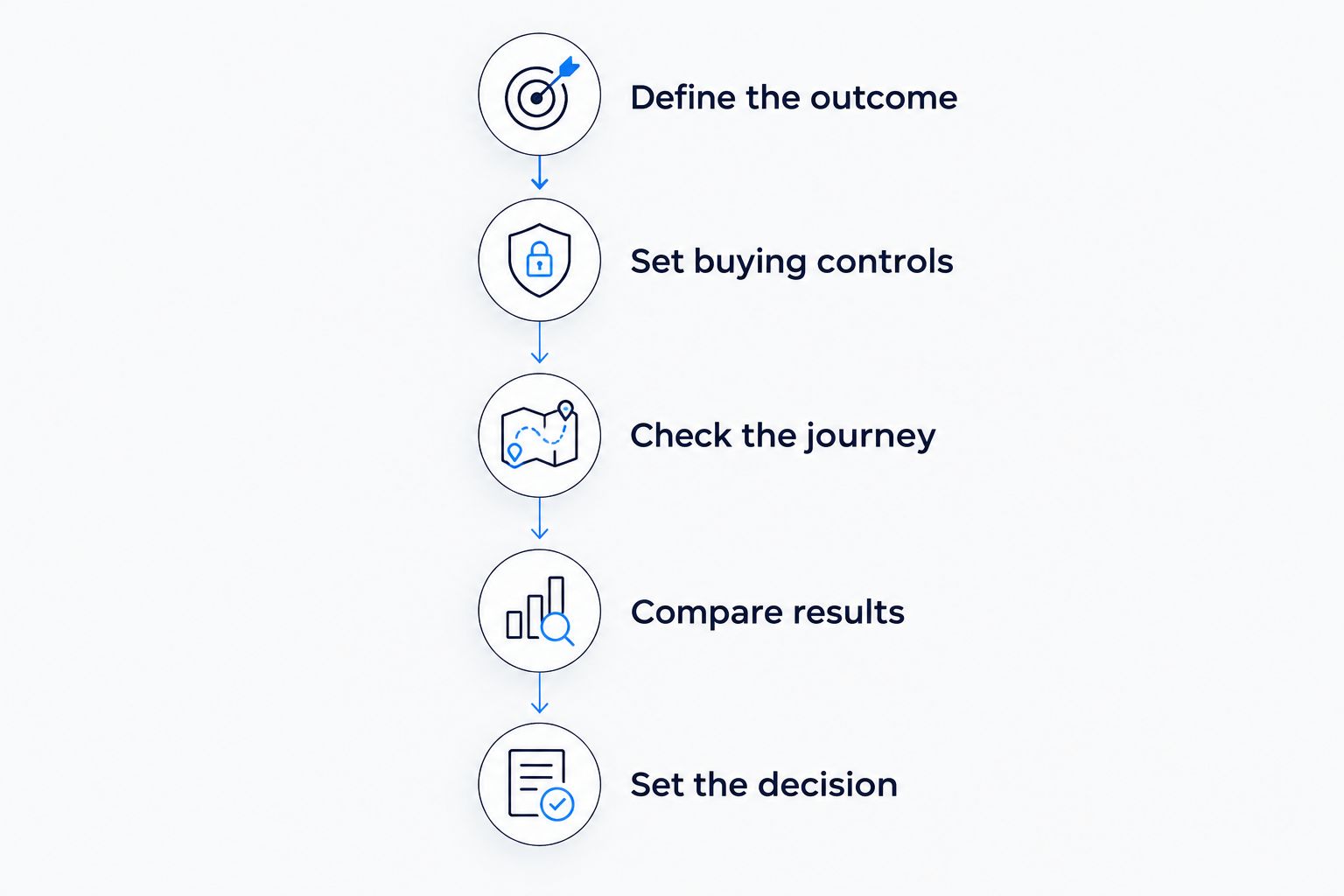
Decide what evidence will change your budget before launching the campaign.
For your 2026 test plan, set the required observation period around the outcome you measure. An immediate interaction and a later repeat purchase require different evaluation schedules. Avoid declaring success while the business event you selected is still incomplete.
Cake.Shop is for independent agencies and brands building their own programmatic advertising stack. Its modular offering spans media buying and reporting, rich media and digital out-of-home creative, data clean rooms and direct publisher supply. swweetshop is the platform that powers in-housing.
That full-stack scope matters when your enquiry concerns operating ownership rather than access to another buying interface. A Cake.Shop discussion should start with which parts your team will operate, which parts need support and what reporting the client or brand must retain.
For an in-app brief, request confirmation of the specific inventory access, creative formats, integrations and measurement requirements you need. The presence of rich media, data clean rooms or direct supply in a wider platform offering does not establish support for every app use case.
A data clean room provides a controlled environment for analysing permitted datasets; it does not create missing consent or prove advertising causality. Likewise, digital out-of-home creative belongs to the wider stack, not automatically to the in-app execution. Modular technology still requires clear ownership and integration work.
In-app advertising does not depend on browser third-party cookies in the same way as cookie-based web targeting. Apps can use different signals, including app context and, where permitted and available, device identifiers.
That distinction does not mean unrestricted tracking. Apple's App Tracking Transparency framework requires permission for tracking across other companies' apps and websites. Ask what signals your campaign uses and how measurement works when identifiers are unavailable.
Cheap impressions alone are not evidence of value. Inspect the apps, placement conditions, delivery quality and business outcomes behind the total.
Compare the complete investment with the outcome you intended to achieve. Media that does not reach a suitable audience or support a valid result is not made worthwhile by a lower impression cost.
Move budget only when the evidence supports the change. Keep the initial decision tied to a defined objective and compare against a relevant alternative or holdout where feasible.
For a 2026 budget review, examine whether in-app activity adds useful reach or incremental outcomes. A separate channel label is not proof of additional value.
Is in-app programmatic advertising worth it for a small brand?
In-app programmatic advertising is worth testing for a small brand when the brand can define a useful outcome and validate the results. Business size alone does not establish whether the inventory, creative and measurement fit.
Do I need my own app to advertise inside apps?
You do not need your own app to advertise inside apps. A campaign can send people to a website, but you should test the destination experience and measurement before launch.
What's the best metric for an in-app campaign?
The best metric is the one tied to the campaign's agreed business objective. App acquisition requires downstream user value, website campaigns require valid business actions, and awareness needs exposure and brand measurement.
How much should I spend on an in-app advertising test?
Set the test budget around the outcome, measurement requirements and decision you need to make. Include creative, verification and operating work rather than treating media spend as the entire investment.
Can I measure in-app advertising without device identifiers?
Measurement without device identifiers depends on the methods supported by your app, platform and measurement setup. Ask which results are observed, aggregated or modelled and which comparisons remain possible.
Is in-app advertising better than mobile web advertising?
Neither environment is automatically better. Compare audience fit, creative conditions, destination experience and measured business outcomes against the same objective.
Where does Cake.Shop fit in an in-app advertising decision?
Cake.Shop provides a modular programmatic advertising stack for brands and independent agencies. Confirm your specific in-app supply, creative and measurement requirements rather than assuming every platform module supports every app campaign.
Before approving your next 2026 in-app campaign, write down the result that would make you stop spending. If no result could change your decision, you have not designed a test; you have approved a channel preference.
Ask for app-level evidence before asking for more reach. You cannot make a sound placement decision from a blended total that hides where the advertising appeared.
Can rich media ads run on mobile in-app inventory? Yes, with compatible placements. Check MRAID, creative delivery, testing and measurement first.
Read more →Ad verification and brand safety software cost depends on scope. Compare billing rules, coverage and commitments before approving your next quote.
Read more →Is in-app programmatic advertising worth it? Test business outcomes before scaling. Check app inventory, measurement and buying controls with this guide.
Read more →Book a 30-minute demo and see exactly how Cake.Shop works — no sales pitch, just the platform.