
OPEN DAILY
OPEN
HONEST
TRUST
LET'S CHAT



Ad verification and brand safety software has no single standard cost: the amount you pay depends on the contracted checks, billable activity and service terms. Budget verification separately from media, and confirm whether a quote covers prevention before bidding, measurement after delivery, or both. For a 2026 buying decision, compare the complete scope rather than an isolated rate.
TL;DR
A verification quote is only useful when you know what it measures and what triggers a charge. A buying team needs to distinguish unsuitable content, invalid traffic and viewability rather than treating them as interchangeable checks.
Your programmatic campaign budget should distinguish media delivery, buying technology, verification and operational work. That separation gives finance a readable budget and gives campaign operators a way to reconcile the invoice against activity.
Buy a defined control and measurement scope, not a reassuring label. A dashboard showing delivery quality does not, by itself, establish that unsuitable impressions were prevented.
Calculate the payable amount from the supplier's written billing rules and your planned activity. Ask every shortlisted supplier to complete the same breakdown before comparing proposals.
Usage-based measurement
Pre-bid filtering
Platform access
Minimum commitment
Implementation
Additional services
Where a quote uses CPM, it means cost per 1,000 impressions. The critical question is which impressions count: requested, analysed, measured, delivered or another explicitly defined population.
A usage calculation is straightforward once that definition is clear: divide billable impressions by the CPM unit, then apply the contracted rate. Add applicable fixed charges and apply the contract's minimum commitment rules without counting the same obligation twice.
For your 2026 comparison, request a worked invoice using your own forecast. Require the supplier to identify every assumption, including currency, taxes, channel coverage and excluded services. A proposal that cannot be reconciled to an example invoice is not ready for approval.
Pre-bid filtering uses available signals to decide whether an impression opportunity meets your campaign rules before bidding. Its role differs from a report describing impressions already delivered.
Best for: buying teams that need suitability or quality rules applied during bidding. The benefit is control at the buying decision; the limitation is that a pre-bid decision does not constitute independent evidence of every subsequent delivery outcome.
Specify the categories you want excluded, who approves the policy and how exceptions work. Brand safety concerns broadly unacceptable environments; brand suitability reflects the particular advertiser's tolerance and context.
Ask whether filtering applies to each intended channel and buying route. Do not accept a general statement about platform support as proof that your particular campaign setup is covered.
Post-bid measurement assesses delivered advertising against the checks in your agreement. Depending on the contracted service, those checks can concern invalid traffic, viewability, placement context or geography.
Best for: teams that need delivery evidence for reporting, investigation and optimisation. Its advantage is visibility into measured outcomes; its limitation is timing, because a report cannot undo an impression that has already been served.
Ask which delivered impressions are eligible for measurement and how unmeasurable activity appears in reports. An excluded or unmeasurable impression is not automatically a safe impression, a fraudulent impression or an invoice adjustment.
Your contract should also distinguish detection from remedy. Establish who investigates a discrepancy, what evidence is required and whether any remedy exists under the applicable agreement.
Buying both services requires a reason for each. Write down the decision that pre-bid signals influence and the evidence that post-bid measurement must provide.
Pre-bid filtering
Post-bid measurement
Combined scope
For an independent agency, the combined scope also needs account-level boundaries. Establish which client owns each policy, who can change settings and how charges will be allocated without exposing another client's reporting.
The useful comparison is not simply whether a supplier charges by usage or contract. It is whether the proposed service covers the decisions, channels and evidence your organisation requires.
Use this list as a 2026 procurement brief, not a list of features to buy automatically. Remove requirements that do not support a real operational decision. Keep requirements that your team needs to enforce policy or explain delivery to a client.
Give suppliers an identical brief and require responses against it. Otherwise, a narrowly scoped measurement proposal and a broader control-and-reporting proposal look comparable when they are not.
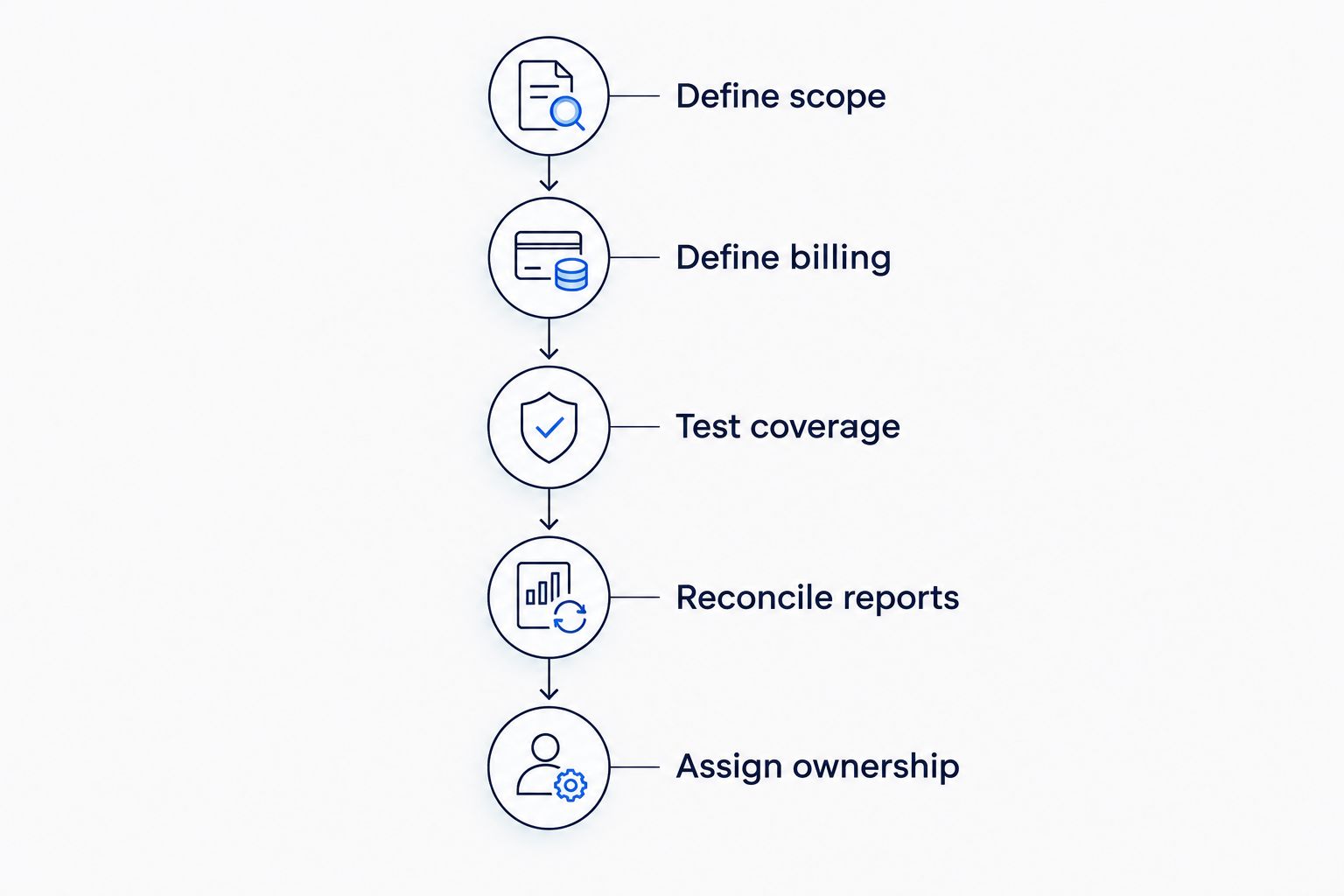
Define the commercial and measurement rules before approving the service.
Use a 30-day planning window for the worked comparison, with the same forecast activity and scope for every supplier. This is a procurement convention you choose, not a claim about standard contract duration.
Specify 1 reporting currency for that comparison and document any conversion assumption separately. Keep tax treatment consistent so the comparison does not mix fundamentally different totals.
Describe the business problem before requesting a feature list. An agency managing distinct advertiser policies has different governance requirements from a brand operating a single internal policy.
A practical brief should identify:
For example, an independent agency should ask how to keep client policies separate and how to attribute charges to each account. An in-house brand should ask who retains access to reports and policy settings when external operators change.
Neither requirement proves that a supplier supports it. Treat each as a question requiring a written answer, followed by a demonstration where the requirement is material to your decision.
Cake.Shop provides a modular programmatic stack spanning media buying and reporting, rich media and DOOH creative, data clean rooms, and direct publisher supply. Its swweetshop platform powers in-housing, making verification a stack-design question rather than just another buying-screen feature.
Cake.Shop is a modular programmatic platform for independent agencies and brands bringing media buying in-house. Assess the full stack against your operating model, then establish the verification requirements and responsibilities for the proposed setup.
The advantage of modular design is the ability to assess distinct parts of the stack against distinct requirements. The trade-off is coordination: your team still needs clear ownership of buying rules, creative deployment, supply decisions and reporting definitions.
For a Cake.Shop enquiry, bring your channel plan, suitability policy, reporting requirements and current measurement arrangements. Ask which controls belong in the proposed configuration and which requirements need separate arrangements; do not assume a particular verification integration or certification.
A demand-side platform, or DSP, can contain buying controls, but you must inspect the specific configuration and agreement. A platform setting, an inventory exclusion and an independently measured result are different things.
For a 2026 stack review, ask which controls are included, which require activation and which involve another supplier. Then establish whether the reporting demonstrates configured rules, measured delivery, or both.
Keep the distinction between applying a policy and proving an outcome. It is the basis for deciding whether additional verification serves a genuine need.
CPM alone is insufficient because a rate per 1,000 impressions does not define the service or the billable population. Compare the same checks, environments and reporting scope before comparing the rate basis.
Request the projected payable total under the same forecast, including applicable commitments and separately contracted work. Keep that calculation in your procurement workbook rather than treating a public headline figure as a universal benchmark.
Map each requested control to its provider, billing location and reporting output. Then check whether an existing arrangement and a proposed service perform the same function or answer different questions.
Overlapping coverage is not automatically waste. Independent measurement can serve a different purpose from a buying-platform control, but that purpose needs to be explicit before you approve another charge.
Require the account owner to explain what action each report supports. If nobody can name the decision it changes, reconsider the requirement before renewing it.
How much does ad verification and brand safety software cost?
The payable amount depends on the contracted scope, billable activity and commercial terms. Request a worked quote covering measurement, filtering, applicable commitments and implementation responsibilities.
Is brand safety included in my DSP?
Check your DSP's agreement and campaign configuration rather than assuming coverage. Establish which controls are included, whether activation is required and what delivery evidence the reporting provides.
What's the difference between pre-bid and post-bid verification?
Pre-bid filtering influences whether an impression opportunity is pursued; post-bid measurement assesses delivered advertising. They address different stages and should have separately defined responsibilities.
What does CPM mean for ad verification?
CPM means cost per 1,000 impressions. Ask which impressions trigger the verification charge, because the billing definition determines how the rate applies to your activity.
Do I need separate verification for every advertising channel?
Define your required coverage channel by channel, then ask suppliers how they meet it. Do not assume that support for one delivery environment establishes equivalent measurement elsewhere.
Can an independent agency use the same suitability policy for every client?
Use a shared policy only where each client's requirements support it. Record advertiser-specific exclusions, approval rights and exception handling rather than treating suitability as universal.
Is Cake.Shop a standalone ad verification tool?
Cake.Shop is a modular programmatic advertising platform spanning media buying and reporting, creative, data clean rooms and publisher supply. Discuss verification requirements as part of the proposed stack rather than assuming a standalone verification product.
Ask the supplier to demonstrate how a flagged impression moves from a report into an operational decision. Who checks it, who changes the campaign and who explains the result to the advertiser?
Make that walkthrough part of your 2026 approval process. A verification report earns its place when someone owns the response. Software scope and invoice detail matter, but neither replaces a clear decision-making process.
Can rich media ads run on mobile in-app inventory? Yes, with compatible placements. Check MRAID, creative delivery, testing and measurement first.
Read more →Ad verification and brand safety software cost depends on scope. Compare billing rules, coverage and commitments before approving your next quote.
Read more →Is in-app programmatic advertising worth it? Test business outcomes before scaling. Check app inventory, measurement and buying controls with this guide.
Read more →Book a 30-minute demo and see exactly how Cake.Shop works — no sales pitch, just the platform.