
OPEN DAILY
OPEN
HONEST
TRUST
LET'S CHAT


For the best white label DSP providers in 2026, shortlist Epom for a white-label DSP and Gocake for a modular programmatic stack. Assess StackAdapt and The Trade Desk as branded buying-platform alternatives—not as confirmed white-label substitutes.
TL;DR
A demand-side platform, or DSP, lets advertisers buy advertising inventory programmatically. White labelling adds a separate requirement: presenting some or all of that buying environment under your own brand.
Those are different decisions. Your agency can need a DSP without needing a rebranded interface, and a branded dashboard does not establish control over campaign data, publisher relationships or account access.
For a 2026 procurement decision, separate the buying platform from the operating model. Choose the technology around the service you intend to deliver, not the logo you can put on its login screen.
Use these criteria before comparing names. Treat each as a question the provider must answer, rather than a capability you assume.
A provider passes a criterion only when its demonstration, documentation or agreement answers your specific requirement. A sales statement is not an acceptance test.
This is a requirements-led shortlist, not a performance leaderboard. The options occupy different buying categories; the table makes that distinction explicit.
Gocake
Epom
StackAdapt
The Trade Desk
Best for describes the procurement use case, not a measured claim of superiority. Confirm the current offer directly before treating any option as a contractual fit.
Gocake is a modular programmatic platform for independent agencies and brands building their own advertising stack. Its stated scope includes media buying, rich media creative, data clean rooms and publisher supply. That makes the evaluation broader than choosing a standalone bidding interface.
An independent agency should map those components to its delivery model. A brand bringing buying in-house should do the same: identify which functions belong internally and which remain with external partners.
Gocake pros:
Gocake cons and boundaries:
Best for: Agencies building their own stack and brands evaluating an in-house programmatic operating model.
Ask for a connected walkthrough: buying setup, creative handoff, reporting requirements, data collaboration and publisher supply. Do not assume that the presence of each component proves how information moves between them.
Verdict: Hold on white-label selection until the branding, ownership and operating requirements are demonstrated.
Epom publicly offers a white-label DSP, making it a relevant starting point when rebranding is a mandatory requirement. The next question is not whether the proposition exists; it is whether its current scope matches your agency's service model.
Define what your clients must see and what your operators must control. Then ask Epom to demonstrate both environments rather than treating a branded dashboard as the whole product.
Epom pros:
Epom cons and boundaries:
Best for: Agencies whose service requires a client-facing DSP environment under their own identity.
For your 2026 demonstration, bring a sample client workflow. Ask how an advertiser is added, who can change a campaign, what the client sees and how reporting leaves the platform. Record any step that still requires provider intervention.
Verdict: Hold until Epom demonstrates the required white-label workflow and documents the account boundaries.
StackAdapt is a programmatic advertising platform with a multichannel buying proposition. It belongs in this comparison when your real requirement is campaign execution rather than reselling a DSP under your own brand.
That distinction changes the brief. You are assessing a buying environment and its fit with your delivery team, not assuming that the platform can become your agency's own software product.
StackAdapt pros:
StackAdapt cons and boundaries:
Best for: Teams prioritising a branded programmatic buying platform over their own client-facing DSP identity.
StackAdapt fits the brief better when you want to operate within a provider's platform and do not require a rebranded product. Confirm the workflows that matter to your campaigns rather than adding white-label requirements your clients do not need.
Verdict: Skip for a mandatory white-label brief unless the required arrangement is explicitly confirmed; assess for branded buying.
The Trade Desk is an independent demand-side platform for programmatic media buying. Include it when your procurement question concerns the buying platform your team will operate, rather than a client-facing product carrying your agency's identity.
Keep access and ownership separate. Using a DSP through an agency relationship does not, by itself, mean the agency can rebrand the platform or transfer every account relationship.
The Trade Desk pros:
The Trade Desk cons and boundaries:
Best for: Agencies and in-house teams comparing independent DSP options without making platform rebranding mandatory.
The Trade Desk fits a buyer better when an independent buying platform is the actual requirement and a proprietary-looking client interface is not. Judge the current access model against your team and campaign requirements.
Verdict: Skip for an unconfirmed white-label requirement; assess within an independent DSP shortlist.
The order follows the stated audience and distinct procurement needs: a modular stack, an explicit white-label proposition, a branded multichannel platform and an independent DSP.
It is not a ranking of campaign results, service quality or technical performance. No comparative testing or client-approved performance figures support those claims here. For your 2026 decision, use the criteria above to turn this shortlist into an evidence-based selection.
A white-label interface is only one part of an advertising operation. Map the following functions before deciding whether one provider or several components suit your business.
The modular programmatic proposition spans the first four functions. Your evaluation must establish how reporting and handoffs work across the arrangement. A component list is not proof of an integrated workflow.
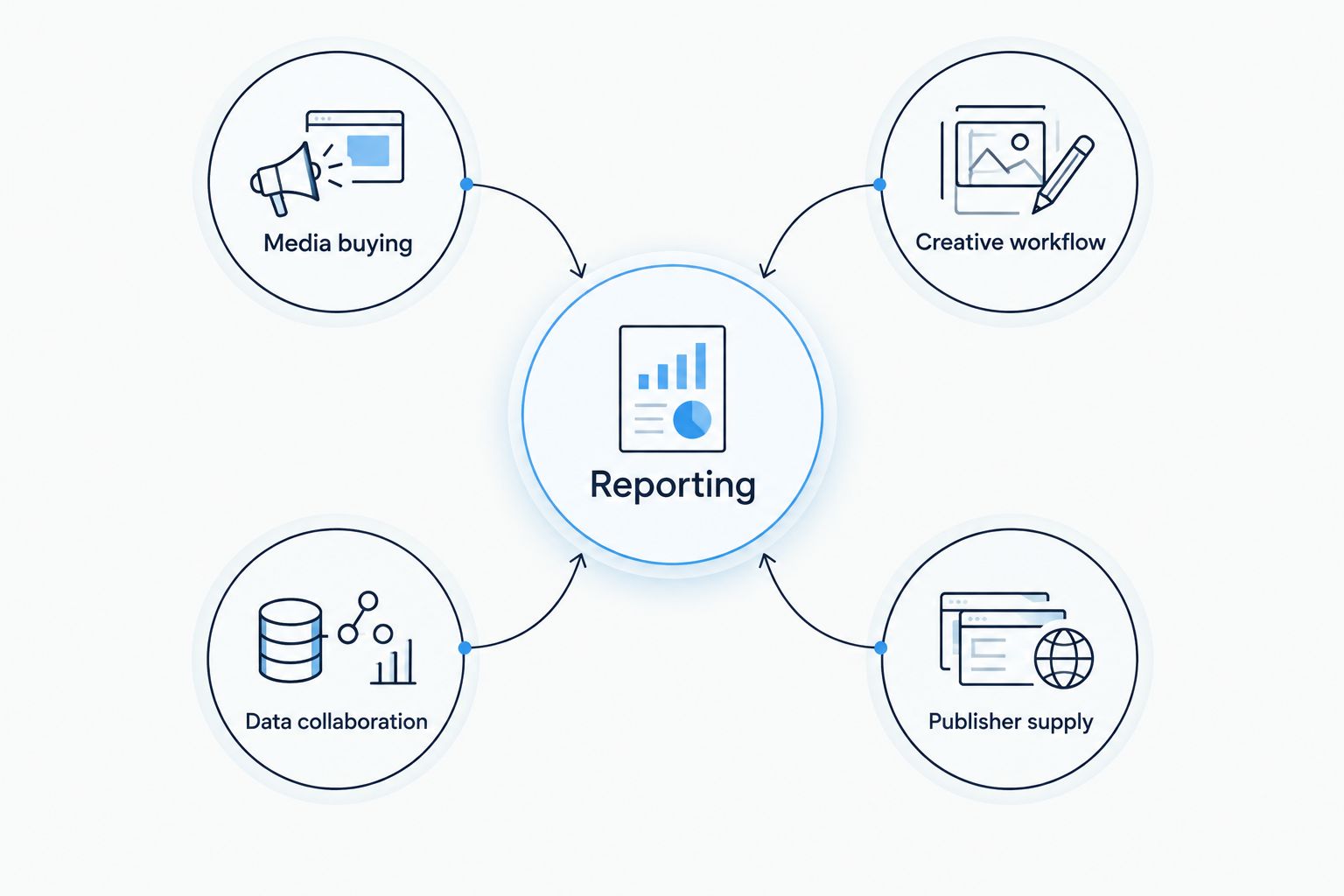
Assess the handoffs between functions, not just each component separately.
For a 2026 evaluation, use a small, defined workflow rather than an open-ended platform tour. The following numbers are suggested test scope, not vendor benchmarks.
Choose one campaign representative of the work you intend to sell or run internally. Specify its channel, creative format, audience requirements and reporting needs before the demonstration.
Follow that campaign through setup, review, activation and reporting. Record who performs each action and where the provider must intervene. This exposes responsibility gaps that a feature presentation leaves unresolved.
Test an operator role and a client-viewing role. Ask the provider to demonstrate what each role can see and change, rather than describing permissions verbally.
Include the exit case: removing a user, transferring responsibility and retaining access to necessary campaign records. Your operating model needs to work when relationships change, not just when accounts are created.
Request a campaign summary, an inventory report and a raw-data export appropriate to your requirements. Specify the fields you need; do not assume every provider supplies the same outputs.
Compare definitions as well as formatting. A clean-looking report is not enough if your team cannot explain its fields or reconcile it with the buying records.
If white labelling is mandatory, start with Epom's explicit white-label proposition and make the demonstration requirements binding. Do not substitute an ordinary DSP shortlist for a rebranding requirement.
Choose Gocake for further evaluation when the decision concerns a modular programmatic stack across buying, creative, data collaboration and publisher supply. Confirm white-label scope separately rather than treating it as an established capability.
If you do not need your own platform identity, compare StackAdapt and The Trade Desk against the buying workflows your team will actually use. Removing an unnecessary white-label requirement keeps the decision focused.
For a 2026 agency enquiry, bring a written brief covering client visibility, operator control, data access and supply requirements. Ask each provider to answer the same questions so the comparison remains usable.
What's the best white-label DSP provider for an independent agency?
There is no supported universal winner in this shortlist. Epom offers an explicit white-label DSP proposition; compare its current branding, permissions, reporting and operating terms against your agency's requirements.
Is Gocake a white-label DSP?
Gocake is described as a modular programmatic platform, but that description does not establish white-label scope. Confirm rebranding rights, client access and operating responsibilities directly before selecting it for a mandatory white-label brief.
Is StackAdapt a white-label alternative?
Do not treat StackAdapt as a confirmed white-label alternative without an explicit arrangement. Assess it as a branded multichannel buying platform when rebranding is not required.
Can an agency white-label The Trade Desk?
Agency access to The Trade Desk does not by itself establish white-label rights. Confirm the exact access and branding arrangement rather than assuming the platform can carry your agency's identity.
What's the difference between a DSP and a white-label DSP?
A DSP provides programmatic media-buying technology; a white-label DSP also offers an agreed scope of rebranding. That branding scope does not automatically include technology ownership, unrestricted exports or control over every account relationship.
What should I ask in a white-label DSP demo?
Ask the provider to demonstrate campaign setup, operator permissions, client visibility and reporting exports. Use one defined workflow and request written answers about branding rights and operational responsibilities.
Does a white-label DSP include creative tools and publisher supply?
White labelling alone does not establish creative tools or publisher supply. Assess those functions separately, including their handoffs to buying and reporting, before treating the arrangement as a full advertising stack.
Ask for an exit walkthrough before an onboarding walkthrough. Have the provider explain how you remove a client, retrieve permitted records and transfer operating responsibility.
The clearest test of control is what you retain when the relationship ends. Put that answer into the agreement, not just the meeting notes.
Build a dynamic creative stock level trigger with validated inventory, approved assets and verified activation. Follow setup, testing and fallback guidance.
Read more →Google Ad Manager publisher supply integration needs a verified route. Map inventory, validate creative delivery and reconcile publisher and buyer reporting.
Read more →Set up a LiveRamp DSP integration with destination checks, audience mapping, suppression tests and reporting controls before activating first-party campaigns.
Read more →Book a 30-minute demo and see exactly how Cake.Shop works — no sales pitch, just the platform.