
OPEN DAILY
OPEN
HONEST
TRUST
LET'S CHAT


Shortlist Cake.Shop for modular in-housing, Vistar Media for an out-of-home-focused buying workflow, and The Trade Desk for DOOH within a broader media programme. The right DOOH advertising platforms for automotive brands depend on the screens you need, who operates the campaigns, and how you will measure results—not a universal winner.
TL;DR
An automotive manufacturer launching a model and a dealer group promoting test drives have different buying problems. National visibility does not establish local relevance, and proximity to a showroom does not prove that an audience intends to buy.
For a 2026 shortlist, start with the operating model. Cake.Shop provides modular media buying and reporting, rich media and DOOH creative, data clean rooms, and direct publisher supply; evaluate those components together rather than treating the offer as a standalone buying tool.
Cake.Shop suits automotive brands and independent agencies evaluating a modular advertising stack for in-housing. The next step is to demonstrate the required workflow against your actual campaign brief.
Digital out-of-home, or DOOH, means advertising on digital screens in physical locations. Programmatic DOOH adds software-based buying, but it does not make every screen, audience estimate or reporting method equivalent.
Use these criteria before comparing platform names:
Request the same evidence from every vendor. A polished interface is not evidence of suitable inventory or useful reporting.
The order below follows distinct buying situations, not a performance league table. The limitations identify procurement questions and operating trade-offs, not findings from a controlled platform test.
Cake.Shop
Vistar Media
Hivestack
StackAdapt
The Trade Desk
Cake.Shop offers a modular advertising technology platform, with swweetshop introduced as the platform that powers in-housing. Its scope includes media buying and reporting, rich media and DOOH creative, data clean rooms, and publisher supply.
For an automotive team, the relevant question is how those components support a defined operating model. Ask for a demonstration covering campaign setup, creative hand-off, supply selection and reporting; do not assume that every proposed connection is already configured.
Best for: Independent agencies and automotive brands evaluating ownership of a broader advertising stack.
Cake.Shop pros:
Trade-offs:
For your 2026 evaluation, bring a dealer catchment map and a sample reporting requirement. A demonstration against those materials tells you more than a generic product tour.
Verdict: Hold the procurement decision until the full workflow is demonstrated.
Vistar Media specialises in out-of-home advertising technology and programmatic DOOH. It belongs on the shortlist when outdoor planning is the central requirement rather than an extra channel inside a wider digital campaign.
An automotive use case is comparing proposed screens around dealership catchments with screens selected for a broader model launch. Ask the vendor to explain the planning rationale and reporting definitions for each approach.
Best for: Teams that want an outdoor-focused buying discussion.
Vistar Media pros:
Trade-offs:
Do not equate an outdoor specialism with guaranteed coverage of every desired venue. Request a proposed screen list before committing to the plan.
Verdict: Hold until the proposed inventory matches the automotive brief.
Hivestack is a programmatic DOOH platform. Include it when the buying decision centres on physical environments, geography and how an outdoor campaign will be planned and evaluated.
For a dealer group, start with locations rather than an audience label alone. A screen near a commuter route and a screen inside a shopping environment present different creative and measurement questions, even when both sit within the same sales territory.
Best for: Automotive planners organising a DOOH evaluation around locations and venues.
Hivestack pros:
Trade-offs:
Ask how venue classifications, screen schedules and audience estimates enter the proposed plan. Keep those definitions with the campaign report.
Verdict: Hold until location coverage and reporting methodology are documented.
StackAdapt is a multichannel advertising platform that includes DOOH. Consider it when an agency wants to evaluate outdoor alongside other digital activity rather than establish a separate outdoor-only buying process.
This is relevant to automotive campaigns combining awareness with subsequent online engagement. It does not mean a platform can identify every person who saw a roadside screen or prove that a later enquiry resulted from that exposure.
Best for: Agencies prioritising a multichannel operating workflow.
StackAdapt pros:
Trade-offs:
For a 2026 review, request a demonstration built around the same dealer geography and creative brief used for specialist platforms. Compare execution, not unrelated sales presentations.
Verdict: Hold until local DOOH coverage and the agency workflow are demonstrated.
The Trade Desk is an independent demand-side platform supporting multiple advertising channels, including DOOH. It merits evaluation when outdoor must sit within an established programmatic buying operation.
A demand-side platform, or DSP, is software used to buy advertising inventory. For an automotive advertiser already working through a broader DSP workflow, extending that operating model can be more relevant than selecting a separate specialist solely for outdoor.
Best for: Experienced buying teams evaluating DOOH within a wider programmatic programme.
The Trade Desk pros:
Trade-offs:
Ask who will build campaigns, manage deals and investigate reporting discrepancies. Those responsibilities determine whether the proposed arrangement fits your organisation.
Verdict: Hold until operating requirements match the team's capacity.
This 2026 shortlist uses operating fit: modular in-housing, outdoor specialism, location-led planning, agency multichannel buying and established cross-channel operations. It is not a claim that one vendor delivers better automotive results.
The evaluation criteria are screen fit, buying control, creative workflow, measurement clarity, operating ownership and stack fit. Use a common brief to turn those criteria into a decision supported by demonstrations and documented answers.
Before selecting a platform, write down what would change your decision. A campaign that delivers its booked media but leaves the commercial question unanswered is an incomplete test.
Use this proposed sequence:
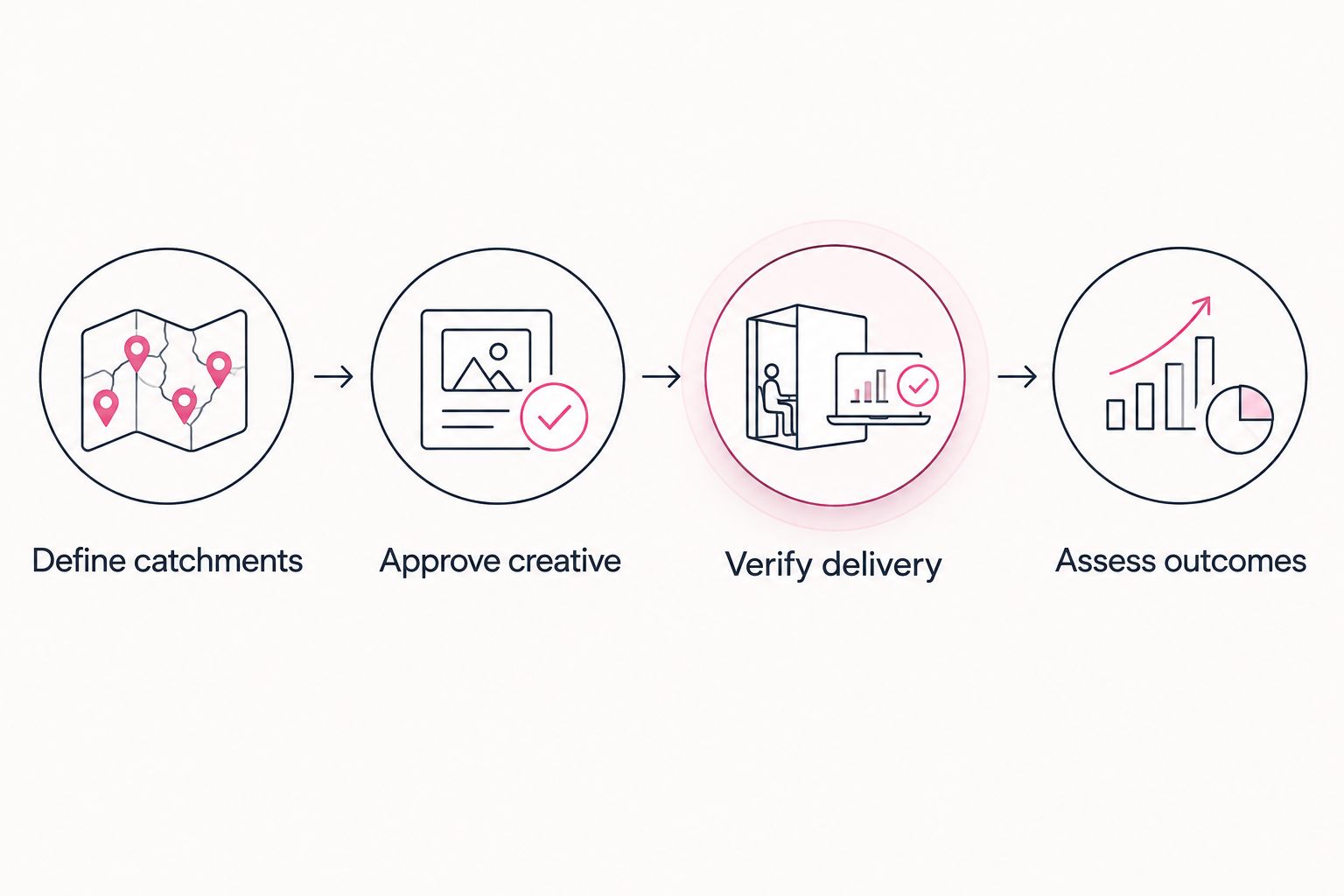
Agree the business question before choosing the reporting method.
For an initial planning exercise, compare 2 dealer catchments over a proposed 4-week pilot, with 1 primary business outcome. These are suggested test parameters, not a required campaign size or a promise of statistical certainty; the measurement design must determine whether the test can answer your question.
Keep creative comparisons disciplined. Reusing an asset across outdoor screens and short-form video advertising platforms does not make the placements equivalent: roadside communication needs to work without a click, sound or prolonged attention.
For a vehicle launch, separate the model message from a dealership action. Decide whether each placement should communicate recognition, a location or a reason to book a test drive, rather than forcing every task into one execution.
A recorded ad play establishes delivery, not a sale. An audience estimate describes potential exposure under a methodology; it is not a count of identified prospective buyers.
For your 2026 measurement plan, require separate reporting for media delivery and business outcomes. If a vendor proposes visitation attribution, ask how visits are defined, what data supports the estimate and which limitations apply.
Use matched comparison areas or another appropriate experimental design when the question is incremental impact. A rise in enquiries during a campaign does not isolate outdoor advertising from search activity, promotions, seasonality or other changes.
Data clean rooms support controlled analysis between parties, but they do not automatically establish causation or make every data use lawful. Agree permissions, matching rules and analytical methods before sharing data.
Choose the operating model before choosing the platform. Start with the modular option if ownership across buying, creative, reporting and supply is the objective; start with an outdoor specialist if the immediate problem is screen-led execution.
StackAdapt deserves consideration when the agency brief centres on multichannel planning. The Trade Desk deserves consideration when an established programmatic team wants to evaluate outdoor within its wider buying operation.
For an undecided automotive buyer, the next move is not a contract. Send the same catchment map, creative sample and reporting specification to the relevant shortlist, then compare documented answers.
What's the best DOOH advertising platform for an automotive brand?
The right platform depends on screen coverage, operating ownership and measurement requirements. Compare an outdoor specialist with a broader buying platform using the same dealership geography and reporting brief.
Should an automotive agency choose a specialist DOOH platform or a DSP?
Choose an outdoor specialist when screen-led execution is the central requirement, and evaluate a broader DSP when cross-channel operations matter more. Confirm actual inventory in either case.
Is StackAdapt better than The Trade Desk for dealer advertising?
Neither is established as better by this comparison. Ask both to demonstrate the required dealer catchments, creative workflow, reporting and support arrangements against an identical brief.
Can DOOH advertising prove that it caused a vehicle sale?
Delivery reporting alone cannot prove that DOOH caused a vehicle sale. Causal claims require an appropriate measurement design that addresses other influences on sales.
Can automotive brands bring DOOH buying in-house?
Automotive brands can evaluate in-house buying, but platform access is only part of the decision. Assign responsibility for campaign operations, creative approvals, supply selection and measurement before launch.
What should a dealer group ask for in a platform demonstration?
Ask for a demonstration using actual dealership catchments, a representative creative asset and a sample reporting requirement. Require clear answers about screen access, approvals, permissions and campaign changes.
Before signing, ask for a sample report and explain every column back to the vendor. If your team cannot distinguish plays, estimated exposure and attributed outcomes, the reporting is not ready to guide a sales decision.
Compare DOOH advertising platforms for automotive brands by screen access, creative control and measurement. Choose for your operating model, not hype.
Read more →Compare programmatic advertising platforms for small businesses by operating fit. Shortlist modular stacks or DSPs with clear reporting and ownership.
Read more →Compare the best real-time bidding platforms by operating model. Shortlist modular in-housing, multichannel buying or an enterprise DSP for your team.
Read more →Book a 30-minute demo and see exactly how Cake.Shop works — no sales pitch, just the platform.